 Add to Chrome
 Add to Firefox
 Add to Edge
InfoSFT: Learn More and Forget Less with Information-Aware Token Weighting
May 14, 2026
Supervised fine-tuning (SFT) provides the standard approach for teaching LLMs new behaviors from offline expert demonstrations. However, standard SFT uniformly fits all samples -- including those with low likelihood under the base model -- which can disproportionately drive training updates toward overfitting specific samples rather than learning the target behavior. Moreover, adapting to these unlikely samples induces substantial policy shifts that degrade prior capabilities. Existing methods mitigate this by filtering, regenerating, or down-weighting low-likelihood data. In doing so, they often suppress precisely the novel behaviors the base model has yet to learn. We propose InfoSFT, a principled weighting scheme for the SFT objective that concentrates learning signals on maximally informative, medium-confidence tokens -- those neither overly familiar to the base model nor too unlikely to cause instability. Requiring only a one-line modification to the standard token-wise loss, InfoSFT demonstrably improves generalization over vanilla SFT and likelihood-weighted baselines across math, code, and chain-of-thought tasks with diverse model families, while better preserving pre-existing capabilities.

Robust Policy Optimization to Prevent Catastrophic Forgetting
Feb 09, 2026Large language models are commonly trained through multi-stage post-training: first via RLHF, then fine-tuned for other downstream objectives. Yet even small downstream updates can compromise earlier learned behaviors (e.g., safety), exposing a brittleness known as catastrophic forgetting. This suggests standard RLHF objectives do not guarantee robustness to future adaptation. To address it, most prior work designs downstream-time methods to preserve previously learned behaviors. We argue that preventing this requires pre-finetuning robustness: the base policy should avoid brittle high-reward solutions whose reward drops sharply under standard fine-tuning. We propose Fine-tuning Robust Policy Optimization (FRPO), a robust RLHF framework that optimizes reward not only at the current policy, but across a KL-bounded neighborhood of policies reachable by downstream adaptation. The key idea is to ensure reward stability under policy shifts via a max-min formulation. By modifying GRPO, we develop an algorithm with no extra computation, and empirically show it substantially reduces safety degradation across multiple base models and downstream fine-tuning regimes (SFT and RL) while preserving downstream task performance. We further study a math-focused RL setting, demonstrating that FRPO preserves accuracy under subsequent fine-tuning.
Llama-3.1-FoundationAI-SecurityLLM-Reasoning-8B Technical Report
Jan 28, 2026We present Foundation-Sec-8B-Reasoning, the first open-source native reasoning model for cybersecurity. Built upon our previously released Foundation-Sec-8B base model (derived from Llama-3.1-8B-Base), the model is trained through a two-stage process combining supervised fine-tuning (SFT) and reinforcement learning from verifiable rewards (RLVR). Our training leverages proprietary reasoning data spanning cybersecurity analysis, instruction-following, and mathematical reasoning. Evaluation across 10 cybersecurity benchmarks and 10 general-purpose benchmarks demonstrates performance competitive with significantly larger models on cybersecurity tasks while maintaining strong general capabilities. The model shows effective generalization on multi-hop reasoning tasks and strong safety performance when deployed with appropriate system prompts and guardrails. This work demonstrates that domain-specialized reasoning models can achieve strong performance on specialized tasks while maintaining broad general capabilities. We release the model publicly at https://huggingface.co/fdtn-ai/Foundation-Sec-8B-Reasoning.
Benchmarking Misuse Mitigation Against Covert Adversaries
Jun 06, 2025Existing language model safety evaluations focus on overt attacks and low-stakes tasks. Realistic attackers can subvert current safeguards by requesting help on small, benign-seeming tasks across many independent queries. Because individual queries do not appear harmful, the attack is hard to {detect}. However, when combined, these fragments uplift misuse by helping the attacker complete hard and dangerous tasks. Toward identifying defenses against such strategies, we develop Benchmarks for Stateful Defenses (BSD), a data generation pipeline that automates evaluations of covert attacks and corresponding defenses. Using this pipeline, we curate two new datasets that are consistently refused by frontier models and are too difficult for weaker open-weight models. Our evaluations indicate that decomposition attacks are effective misuse enablers, and highlight stateful defenses as a countermeasure.
Adversarial Reasoning at Jailbreaking Time
Feb 03, 2025As large language models (LLMs) are becoming more capable and widespread, the study of their failure cases is becoming increasingly important. Recent advances in standardizing, measuring, and scaling test-time compute suggest new methodologies for optimizing models to achieve high performance on hard tasks. In this paper, we apply these advances to the task of model jailbreaking: eliciting harmful responses from aligned LLMs. We develop an adversarial reasoning approach to automatic jailbreaking via test-time computation that achieves SOTA attack success rates (ASR) against many aligned LLMs, even the ones that aim to trade inference-time compute for adversarial robustness. Our approach introduces a new paradigm in understanding LLM vulnerabilities, laying the foundation for the development of more robust and trustworthy AI systems.
Explicitly Encoding Structural Symmetry is Key to Length Generalization in Arithmetic Tasks
Jun 04, 2024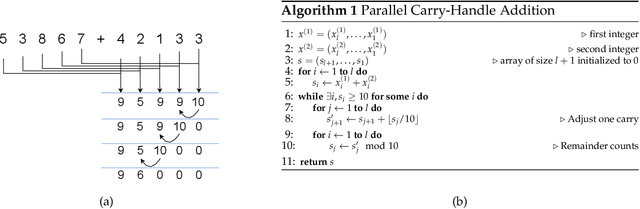

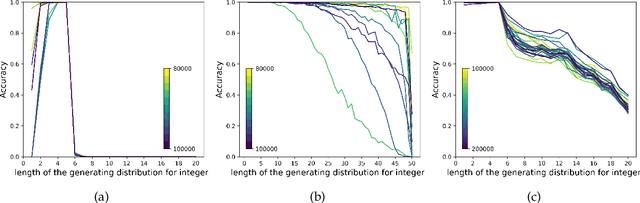
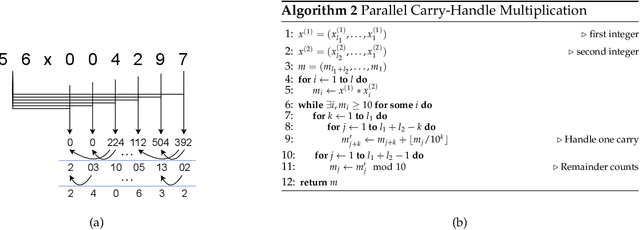
Despite the success of Transformers on language understanding, code generation, and logical reasoning, they still fail to generalize over length on basic arithmetic tasks such as addition and multiplication. A major reason behind this failure is the vast difference in structure between numbers and text; For example, the numbers are typically parsed from right to left, and there is a correspondence between digits at the same position across different numbers. In contrast, for text, such symmetries are quite unnatural. In this work, we propose to encode these semantics explicitly into the model via modified number formatting and custom positional encodings. Empirically, our method allows a Transformer trained on numbers with at most 5-digits for addition and multiplication to generalize up to 50-digit numbers, without using additional data for longer sequences. We further demonstrate that traditional absolute positional encodings (APE) fail to generalize to longer sequences, even when trained with augmented data that captures task symmetries. To elucidate the importance of explicitly encoding structure, we prove that explicit incorporation of structure via positional encodings is necessary for out-of-distribution generalization. Finally, we pinpoint other challenges inherent to length generalization beyond capturing symmetries, in particular complexity of the underlying task, and propose changes in the training distribution to address them.