 Add to Chrome
 Add to Firefox
 Add to Edge
How to pick the best anomaly detector?
Nov 18, 2025


Anomaly detection has the potential to discover new physics in unexplored regions of the data. However, choosing the best anomaly detector for a given data set in a model-agnostic way is an important challenge which has hitherto largely been neglected. In this paper, we introduce the data-driven ARGOS metric, which has a sound theoretical foundation and is empirically shown to robustly select the most sensitive anomaly detection model given the data. Focusing on weakly-supervised, classifier-based anomaly detection methods, we show that the ARGOS metric outperforms other model selection metrics previously used in the literature, in particular the binary cross-entropy loss. We explore several realistic applications, including hyperparameter tuning as well as architecture and feature selection, and in all cases we demonstrate that ARGOS is robust to the noisy conditions of anomaly detection.

Universal New Physics Latent Space
Jul 29, 2024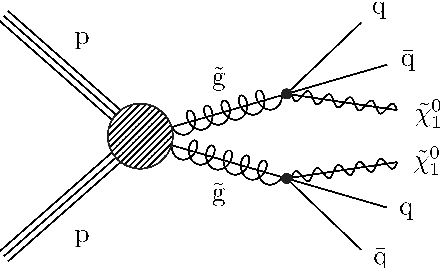
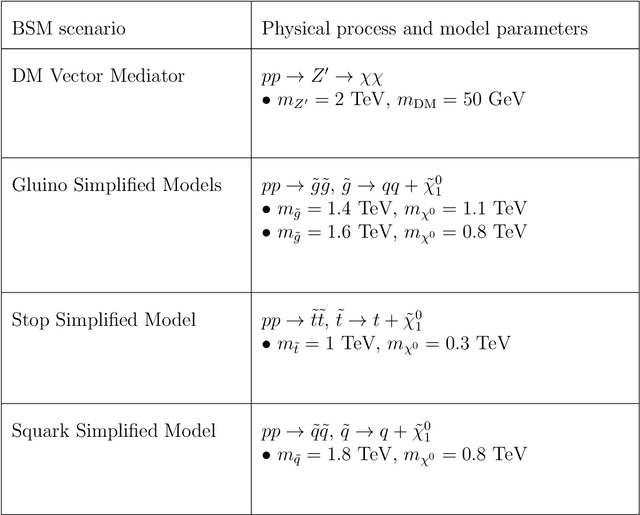
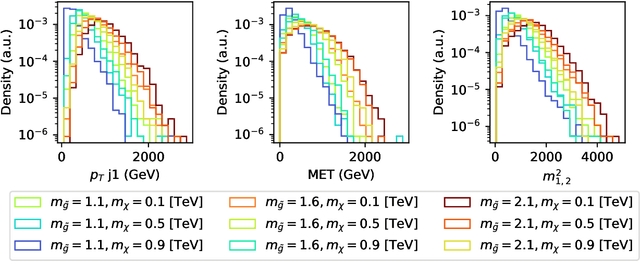
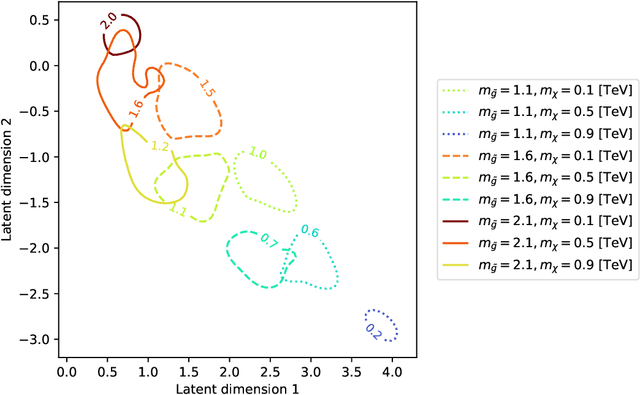
We develop a machine learning method for mapping data originating from both Standard Model processes and various theories beyond the Standard Model into a unified representation (latent) space while conserving information about the relationship between the underlying theories. We apply our method to three examples of new physics at the LHC of increasing complexity, showing that models can be clustered according to their LHC phenomenology: different models are mapped to distinct regions in latent space, while indistinguishable models are mapped to the same region. This opens interesting new avenues on several fronts, such as model discrimination, selection of representative benchmark scenarios, and identifying gaps in the coverage of model space.