 Add to Chrome
 Add to Firefox
 Add to Edge
Near-Field Velocity Estimation and Doppler-Aware Localization in OFDM Massive MIMO
Aug 05, 2026
In Orthogonal Frequency Division Multiplexing (OFDM)-based massive Multiple-Input Multiple-Output (MIMO) near-field (NF) sensing, target motion induces an antenna-dependent bistatic Doppler variation across the array aperture. Ignoring this spatial Doppler variation leads to a model mismatch that degrades NF localization. In this paper, we propose a low-complexity recursive framework for joint radial/transverse velocity estimation and Doppler-aware localization. Initialized by a constant-Doppler coarse localization, the method alternates between closed-form Least Squares Estimator (LSE)-based velocity estimation and antenna-dependent Doppler-aware localization refinement. Simulation and measurement results demonstrate the effectiveness of the proposed framework against two benchmark methods. Compared with a low-complexity constant-Doppler baseline method, the proposed algorithm improves range, angle, and radial velocity estimation results, while also enabling transverse velocity estimation. In the measurement results, the overall localization error decreases from 0.268 m to 0.064 m. The radial and transverse velocity estimation errors are 0.032 m/s and 0.069 m/s, respectively. Compared with a high-complexity exhaustive four-dimensional (4D) Maximum Likelihood Estimator (MLE), the proposed method achieves comparable velocity estimation results while yielding a more accurate localization result when the 4D MLE has a practical finite search grid.

Beyond Point Targets: Experimental Analysis of Frequency Anisotropy for Multi-band ISAC in FR3
Jul 23, 2026As Integrated Sensing And Communication (ISAC) systems push toward higher sensing resolution, multi-band processing has emerged as a key enabler, with Frequency Range 3 (FR3) (7-24 GHz) standing out for its combination of wide bandwidth and favorable propagation. A common assumption underlying existing multi-band ISAC techniques is that targets behave as frequency-invariant point scatterers, enabling coherent combination of measurements across widely spaced subbands. However, this assumption does not hold over wide fractional bandwidths, since real objects exhibit frequency-dependent scattering mechanisms and migrating scattering centers. This paper provides the first systematic experimental characterization of the frequency anisotropy of everyday objects for ISAC, using channel measurements collected with a calibrated vector network analyzer over the 6-24 GHz band, across 10 objects and 120 viewpoints. We process bistatic channel impulse responses and synthetic aperture radar images to quantify multi-band coherence, extracting the real part of the cross-band correlation coefficient. Our results reveal complex, non-trivial coherence structures that vary substantially with object type and viewing angle, highlighting the need to account for frequency anisotropy in multi-band ISAC system design.
Beyond Legacy OFDM: A Mobility-Adaptive Multi-Gear Framework for 6G
Mar 31, 2026While Third Generation Partnership Project (3GPP) has confirmed orthogonal frequency division multiplexing (OFDM) as the baseline waveform for sixth-generation (6G), its performance is severely compromised in the high-mobility scenarios envisioned for 6G. Building upon the GEARBOX-PHY vision, we present gear-switching OFDM (GS-OFDM): a unified framework in which the base station (BS) adaptively selects among three gears, ranging from legacy OFDM to delay-Doppler domain processing based on the channel mobility conditions experienced by the user equipments (UEs). We illustrate the benefit of adaptive gear switching for communication throughput and, finally, we conclude with an outlook on research challenges and opportunities.
Mobile Radio Networks and Weather Radars Dualism: Rainfall Measurement Revolution in Densely Populated Areas
Mar 19, 2026This study demonstrates, for the first time, how a network of cellular base stations (BSs) - the infrastructure of mobile radio networks - can be used as a distributed opportunistic radar for rainfall remote sensing. By adapting signal-processing techniques traditionally employed in Doppler weather radar systems, we demonstrate that BS signals can be used to retrieve typical weather radar products, including reflectivity factor, mean Doppler velocity, and spectral width. Due to the high spatial density of BS infrastructure in urban environments, combined with intrinsic technical features such as electronically steerable antenna arrays and wide receiver bandwidths, the proposed approach achieves unprecedented spatial and temporal resolutions, on the order of a few meters and several tens of seconds, respectively. Despite limitations related to low transmitted power, limited antenna gain, and other system constraints, a major challenge arises from ground clutter contamination, which is exacerbated by the nearly horizontal orientation of BS antenna beams. This work provides a thorough assessment of clutter impact and demonstrates that, through appropriate processing, the resulting clutter-filtered radar moments reach a satisfactory level of quality when compared with raw observations and with measurements from independent BSs with overlapped field-of-views. The findings highlight a transformative opportunity for urban hydrometeorology: leveraging existing telecommunications infrastructure to obtain rainfall information with a level of spatial granularity and temporal immediacy like never before.
NLOS-Aided Joint OTA Synchronization and Off-Grid Imaging for Distributed MIMO Systems
Mar 14, 2026Distributed multiple-input multiple-output (MIMO) architectures enable large-scale integrated sensing and communication (ISAC) by providing high spatial resolution and robustness through spatial diversity. However, practical phase-coherent sensing is challenged by phase synchronization errors and modeling mismatch caused by grid discretization. Existing over-the-air (OTA) synchronization methods typically treat synchronization and sensing tasks separately, which may lead to inaccurate phase alignment when multipath components are used for imaging. In this paper, we propose a non-line-of-sight (NLOS)-aided joint OTA synchronization and off-grid imaging framework for distributed MIMO ISAC systems. First, a line-of-sight (LOS)-assisted coarse synchronization is performed to establish initial phase coherence across distributed links. Subsequently, an iterative refinement stage exploits reconstructed NLOS components obtained from imaging results. By modeling off-grid effects via a first-order Taylor expansion, we transform measurements with nonlinear off-grid offset into an augmented linear model with jointly sparse reflectivity and off-set variables. The imaging problem is reformulated as a structured sparse recovery task and solved using a tailored off-grid approximate message passing (OG-AMP) algorithm. The imaging and synchronization modules are coupled within a closed-loop alternative optimization framework, where improved imaging enables more accurate phase refinement, and vice versa. Numerical results show that the proposed framework achieves accurate synchronization and imaging under phase errors. Compared with conventional approaches, it shows superior robustness and accuracy.
POLO: Phase-Only Localization in Uplink Distributed MIMO Systems
Dec 10, 2025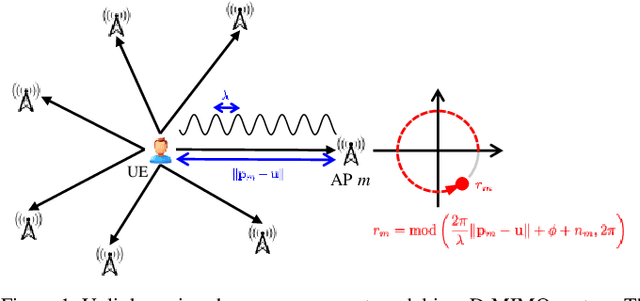
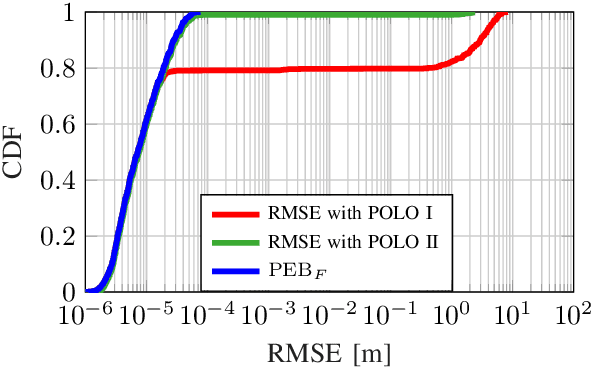
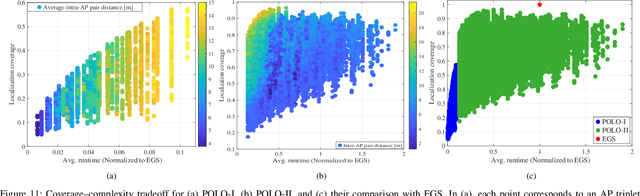
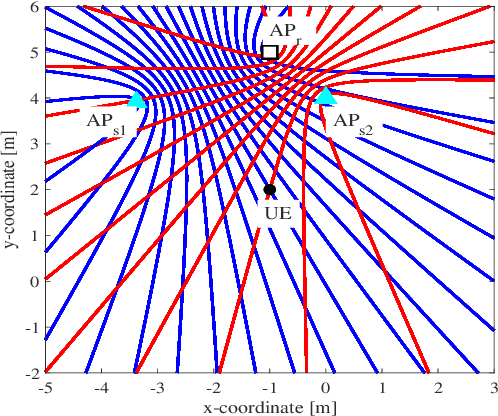
We propose a low-complexity localization framework for uplink distributed MIMO (D-MIMO) systems, targeting the challenge of minimizing the highly spiky maximum-likelihood (ML) cost function that arises in sparsely deployed phasecoherent access points (APs) with narrowband transmission. In such systems, ML-based localization typically relies on dense grid search, incurring prohibitive computational complexity. To address this, we introduce phase-only localization (POLO), an approach that leverages differential carrier-phase measurements from selected APs to generate a compact set of candidate user positions. The ML cost function is then evaluated only at these candidates, reducing complexity significantly. A key challenge is to devise an AP selection mechanism that reduces the number of candidate points while maintaining reliable coverage. We propose two variants: POLO-I, which selects three APs to provide closed-form candidate positions with low computational cost, and POLO-II, which selects four APs using an alternative strategy that enhances coverage at marginally higher runtime. Comprehensive analytical and simulation results show that POLO achieves a favorable coverage-complexity trade-off, reducing cost by orders of magnitude relative to exhaustive grid search with only marginal loss in coverage. By characterizing this tradeoff under diverse AP configurations, we also provide practical guidelines for selecting between POLO-I and POLO-II depending on latency and coverage requirements.
Enabling NLOS Imaging Capabilities at the Initial Access of 6G Base Stations
Nov 19, 2025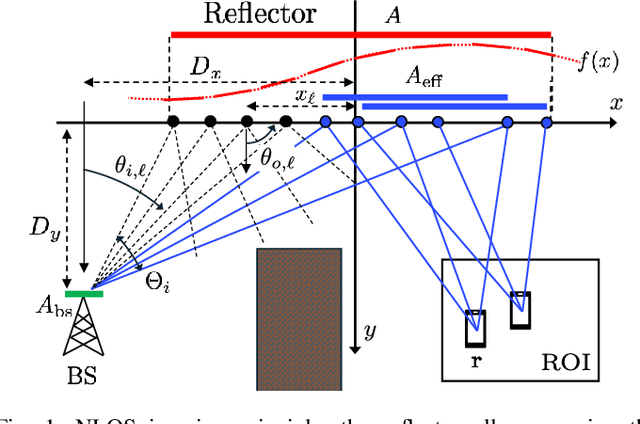
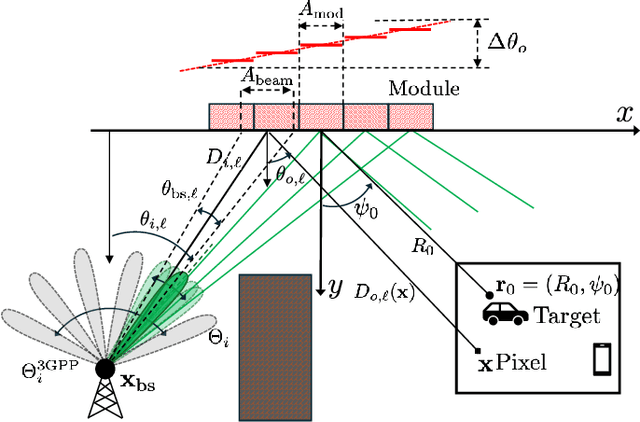
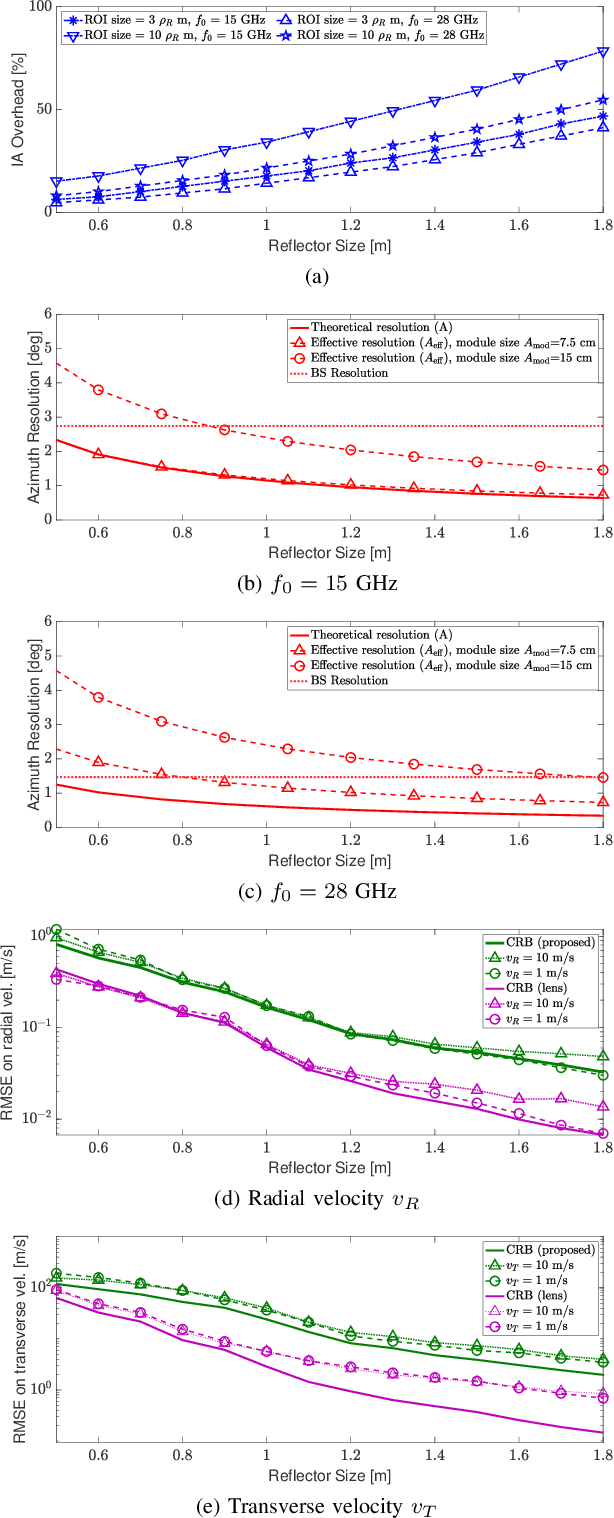
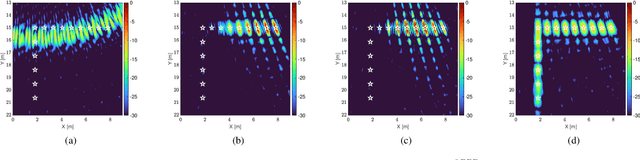
Sensing in non-line-of-sight (NLOS) is one of the major challenges for integrated sensing and communication systems. Existing countermeasures for NLOS either use prior knowledge on the environment to characterize all the multiple bounces or deploy anomalous reflectors in the environment to enable communication infrastructure to ''\textit{see behind the corner}''. This work addresses the integration of monostatic NLOS imaging functionalities into the initial access (IA) procedure of a next generation base station (BS), by means of a non-reconfigurable modular reflector. During standard-compliant IA, the BS sweeps a narrow beam using a pre-defined dedicated codebook to achieve the beam alignment with users. We introduce the imaging functionality by enhancing such codebook with imaging-specific entries that are jointly designed with the angular configuration of the modular reflector to enable high-resolution imaging of a region in NLOS by \textit{coherently} processing all the echoes at the BS. We derive closed-form expressions for the near-field (NF) spatial resolution, as well as for the \textit{effective aperture} (i.e., the portion of the reflector that actively contributes to improve image resolution). The problem of imaging of moving targets in NLOS is also addressed, and we propose a maximum-likelihood estimation for target's velocity in NF and related theoretical bound. Further, we discuss and quantify the inherent communication-imaging performance trade-offs and related system design challenges through numerical simulations. Finally, the proposed imaging method employing modular reflectors is validated both numerically and experimentally, showing the effectiveness of our concept.
Integrating Phase-Coherent Multistatic Imaging in Downlink D-MIMO Networks
Oct 05, 2025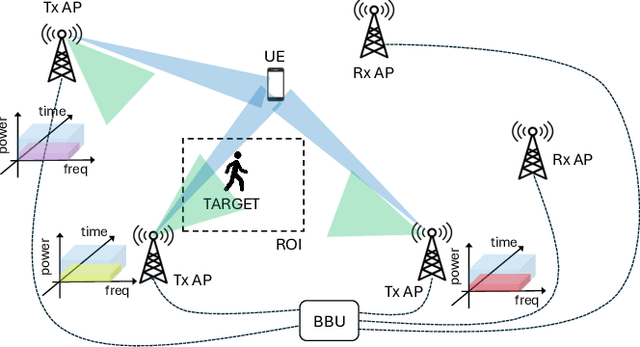
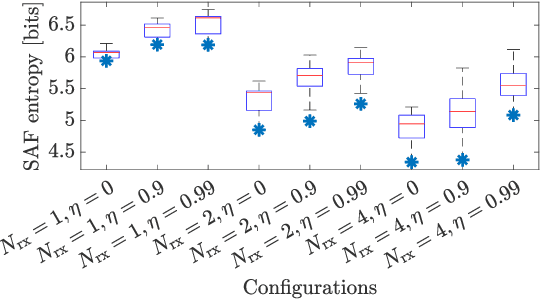
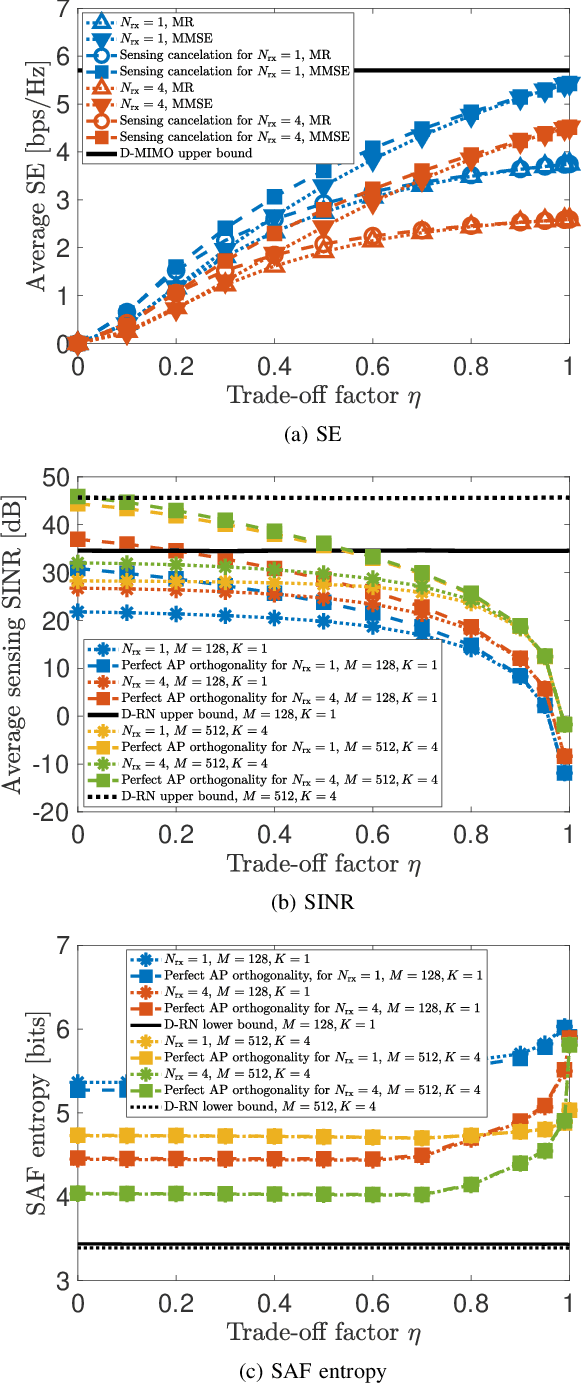
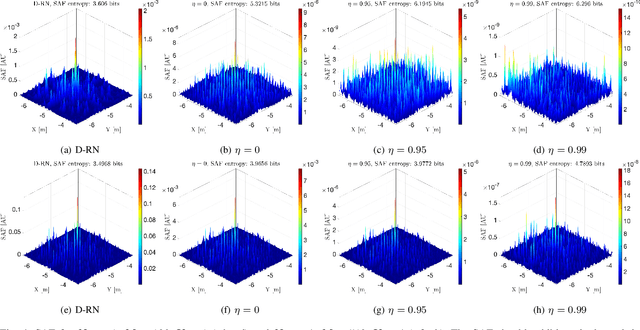
This paper addresses the challenge of integrating multistatic coherent imaging functionalities in the downlink (DL) of a phase-coherent distributed multiple input multiple output (D-MIMO) communication network. During DL, the D-MIMO access points (APs) jointly precode the transmitted signals to maximize the spectral efficiency (SE) at the users (UEs) locations. However, imaging requires that \textit{(i)} a fraction of the APs work as receivers for sensing and \textit{(ii)} the transmitting APs emit AP-specific and orthogonal signals to illuminate the area to be imaged and allow multistatic operation. In these settings, our contribution is twofold. We propose a novel distributed integrated sensing and communication (D-ISAC) system that superposes a purposely designed AP-specific signal for imaging to the legacy UE-specific communication one, with a tunable trade-off factor. We detail both the imaging waveform design according to the \textit{extended orthogonality condition} and the space-frequency precoder design. Then, we propose an optimized selection strategy for the receiving APs, in order to maximize imaging performance under half-duplex constraints. Extensive numerical results prove the feasibility and benefits of our proposal, materializing the potential of joint multistatic imaging and communications in practical D-MIMO deployments.
Bridging the Gap via Data-Aided Sensing: Can Bistatic ISAC Converge to Genie Performance?
May 02, 2025We investigate data-aided iterative sensing in bistatic OFDM ISAC systems, focusing on scenarios with co-located sensing and communication receivers. To enhance target detection beyond pilot-only sensing methods, we propose a multi-stage bistatic OFDM receiver, performing iterative sensing and data demodulation to progressively refine ISAC channel and data estimates. Simulation results demonstrate that the proposed data-aided scheme significantly outperforms pilot-only benchmarks, particularly in multi-target scenarios, substantially narrowing the performance gap compared to a genie-aided system with perfect data knowledge. Moreover, the proposed approach considerably expands the bistatic ISAC trade-off region, closely approaching the probability of detection-achievable rate boundary established by its genie-aided counterpart.
Joint Localization and Synchronization in Downlink Distributed MIMO
Apr 14, 2025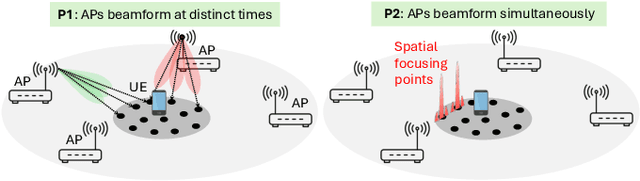
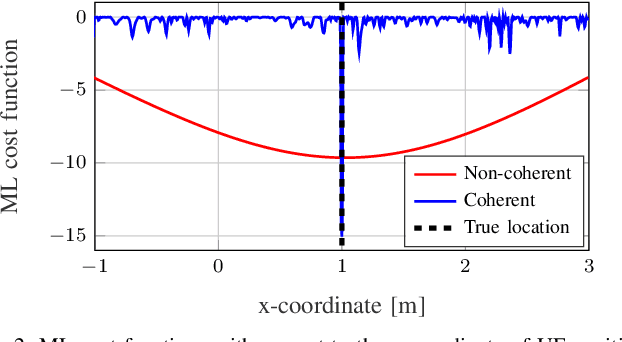
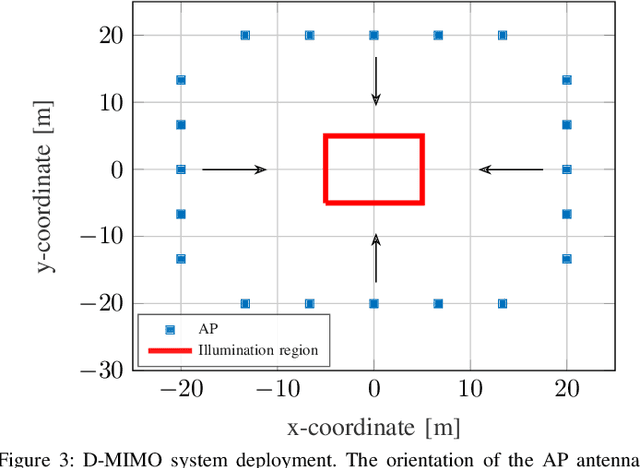
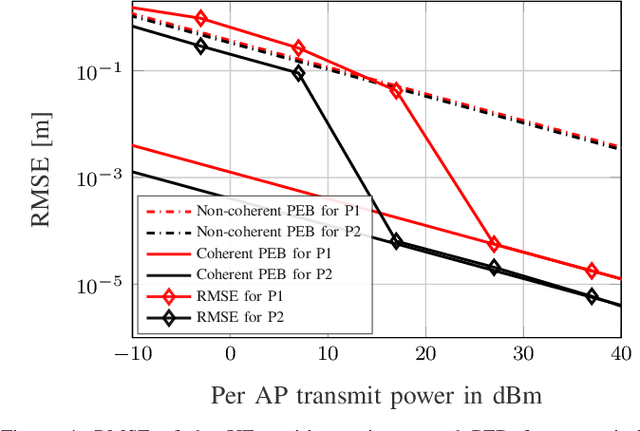
We investigate joint localization and synchronization in the downlink of a distributed multiple-input-multiple-output (D-MIMO) system, aiming to estimate the position and phase offset of a single-antenna user equipment (UE) using downlink transmissions of multiple phase-synchronized, multi-antenna access points (APs). We propose two transmission protocols: sequential (P1) and simultaneous (P2) AP transmissions, together with the ML estimators that either leverage (coherent estimator) or disregard phase information (non-coherent estimator). Simulation results reveal that downlink D-MIMO holds significant potential for high-accuracy localization while showing that P2 provides superior localization performance and reduced transmission latency.