 Add to Chrome
 Add to Firefox
 Add to Edge
Phase-Coherent D-MIMO ISAC: Multi-Target Estimation and Spectral Efficiency Trade-Offs
Dec 26, 2025
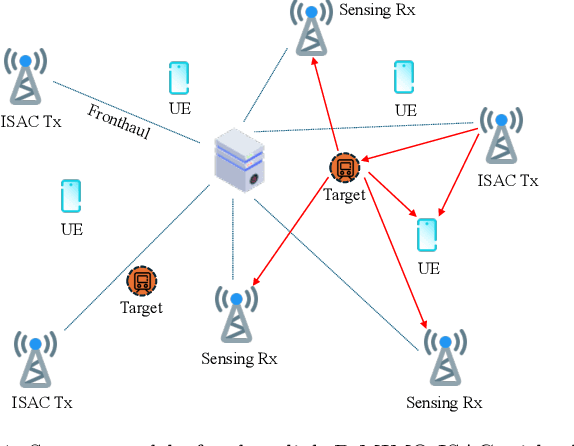
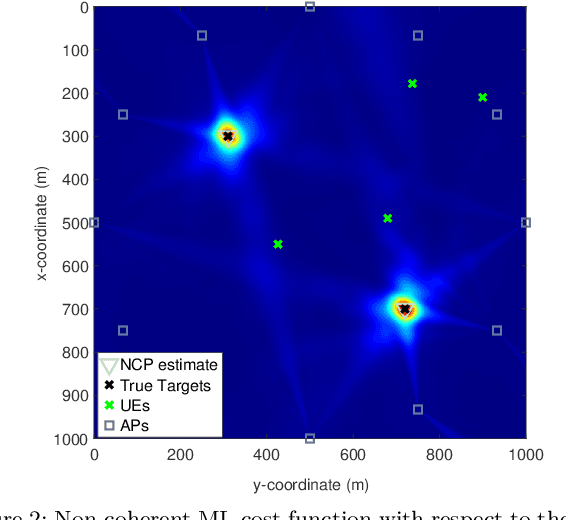
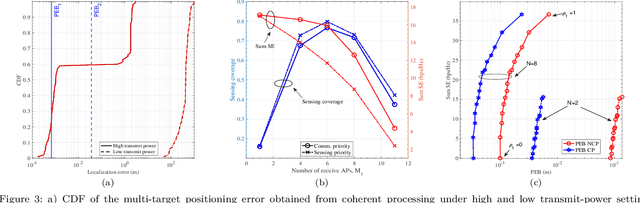
We investigate distributed multiple-input multiple-output (D-MIMO) integrated sensing and communication (ISAC) systems, in which multiple phase-synchronized access points (APs) jointly serve user equipments (UEs) while cooperatively detecting and estimating multiple static targets. To achieve high-accuracy multi-target estimation, we propose a two-stage sensing framework combining non-coherent and coherent maximum-likelihood (ML) estimation. In parallel, adaptive AP mode-selection strategies are introduced to balance communication and sensing performance: a communication-centric scheme that maximizes downlink spectral efficiency (SE) and a sensing-centric scheme that selects geometrically diverse receive APs to enhance sensing coverage. Simulation results confirm the SE-sensing trade-off, where appropriate power allocation between communication and sensing and larger array apertures alleviate performance degradation, achieving high SE with millimeter-level sensing precision. We further demonstrate that the proposed AP-selection strategy reveals an optimal number of receive APs that maximizes sensing coverage without significantly sacrificing SE.

POLO: Phase-Only Localization in Uplink Distributed MIMO Systems
Dec 10, 2025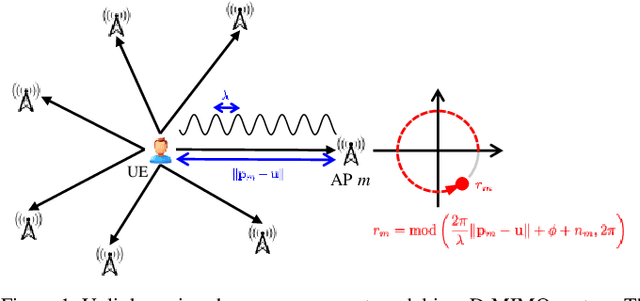
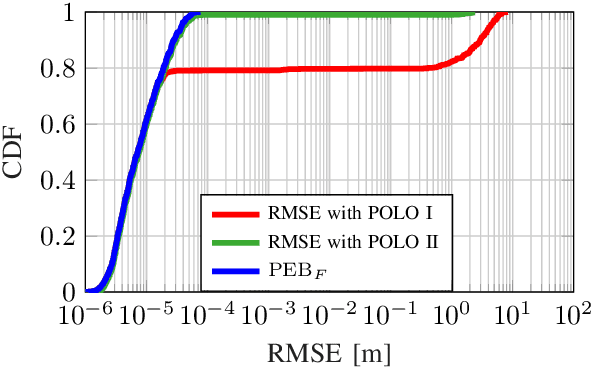
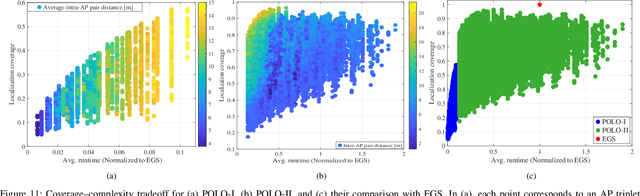
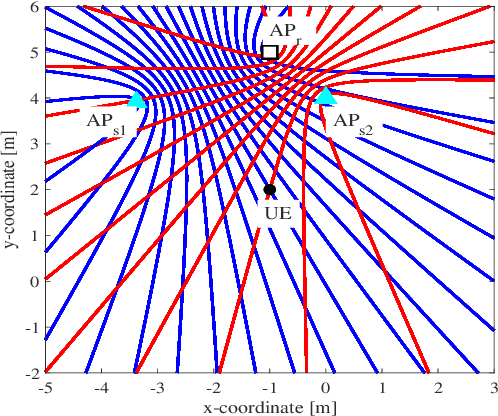
We propose a low-complexity localization framework for uplink distributed MIMO (D-MIMO) systems, targeting the challenge of minimizing the highly spiky maximum-likelihood (ML) cost function that arises in sparsely deployed phasecoherent access points (APs) with narrowband transmission. In such systems, ML-based localization typically relies on dense grid search, incurring prohibitive computational complexity. To address this, we introduce phase-only localization (POLO), an approach that leverages differential carrier-phase measurements from selected APs to generate a compact set of candidate user positions. The ML cost function is then evaluated only at these candidates, reducing complexity significantly. A key challenge is to devise an AP selection mechanism that reduces the number of candidate points while maintaining reliable coverage. We propose two variants: POLO-I, which selects three APs to provide closed-form candidate positions with low computational cost, and POLO-II, which selects four APs using an alternative strategy that enhances coverage at marginally higher runtime. Comprehensive analytical and simulation results show that POLO achieves a favorable coverage-complexity trade-off, reducing cost by orders of magnitude relative to exhaustive grid search with only marginal loss in coverage. By characterizing this tradeoff under diverse AP configurations, we also provide practical guidelines for selecting between POLO-I and POLO-II depending on latency and coverage requirements.
Integrating Phase-Coherent Multistatic Imaging in Downlink D-MIMO Networks
Oct 05, 2025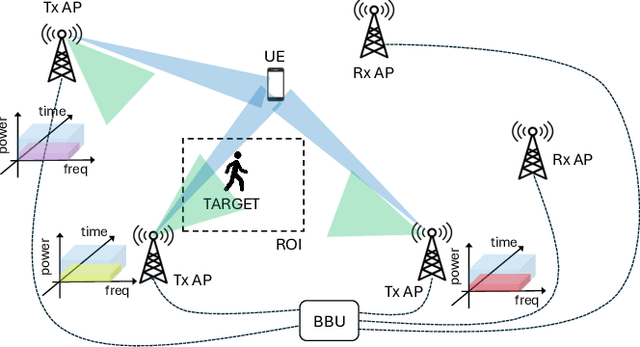
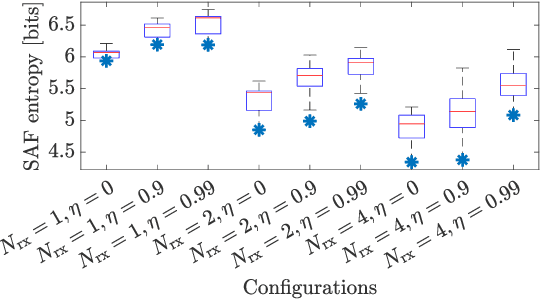
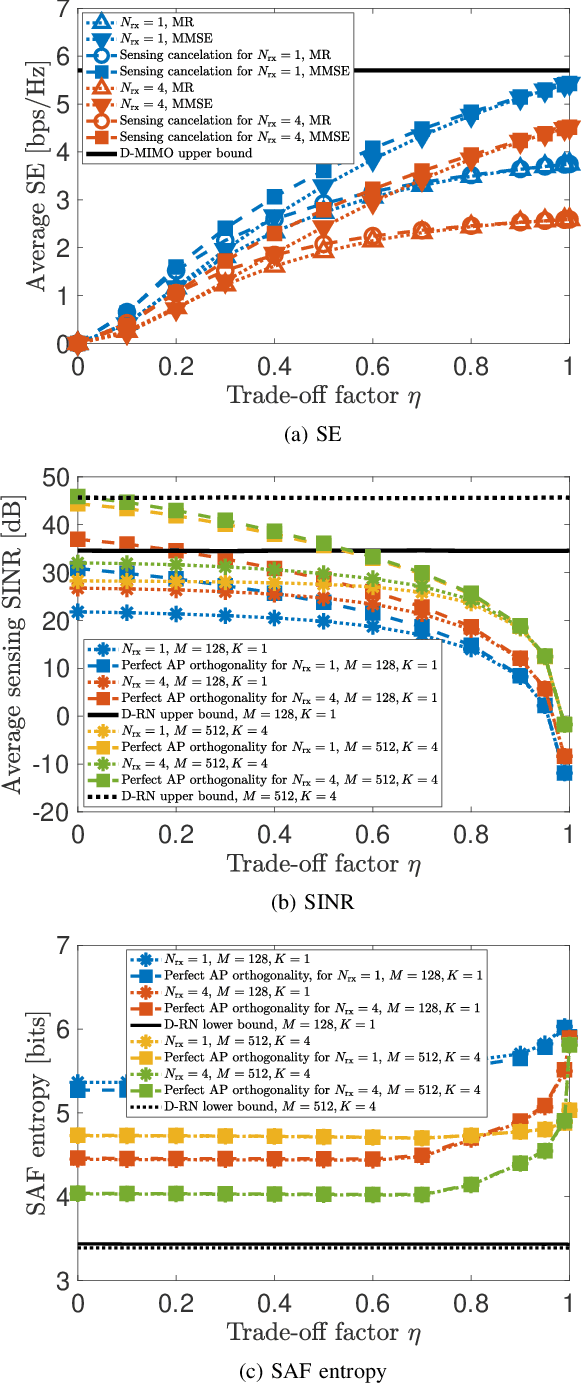
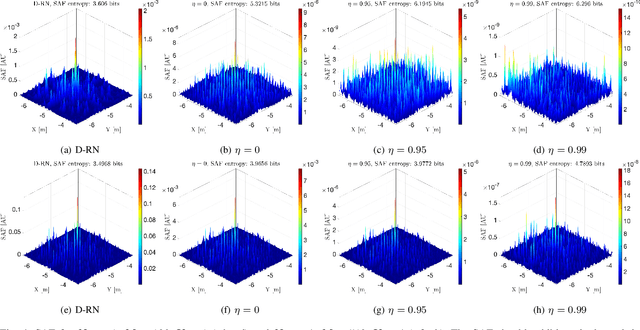
This paper addresses the challenge of integrating multistatic coherent imaging functionalities in the downlink (DL) of a phase-coherent distributed multiple input multiple output (D-MIMO) communication network. During DL, the D-MIMO access points (APs) jointly precode the transmitted signals to maximize the spectral efficiency (SE) at the users (UEs) locations. However, imaging requires that \textit{(i)} a fraction of the APs work as receivers for sensing and \textit{(ii)} the transmitting APs emit AP-specific and orthogonal signals to illuminate the area to be imaged and allow multistatic operation. In these settings, our contribution is twofold. We propose a novel distributed integrated sensing and communication (D-ISAC) system that superposes a purposely designed AP-specific signal for imaging to the legacy UE-specific communication one, with a tunable trade-off factor. We detail both the imaging waveform design according to the \textit{extended orthogonality condition} and the space-frequency precoder design. Then, we propose an optimized selection strategy for the receiving APs, in order to maximize imaging performance under half-duplex constraints. Extensive numerical results prove the feasibility and benefits of our proposal, materializing the potential of joint multistatic imaging and communications in practical D-MIMO deployments.
Joint Localization and Synchronization in Downlink Distributed MIMO
Apr 14, 2025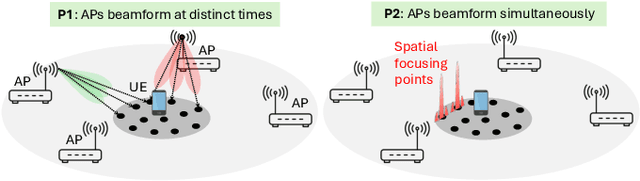
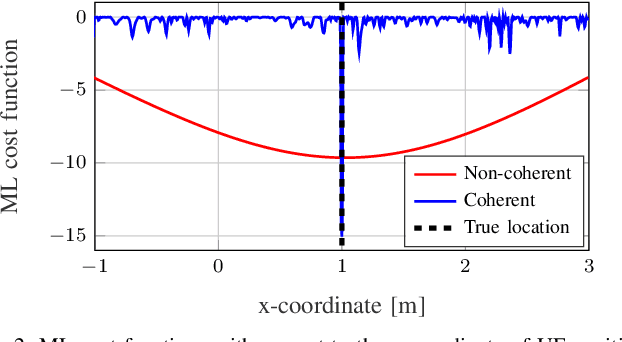
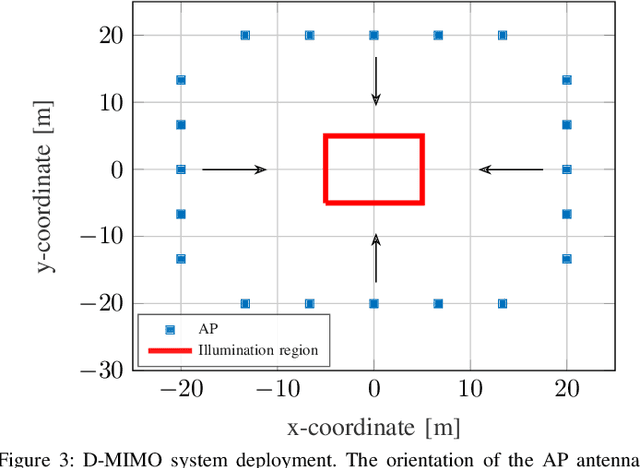
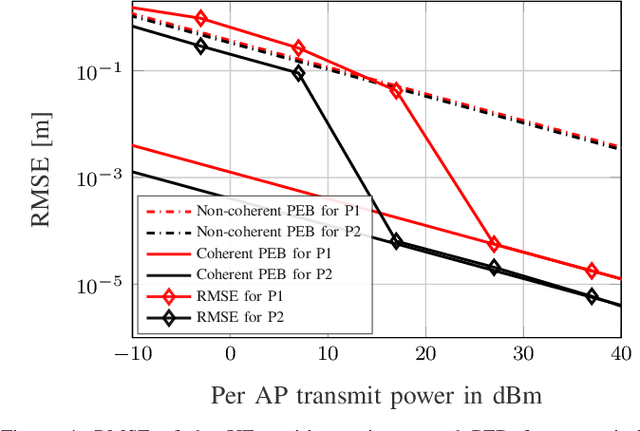
We investigate joint localization and synchronization in the downlink of a distributed multiple-input-multiple-output (D-MIMO) system, aiming to estimate the position and phase offset of a single-antenna user equipment (UE) using downlink transmissions of multiple phase-synchronized, multi-antenna access points (APs). We propose two transmission protocols: sequential (P1) and simultaneous (P2) AP transmissions, together with the ML estimators that either leverage (coherent estimator) or disregard phase information (non-coherent estimator). Simulation results reveal that downlink D-MIMO holds significant potential for high-accuracy localization while showing that P2 provides superior localization performance and reduced transmission latency.