 Add to Chrome
 Add to Firefox
 Add to Edge
InfinityStory: Unlimited Video Generation with World Consistency and Character-Aware Shot Transitions
Mar 04, 2026
Generating long-form storytelling videos with consistent visual narratives remains a significant challenge in video synthesis. We present a novel framework, dataset, and a model that address three critical limitations: background consistency across shots, seamless multi-subject shot-to-shot transitions, and scalability to hour-long narratives. Our approach introduces a background-consistent generation pipeline that maintains visual coherence across scenes while preserving character identity and spatial relationships. We further propose a transition-aware video synthesis module that generates smooth shot transitions for complex scenarios involving multiple subjects entering or exiting frames, going beyond the single-subject limitations of prior work. To support this, we contribute with a synthetic dataset of 10,000 multi-subject transition sequences covering underrepresented dynamic scene compositions. On VBench, InfinityStory achieves the highest Background Consistency (88.94), highest Subject Consistency (82.11), and the best overall average rank (2.80), showing improved stability, smoother transitions, and better temporal coherence.

A Survey on Long-Video Storytelling Generation: Architectures, Consistency, and Cinematic Quality
Jul 09, 2025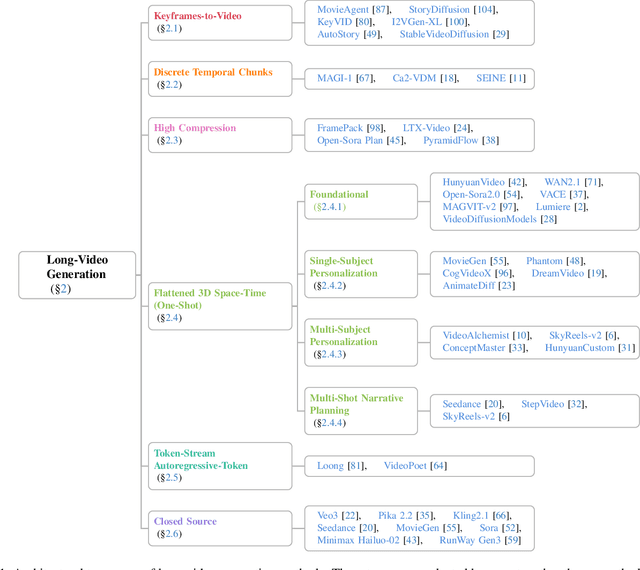
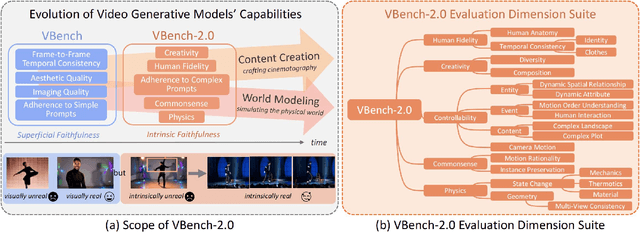
Despite the significant progress that has been made in video generative models, existing state-of-the-art methods can only produce videos lasting 5-16 seconds, often labeled "long-form videos". Furthermore, videos exceeding 16 seconds struggle to maintain consistent character appearances and scene layouts throughout the narrative. In particular, multi-subject long videos still fail to preserve character consistency and motion coherence. While some methods can generate videos up to 150 seconds long, they often suffer from frame redundancy and low temporal diversity. Recent work has attempted to produce long-form videos featuring multiple characters, narrative coherence, and high-fidelity detail. We comprehensively studied 32 papers on video generation to identify key architectural components and training strategies that consistently yield these qualities. We also construct a comprehensive novel taxonomy of existing methods and present comparative tables that categorize papers by their architectural designs and performance characteristics.
KaPQA: Knowledge-Augmented Product Question-Answering
Jul 22, 2024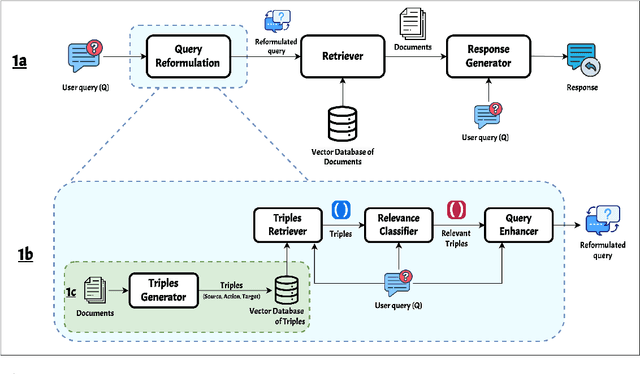

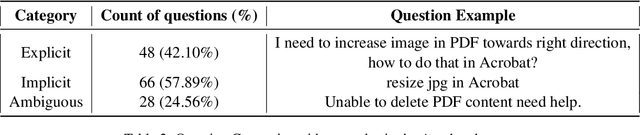
Question-answering for domain-specific applications has recently attracted much interest due to the latest advancements in large language models (LLMs). However, accurately assessing the performance of these applications remains a challenge, mainly due to the lack of suitable benchmarks that effectively simulate real-world scenarios. To address this challenge, we introduce two product question-answering (QA) datasets focused on Adobe Acrobat and Photoshop products to help evaluate the performance of existing models on domain-specific product QA tasks. Additionally, we propose a novel knowledge-driven RAG-QA framework to enhance the performance of the models in the product QA task. Our experiments demonstrated that inducing domain knowledge through query reformulation allowed for increased retrieval and generative performance when compared to standard RAG-QA methods. This improvement, however, is slight, and thus illustrates the challenge posed by the datasets introduced.