 Add to Chrome
 Add to Firefox
 Add to Edge
On-Off Digital Noise Modulation with Fluid Antenna Systems over $κ$-$μ$ Fading Channels
Aug 13, 2026
This letter proposes the integration of on-off digital noise (OODN) modulation with fluid antenna systems (FASs). A unified analytical framework is developed to evaluate the performance of FAS- assisted OODN receivers over additive white Gaussian noise and generalized \k{appa}-μ fading channels. The analysis incorporates fluid antenna port selection, the number of available ports, and spatial correlation. Analytical expressions for the average bit error probability are derived and the achievable diversity order is characterized. All expressions are validated through Monte Carlo simulations. Results demonstrate that the spatial diversity provided by the FAS significantly enhances the reliability of OODN transmissions while preserving their inherent low-complexity, non-coherent operation without carrier-phase recovery. The proposed framework establishes a new research direction for energy-efficient Internet of Things (IoT) and machine-type communication systems.

Constellation Design for Nonlinear Unified SWIPT Receiver Channels with Memory
Jun 16, 2026Unified receivers (URs) have emerged as a promising architecture for simultaneous wireless information and power transfer (SWIPT), since a common rectifying front-end enables information decoding (ID) and energy harvesting (EH) from the same rectified output. However, rectification is nonlinear due to the diode, while the capacitor introduces memory across symbols, making constellation design over the channel challenging. In this paper, we study constellation design for nonlinear UR-SWIPT channels in both memoryless and memory regimes. First, we propose a tractable unified rectification model that captures both (i) the nonlinear steady-state mapping and (ii) the asymmetric capacitor charging/discharging dynamics under transient operation. To isolate the impact of rectification with memory on ID, we study the information-based design. In this setting, we develop a state-adaptive policy with an algorithmic constellation design that accounts for the rectifier state and shapes the constellation in the observation domain. By approximating the rectifier state distribution, we derive a closed-form average symbol error rate (SER) expression and characterize the rate-reliability (R-R) tradeoff. We then seek constellations that minimize the SER under average transmit power and EH constraints. We address the resulting energy-constrained setting in the memoryless regime using an autoencoder-based framework that embeds the nonlinear rectification model as a differentiable channel block. Numerical results validate the proposed models, demonstrate the impact of memory on the R-R tradeoff, and show how learned constellations adapt to EH requirements in the rate-energy tradeoff.
Large-scale Tunable Liquid Lens-assisted VLC Systems under Random Receiver Orientation
Jun 15, 2026This paper investigates the performance of tunable liquid lens (TLL)-assisted receivers in large-scale visible light communication (VLC) systems under random receiver orientation. A simple electrowetting-based TLL architecture is proposed, capable of dynamically steering the incident optical signal toward the photodiode receiver by adjusting the orientation of the liquid interface. The proposed architecture enhances the desired signal reception while mitigating interference from neighboring access points (APs). The spatial distribution of APs is modeled using a Matérn hard-core point process, whereas receiver orientation is characterized by uniformly distributed azimuth angles and Gaussian-distributed polar angles. Furthermore, a tractable mathematical optical channel model is developed to capture the combined effects of AP/receiver locations, receiver orientation, and lens adjustment angles on the VLC channel gain. Based on this framework, three lens orientation strategies, namely best signal reception (BSR), closest LED selection, and vertical upward lens orientation, are proposed to improve system performance under dynamic receiver conditions. Using stochastic geometry tools, exact and approximate analytical expressions for the outage probability are derived for each scheme. Numerical results verify the accuracy of the developed analysis and demonstrate that the proposed TLL-assisted receiver architecture significantly improves the robustness of VLC systems under severe receiver orientation fluctuations and dense AP deployments. In particular, the BSR scheme reduces the outage probability by $57.1\%$ compared with conventional fixed-lens receivers at an AP height of $3.5$ m and AP density of $0.2~\text{m}^{-2}$. The presented analytical framework and numerical results provide useful design insights for the deployment of future TLL-assisted VLC networks.
Dual-Diode Unified SWIPT for High Data Rates with Adaptive Detection
Jan 29, 2026Due to their low-complexity and energy-efficiency, unified simultaneous wireless information and power transfer (U-SWIPT) receivers are especially suitable for low-power Internet of Things (IoT) applications. Towards accurately modeling practical operating conditions, in this study, we provide a unified transient framework for a dual-diode U-SWIPT that jointly accounts for diode nonlinearity and capacitor-induced memory effects. The proposed model accurately describes the inherent time dependence of the rectifier, highlighting its fundamental impact on both energy harvesting (EH) and information decoding (ID) processes. Based on the provided memory-aware model, we design a low-complexity adaptive detector that learns the nonlinear state transition dynamics and performs decision-directed detection with linear complexity. The proposed detection scheme approaches maximum likelihood sequence detection (MLSD) performance in memory-dominated regimes, while avoiding the exponential search required by classical sequence detection. Overall, these results demonstrate that properly exploiting rectifier memory provides a better tradeoff between data rate and reliability for U-SWIPT receivers.
Sub-6 GHz Beam-Reconfigurable Microfluidic Antenna Using Graphene Liquid for 5G Network
Dec 19, 2025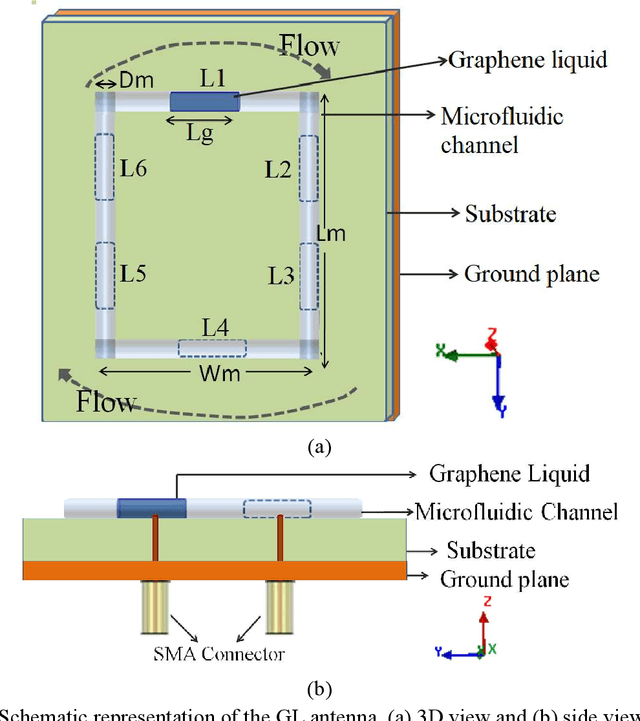

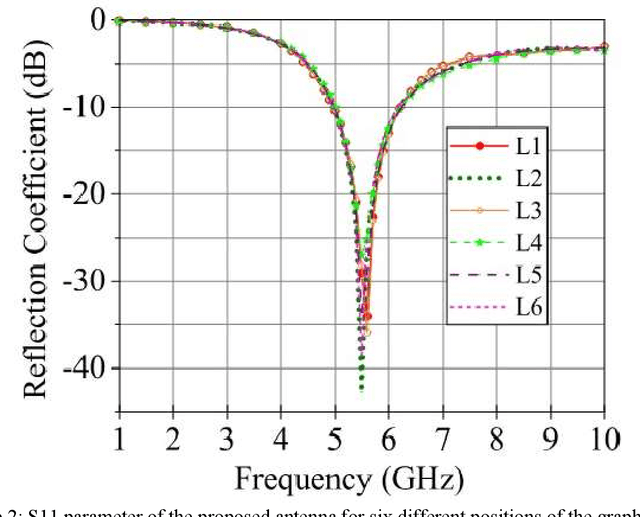

As wireless communication systems continue to grow rapidly, high-performance antennas become increasingly crucial for expanding coverage, improving capacity, and enhancing transmission quality. In light of this, research has focused considerable attention on liquid antennas due to their unique characteristics, which include small size, flexibility, reconfigurability and transparency. Recently, graphene liquid has been explored for numerous applications due to its low cost, high conductivity, flexibility, and ease of processing. Specifically for antenna applications, graphene liquid performs better than conventional liquid metal. This paper presents a graphene-liquid antenna with beam reconfiguration ability for sub-6 GHz communication system. The graphene-liquid movement within the microfluidic channel is taken into consideration by the reconfiguration mechanism. The antenna achieves beam reconfiguration in 360° directions with 6 dBi of gain at 5.5 GHz, featuring a wideband impedance bandwidth of 24%. The antenna main beam is specifically reconfigured into six directions (0°, 45°, 135°, 180°, 225° and 315°) at 5.5 GHz. Additionally, in all six reconfigurable scenarios at 5.5 GHz, the antenna provides a stable reflection coefficient. Therefore, for the next generation of wireless communication systems, this novel design of graphene-liquid-based reconfigurable sub-6 GHz antennas holds promise.
Outage Probability Analysis of Tunable Liquid Lens-assisted VLC Systems
May 20, 2025This paper presents a tunable liquid lens (TLL)-assisted indoor mobile visible light communication system. To mitigate performance degradation caused by user mobility and random receiver orientation, an electrowetting cuboid TLL is used at the receiver. By dynamically controlling the orientation angle of the liquid surface through voltage adjustments, signal reception and overall system performance are enhanced. An accurate mathematical framework is developed to model channel gains, and two lens optimization strategies, namely ($i$) the best signal reception (BSR), and ($ii$) the vertically upward lens orientation (VULO) are introduced for improved performance. Closed form expressions for the outage probability are derived for each scheme for practical mobility and receiver orientation conditions. Numerical results demonstrate that the proposed TLL and lens adjustment strategies significantly reduce the outage probability compared to fixed lens and no lens receivers across various mobility and orientation conditions. Specifically, the outage probability is improved from $1\times 10^{-1}$ to $3\times 10^{-3}$ at a transmit power of $12$ dBW under a $8^{\circ}$ polar angle variation in random receiver orientation using the BSR scheme.
An RIS-enabled Time Reversal Scheme for Multipath Near-Field Channels
Aug 26, 2024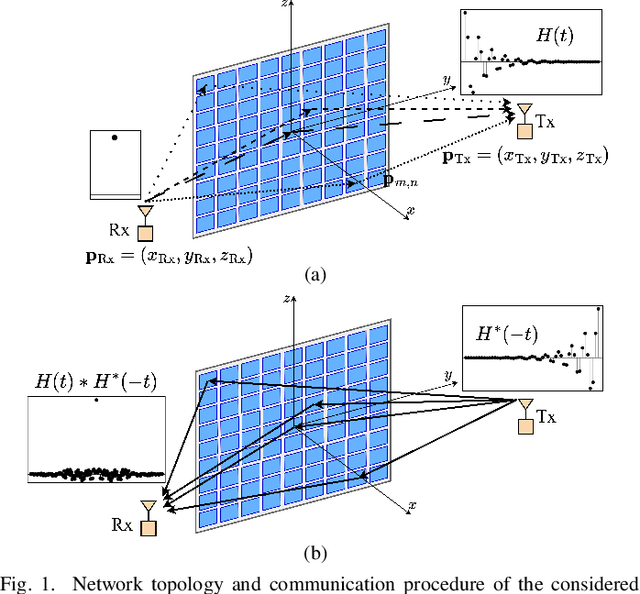
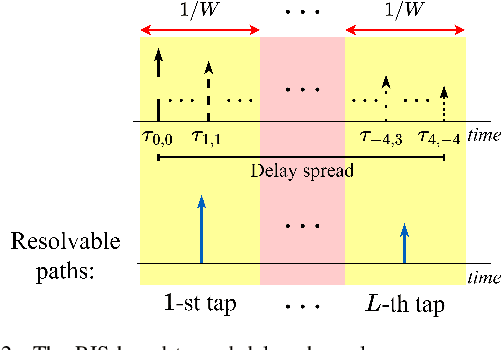
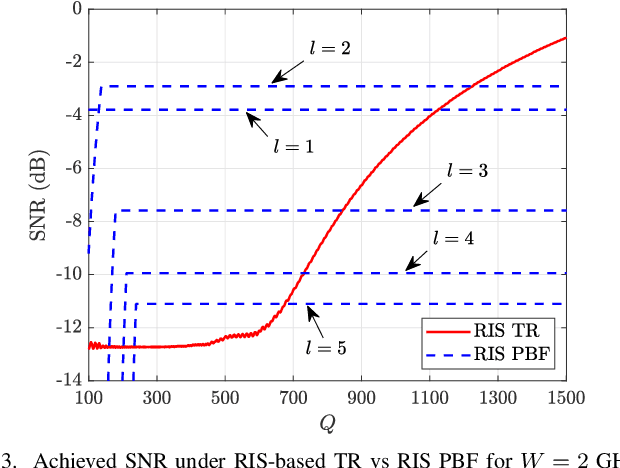
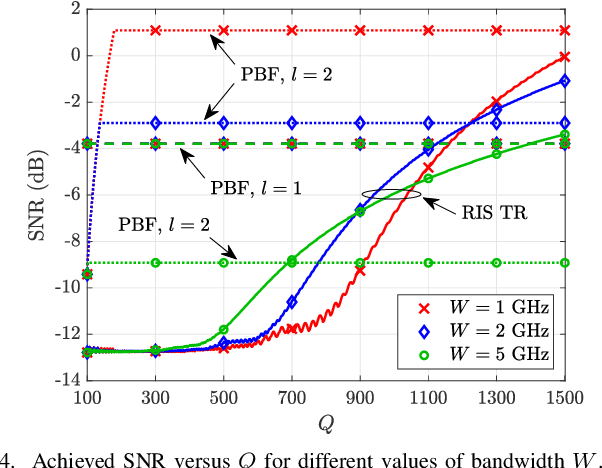
Time reversal (TR) is a promising technique that exploits multipaths for achieving energy focusing in high-frequency wideband communications. In this letter, we focus on a TR scheme facilitated by a reconfigurable intelligent surface (RIS) which, due to the higher frequency and large array aperture, operates in the near-field region. The proposed scheme enriches the propagation environment for the TR in such weak scattering conditions and does not need channel knowledge for the RIS configuration. Specifically, the RIS is employed to create multiple virtual propagation paths that are required to efficiently apply the TR. We derive a performance bound for the proposed scheme under near-field modeling through the received signal-to-noise ratio (SNR) and we examine how various system design parameters affect the performance. We observe that a linear RIS topology maximizes the number of resolvable paths. It is also demonstrated that the proposed scheme improves the SNR, while for a large number of elements it can outperform the conventional passive beamforming at the RIS.
DCSK-based Waveform Design for Self-sustainable RIS-aided Noncoherent SWIPT
Aug 23, 2024This paper investigates the problem of transmit waveform design in the context of a chaotic signal-based self-sustainable reconfigurable intelligent surface (RIS)-aided system for simultaneous wireless information and power transfer (SWIPT). Specifically, we propose a differential chaos shift keying (DCSK)-based RIS-aided point-to-point set-up, where the RIS is partitioned into two non-overlapping surfaces. The elements of the first sub-surface perform energy harvesting (EH), which in turn, provide the required power to the other sub-surface operating in the information transfer (IT) mode. In this framework, by considering a generalized frequency-selective Nakagami-m fading scenario as well as the nonlinearities of the EH process, we derive closed-form analytical expressions for both the bit error rate (BER) at the receiver and the harvested power at the RIS. Our analysis demonstrates, that both these performance metrics depend on the parameters of the wireless channel, the transmit waveform design, and the number of reflecting elements at the RIS, which switch between the IT and EH modes, depending on the application requirements. Moreover, we show that, having more reflecting elements in the IT mode is not always beneficial and also, for a given acceptable BER, we derive a lower bound on the number of RIS elements that need to be operated in the EH mode. Furthermore, for a fixed RIS configuration, we investigate a trade-off between the achievable BER and the harvested power at the RIS and accordingly, we propose appropriate transmit waveform designs. Finally, our numerical results illustrate the importance of our intelligent DCSK-based waveform design on the considered framework.
Wireless Information and Energy Transfer in the Era of 6G Communications
Apr 29, 2024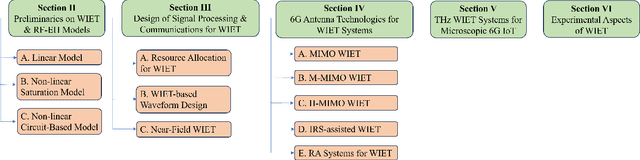

Wireless information and energy transfer (WIET) represents an emerging paradigm which employs controllable transmission of radio-frequency signals for the dual purpose of data communication and wireless charging. As such, WIET is widely regarded as an enabler of envisioned 6G use cases that rely on energy-sustainable Internet-of-Things (IoT) networks, such as smart cities and smart grids. Meeting the quality-of-service demands of WIET, in terms of both data transfer and power delivery, requires effective co-design of the information and energy signals. In this article, we present the main principles and design aspects of WIET, focusing on its integration in 6G networks. First, we discuss how conventional communication notions such as resource allocation and waveform design need to be revisited in the context of WIET. Next, we consider various candidate 6G technologies that can boost WIET efficiency, namely, holographic multiple-input multiple-output, near-field beamforming, terahertz communication, intelligent reflecting surfaces (IRSs), and reconfigurable (fluid) antenna arrays. We introduce respective WIET design methods, analyze the promising performance gains of these WIET systems, and discuss challenges, open issues, and future research directions. Finally, a near-field energy beamforming scheme and a power-based IRS beamforming algorithm are experimentally validated using a wireless energy transfer testbed. The vision of WIET in communication systems has been gaining momentum in recent years, with constant progress with respect to theoretical but also practical aspects. The comprehensive overview of the state of the art of WIET presented in this paper highlights the potentials of WIET systems as well as their overall benefits in 6G networks.
Integrated SWIPT Receiver with Memory Effects: Circuit Analysis and Information Detection
Mar 11, 2024Wireless power transfer has been proposed as a key technology for the foreseen machine type networks. A main challenge in the research community lies in acquiring a simple yet accurate model to capture the energy harvesting performance. In this work, we focus on a half-wave rectifier and based on circuit analysis we provide the actual output of the circuit which accounts for the memory introduced by the capacitor. The provided expressions are also validated through circuit simulations on ADS. Then, the half-wave rectifier is used as an integrated simultaneous wireless information and power transfer receiver where the circuit's output is used for decoding information based on amplitude modulation. We investigate the bit error rate performance based on two detection schemes: (i) symbol-by-symbol maximum likelihood (ML); and (ii) ML sequence detection (MLSD). We show that the symbol period is critical due to the intersymbol interference induced by circuit. Our results reveal that MLSD is necessary towards improving the error probability and achieving higher data rates.