 Add to Chrome
 Add to Firefox
 Add to Edge
On the Probability of Network States with Gaussian Connectivity Functions
Aug 18, 2026
In this paper, we consider the connectivity of a random network of N mobile devices in three dimensions (3D), where the location of each device or node has a Gaussian distribution in each dimension. For each pair of nodes, the probability of connectivity is related to the nodes' separation by a Gaussian connectivity function. The fundamental analytical tool for studying such systems is the probability of a given network state, derived and expressed in terms of its graph Laplacian. Leveraging this result, we obtain results for the connectivity of small networks, the probability of a complete network (where all nodes are connected to all other nodes), and the probability of an isolated node, which gives an approximation to the connectivity probability of larger networks. The general results are then simplified for special cases and limiting scenarios.

Spatial Limits of Fluid Antenna Systems
Jul 08, 2026Continuous fluid antenna systems (CFASs) represent an upper bound on the spatial diversity performance of fluid antenna systems (FASs), achieved when antennas may be positioned anywhere within a defined spatial region. This article examines the fundamental relationships governing CFAS performance. The focus is on the probability that the signal-to-noise ratio (SNR) exceeds a prescribed high threshold, termed the high SNR probability (HSP). This is among the few FAS performance metrics that admit the derivation of closed-form expressions. Following a survey of recent analytical advances in FAS performance limits, a dimensional scaling law derived for the HSP of a single-user, single-antenna CFAS is examined. This law is then applied to the per-user high signal-to-interference-plus-noise ratio (SINR) probability of a two-antenna, two-user CFAS employing minimum mean-squared error (MMSE) combining. For both scenarios, performance gains are shown to increase consistently with both dimensionality and region size. Remarkably, the scaling law remains accurate in the two-user case, showing that, in both scenarios, the influence of additional dimensions is dominated by the CFAS size and considered threshold. Moreover, the per-user high SINR probability of the two-user system exceeds the single-user HSP, despite the addition of inter-user interference.
Beam Squinting Effects in Super Wideband Communication Systems
Apr 16, 2026Beam squint, the frequency-dependent shift of the main beam, poses a major challenge for wideband antenna arrays. This paper focuses on the beam squint effects in super wideband (SW) systems, where high mutual coupling (MC) effects are present. These high MC effects complicate beamforming (BF) by creating frequency-dependent phase relationships that invalidate conventional approaches. To accurately model MC effects, this paper uses a circuit-theoretic framework for tightly coupled SW uniform linear arrays (ULAs). We derive closed-form expressions for the average received signal-to-noise ratio (SNR) with BF in conventional half-wavelength spaced, weakly coupled arrays and validate them. Extending our analysis to tightly coupled SW arrays, we demonstrate that, in contrast to conventional weakly coupled arrays, the effective true time delays exhibit a nonlinear dependence on frequency due to coupling-induced phase shifts. A comparative analysis reveals that strong MC in SW arrays significantly reduces squint in phase-controlled BF, extending the usable bandwidth considerably.
BER Analysis and Optimization for Continuous RIS-Enabled NOMA
Mar 12, 2026This letter investigates a novel uplink (UL) system that integrates power-domain non-orthogonal multiple access (PD-NOMA) with a continuous reconfigurable intelligent surface (CRIS). We analyze the effective CRIS-assisted channels under spatially correlated fading to accurately approximate the characteristic function of the cascaded channel. This allows the derivation of an expression for the bit error rate (BER), a key performance metric for UL PD-NOMA. We further utilize the derived BER expressions to introduce a joint optimization framework that minimizes the average BER via UL power allocation and dynamic RIS partitioning among the users. The analytical results are validated by simulations, and show that the proposed optimization scheme eliminates the BER floors that are associated with UL NOMA. The results also confirm the superiority of the optimized CRIS-NOMA scheme over conventional orthogonal multiple access (OMA) and non-optimized UL NOMA schemes.
On the Distribution of Matched Filtering with Continuous Aperture Arrays
Mar 12, 2026Continuous aperture arrays (CAPAs) provide a theoretical upper bound on the performance of densely packed antenna arrays, but their analysis is limited by the lack of closed-form signal-to-noise ratio (SNR) distributions under realistic fading conditions. This paper derives accurate analytical expressions for the matched-filter SNR distribution of one-dimensional CAPAs in correlated Rayleigh environments under both the sinc and Jakes correlation models using the Karhunen-Loeve expansion. By applying a truncated hypoexponential model, we obtain accurate approximations for the probability density function and cumulative distribution function of the SNR that closely match simulations, including the outage probability region where precise characterization is critical. Compared to a standard gamma approximation, our approach provides significantly improved accuracy in this regime. Additionally, the CAPA system considered is shown to outperform discrete antenna arrays. The derived expressions enable tractable and accurate evaluation of CAPAs under practical channel models.
Dimensional Scaling Laws for Continuous Fluid Antenna Systems
Mar 12, 2026Consider the signal-to-noise ratio (SNR) of a continuous fluid antenna system (CFAS) operating over a Rayleigh fading channel. In this paper, we extend traditional system assumptions and consider spatially coherent isotropic correlation, continuous positioning of the antenna rather than discrete, and the use of multi-dimensional space (1D, 2D and 3D). By focusing on the upper tail of the received SNR distribution (the high SNR probability (HSP)), we are able to derive asymptotically exact closed-form formulas for the HSP. Finally, these results lead to scaling laws which describe the increase in the HSP as we employ more dimensions and the optimal CFAS dimensions.
Level Crossing Rate Analysis for Optimal Single-user RIS Systems
Mar 11, 2026We analyse the level crossing rate (LCR) of an uplink single-user (SU) reconfigurable intelligent surface (RIS) aided system. It is assumed that the RIS to base station (RIS-BS) channel is deployed as line-of-sight (LoS), and the user (UE)-RIS and UE-BS channels are correlated Rayleigh. For the optimal RIS reflection matrix, we derive a novel and exact analytical LCR expression for when the direct (UE-BS) channel is blocked, i.e. the RIS-only channel. Also, the existing exact expression for the direct-only channel (equivalent to classical maximal-ratio-combining (MRC)) suffers from extreme numerical precision problems when the BS has many elements. Therefore, we propose a new stable and accurate approximation to the LCR of the direct channel. The approximation is based on replacing any small similar eigenvalues of the channel correlation matrix by their average. We show that increasing the number of elements at the RIS or BS and decreasing channel correlation makes the LCR drop more rapidly for thresholds away from the mean SNR. Crucially, we find that RIS systems do not significantly amplify temporal variations in the channel. This is particularly beneficial for RIS systems considering the difficulty in acquiring channel state information (CSI).
Performance Characterization of Continuous Reconfigurable Intelligent Surfaces
Jun 17, 2025We consider a reconfigurable intelligent surface (RIS) that can implement a phase rotation continuously over the whole surface rather than via a finite number of discrete elements. Such an RIS can be considered a design for future systems where advances in metamaterials make such an implementation feasible or as the limiting case where the number of elements in a traditional RIS increases in a given area. We derive the optimal RIS design for the single-user (SU) scenario assuming a line-of-sight (LoS) from the RIS to the base station (BS) and correlated Rayleigh fading for the other links. We also derive the associated optimal signal-to-noise ratio (SNR) and its mean, a bound on the mean spectral efficiency (SE), an approximation to the SNR outage probability and an approximation to the coefficient of variation for the investigation of channel hardening.
Phase Selection and Analysis for Multi-frequency Multi-user RIS Systems Employing Subsurfaces in Correlated Ricean and Rayleigh Environments
Nov 24, 2024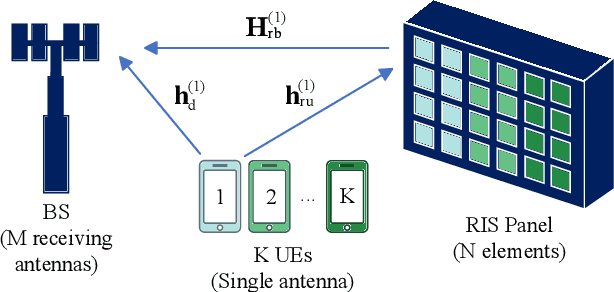
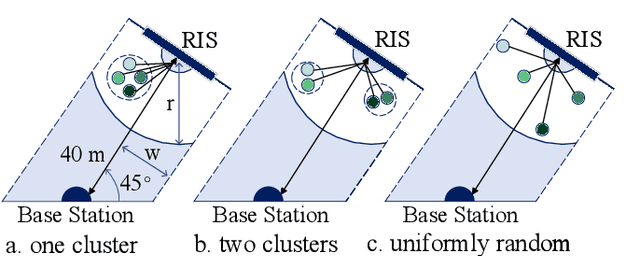
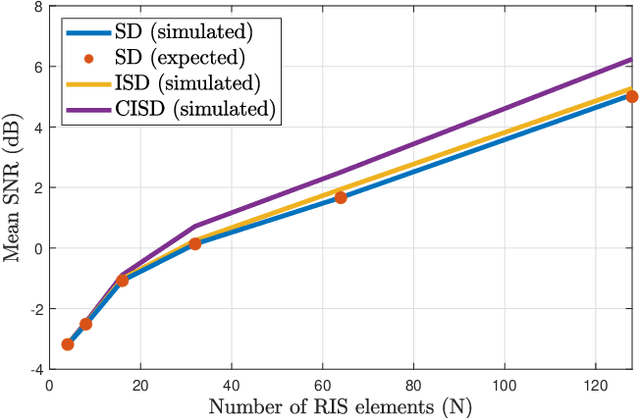
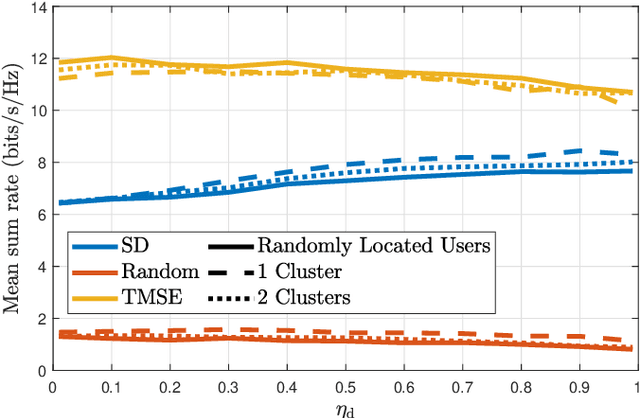
We analyse the performance of a reconfigurable intelligent surface (RIS) aided system where the RIS is divided into subsurfaces. Each subsurface is designed specifically for one user, who is served on their own frequency band. The other subsurfaces (those not designed for this user) provide additional uncontrolled scattering. We derive the exact closed-form expression for the mean signal-to-noise ratio (SNR) of the subsurface design (SD) when all channels experience correlated Ricean fading. We simplify this to find the mean SNR for line-of-sight (LoS) channels and channels experiencing correlated Rayleigh fading. An iterative SD (ISD) process is proposed, where subsurfaces are designed sequentially, and the phases that are already set are used to enhance the design of the remaining subsurfaces. This is extended to a converged ISD (CISD), where the ISD process is repeated multiple times until the SNR increases by less than a specified tolerance. The ISD and CISD both provide a performance improvement over SD, which increases as the number of RIS elements (N) increases. The SD is significantly simpler than the lowest complexity multi-user (MU) method we know of, and despite each user having less bandwidth, the SD outperforms the existing method in some key scenarios. The SD is more robust to strongly LoS channels and clustered users, as it does not rely on spatial multiplexing like other MU methods. Combined with the complexity reduction, this makes the SD an attractive phase selection method.
Rician Channel Modelling for Super Wideband MIMO Communications
Nov 04, 2024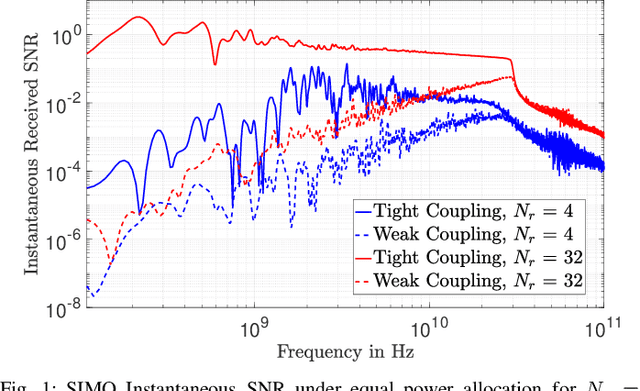
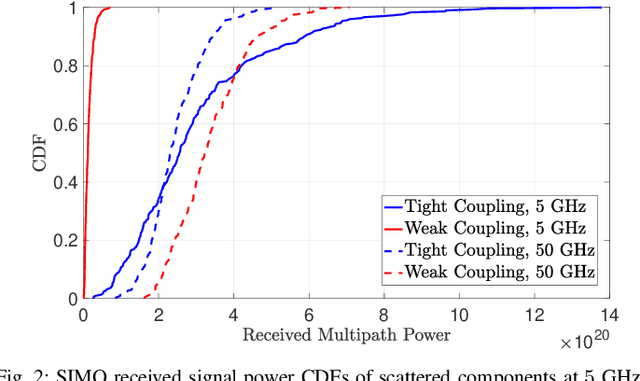
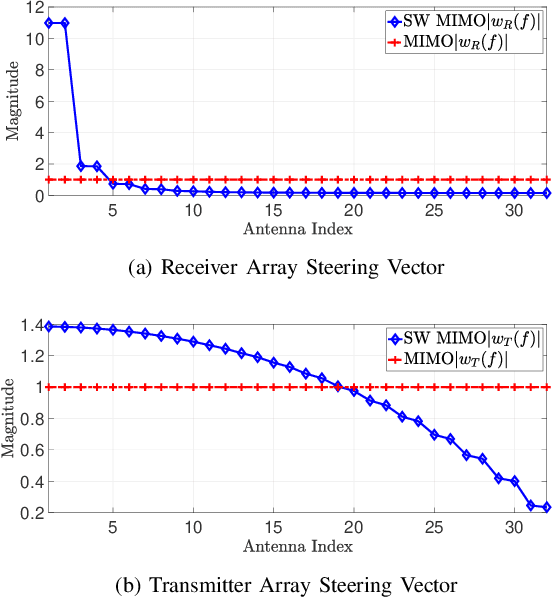
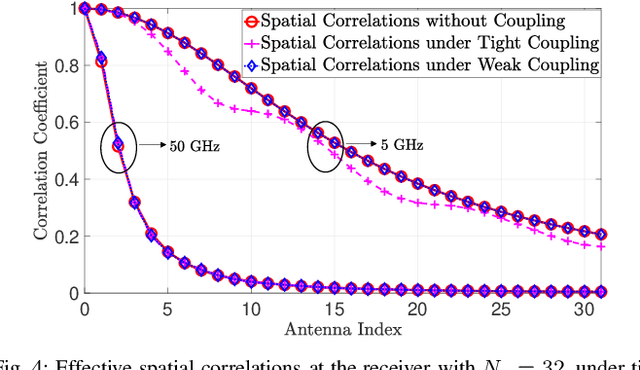
Recent developments in Multiple-Input-Multiple-Output (MIMO) technology include packing a large number of antenna elements in a compact array to access the bandwidth benefits provided by higher mutual coupling (MC). The resulting super-wideband (SW) systems require a circuit-theoretic framework to handle the MC and channel models which span extremely large bands. Hence, in this paper, we make two key contributions. First, we develop a physically-consistent Rician channel model for use with SW systems. Secondly, we express the circuit-theoretic models in terms of a standard MIMO model, so that insights into the effects of antenna layouts, MC, and bandwidth can be made using standard communication theory. For example, we show the bandwidth widening resulting from the new channel model. In addition, we show that MC distorts line-of-sight paths which has beamforming implications. We also highlight the interaction between spatial correlation and MC and show that tight coupling reduces spatial correlations at low frequencies.