 Add to Chrome
 Add to Firefox
 Add to Edge
Sub-6 GHz Beam-Reconfigurable Microfluidic Antenna Using Graphene Liquid for 5G Network
Dec 19, 2025
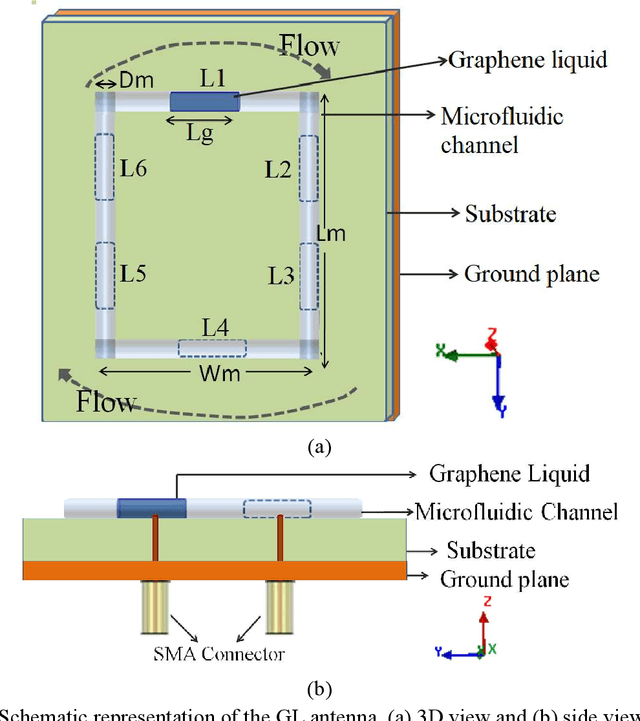

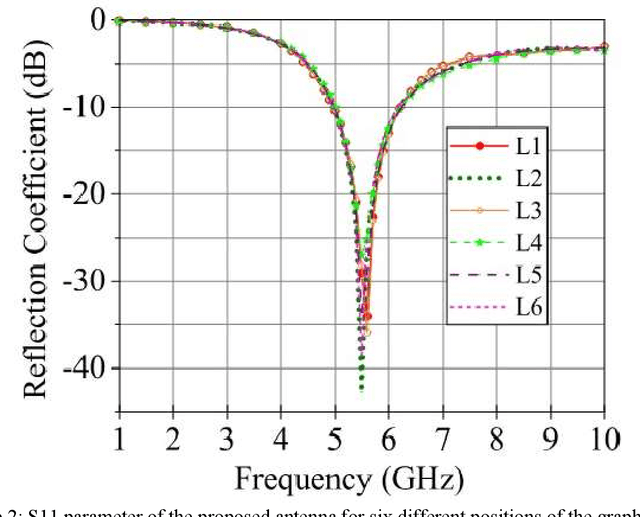

As wireless communication systems continue to grow rapidly, high-performance antennas become increasingly crucial for expanding coverage, improving capacity, and enhancing transmission quality. In light of this, research has focused considerable attention on liquid antennas due to their unique characteristics, which include small size, flexibility, reconfigurability and transparency. Recently, graphene liquid has been explored for numerous applications due to its low cost, high conductivity, flexibility, and ease of processing. Specifically for antenna applications, graphene liquid performs better than conventional liquid metal. This paper presents a graphene-liquid antenna with beam reconfiguration ability for sub-6 GHz communication system. The graphene-liquid movement within the microfluidic channel is taken into consideration by the reconfiguration mechanism. The antenna achieves beam reconfiguration in 360° directions with 6 dBi of gain at 5.5 GHz, featuring a wideband impedance bandwidth of 24%. The antenna main beam is specifically reconfigured into six directions (0°, 45°, 135°, 180°, 225° and 315°) at 5.5 GHz. Additionally, in all six reconfigurable scenarios at 5.5 GHz, the antenna provides a stable reflection coefficient. Therefore, for the next generation of wireless communication systems, this novel design of graphene-liquid-based reconfigurable sub-6 GHz antennas holds promise.

Advancements in Terahertz Antenna Design
Dec 26, 2024The promising way to provide sufficient transmission capacity is by accessing transmission bands at higher carrier frequencies. This desire for higher carrier frequency or more bandwidth led the researchers to take advantage of the terahertz (THz) spectrum. The opportunity for large bandwidth in the THz band leads to the possibility of easy, high data rate transmission. In spite of the advantages, the THz band suffers from large free space path loss. In the development of THz communication systems, the antenna is the most significant component. The focus is especially on designing highly directive antennas because they enhance the performance of the overall system by compensating for the large path loss at THz and thus improving the signal-to-noise ratio. This chapter presents different types of THz antennas, including planar, reflectarray, horn antenna, and lens antenna. Emphasis has been made to present the latest trend of designing THz antennas using carbon-based materials, such as graphene and carbon nanotubes. The performance of these antennas has been compared with that of traditional copper-based THz antennas by critically analyzing their properties. A brief discussion on THz power sources is included in this chapter for completeness. A comprehensive discussion on different fabrication techniques has been provided to appraise the reader of the general fabrication processes of THz components.