 Add to Chrome
 Add to Firefox
 Add to Edge
Statistical Channel Model for FSO Systems Assisted by a UAV-Mounted IRS
Aug 11, 2026
Integrating optical intelligent reflecting surfaces (IRSs) into aerial platforms, such as unmanned aerial vehicles (UAVs), has been proposed to relax the line-of-sight (LoS) constraint, extend coverage, and enhance deployment flexibility of free space optical (FSO) systems. However, misalignment errors induced by the UAV hovering, in both position and orientation, may degrade connectivity and impair the end-to-end channel quality. In this paper, we develop novel expressions for the electric fields incident on and reflected by an optical IRS, based on the Huygens-Fresnel principle. The resulting expressions are applicable for any combination of incident and reflected propagation directions. Building on this framework, we derive a closed-form statistical channel model that captures the geometric and misalignment losses of an FSO link assisted by a UAV-mounted IRS in the presence of random UAV fluctuations. In particular, we develop a statistical model for the beam misalignment at the receiver lens, assuming Gaussian fluctuations in both the UAV position and orientation. The proposed analytical model is validated through Monte Carlo (MC) simulations and is further used to provide practical design guidelines regarding the optimal placement of the UAV-mounted IRS for the minimization of the outage probability.

On the Identifiability of Semi-Blind Estimation in Cell-Free Massive MIMO Networks
May 20, 2026Semi-blind joint channel estimation and data detection (JCD) is a promising approach to mitigate pilot contamination in cell-free massive multiple-input multiple-output (CF-MaMIMO) networks. The effectiveness of such methods fundamentally depends on identifiability, i.e., the ability to unambiguously recover the unknown channel coefficients and transmitted data signals from the received uplink observations. In this work, we investigate the identifiability of semi-blind JCD from a large-scale system design perspective. We consider a CF-MaMIMO network in which access points (APs) and user equipments (UEs) are spatially distributed according to Poisson point processes (PPPs). The resulting network topology is modeled as bipartite random geometric graph (BRGG) that captures local connectivity induced by wireless propagation. To enable a tractable analysis, the spatially dependent graph model is approximated by a surrogate independent-edge random graph with matched degree distributions. Building on this model, we develop a recursive probabilistic analysis that characterizes the conditions under which semi-blind recovery succeeds with high probability. The proposed analysis reveals an identifiability region as a function of key system parameters, including AP and UE densities and the connectivity radius beyond which channel coefficients are assumed negligible. Monte Carlo simulations validate the predicted identifiability region and assess the accuracy of the proposed graph approximation. The proposed framework provides system level insights into how network density and connectivity affect identifiability in large-scale CF-MaMIMO systems and offers guidelines for selecting deployment parameters and pilot sequence lengths that enable reliable semi-blind recovery.
Expectation Propagation for Distributed Inference in Grant-Free Cell-Free Massive MIMO
Jan 07, 2026Grant-free cell-free massive multiple-input multiple-output (GF-CF-MaMIMO) systems are anticipated to be a key enabling technology for next-generation Internet-of-Things (IoT) networks, as they support massive connectivity without explicit scheduling. However, the large amount of connected devices prevents the use of orthogonal pilot sequences, resulting in severe pilot contamination (PC) that degrades channel estimation and data detection performance. Furthermore, scalable GF-CF-MaMIMO networks inherently rely on distributed signal processing. In this work, we consider the uplink of a GF-CF-MaMIMO system and propose two novel distributed algorithms for joint activity detection, channel estimation, and data detection (JACD) based on expectation propagation (EP). The first algorithm, denoted as JACD-EP, uses Gaussian approximations for the channel variables, whereas the second, referred to as JACD-EP-BG, models them as Bernoulli-Gaussian (BG) random variables. To integrate the BG distribution into the EP framework, we derive its exponential family representation and develop the two algorithms as efficient message passing over a factor graph constructed from the a posteriori probability (APP) distribution. The proposed framework is inherently scalable with respect to both the number of access points (APs) and user equipments (UEs). Simulation results show the efficient mitigation of PC by the proposed distributed algorithms and their superior detection accuracy compared to (genie-aided) centralized linear detectors.
Distributed Joint User Activity Detection, Channel Estimation, and Data Detection via Expectation Propagation in Cell-Free Massive MIMO
May 16, 2024
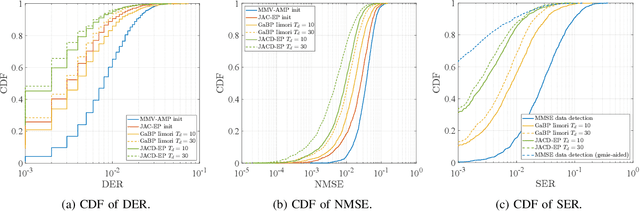


We consider the uplink of a grant-free cell-free massive multiple-input multiple-output (GF-CF-MaMIMO) system. We propose an algorithm for distributed joint activity detection, channel estimation, and data detection (JACD) based on expectation propagation (EP) called JACD-EP. We develop the algorithm by factorizing the a posteriori probability (APP) of activities, channels, and transmitted data, then, mapping functions and variables onto a factor graph, and finally, performing a message passing on the resulting factor graph. If users with the same pilot sequence are sufficiently distant from each other, the JACD-EP algorithm is able to mitigate the effects of pilot contamination which naturally occurs in grant-free systems due to the large number of potential users and limited signaling resources. Furthermore, it outperforms state-of-the-art algorithms for JACD in GF-CF-MaMIMO systems.
Wireless Information and Energy Transfer in the Era of 6G Communications
Apr 29, 2024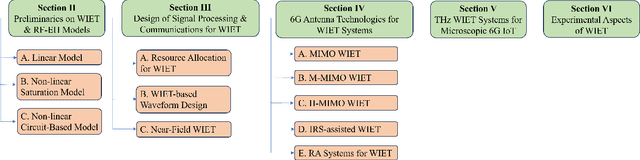

Wireless information and energy transfer (WIET) represents an emerging paradigm which employs controllable transmission of radio-frequency signals for the dual purpose of data communication and wireless charging. As such, WIET is widely regarded as an enabler of envisioned 6G use cases that rely on energy-sustainable Internet-of-Things (IoT) networks, such as smart cities and smart grids. Meeting the quality-of-service demands of WIET, in terms of both data transfer and power delivery, requires effective co-design of the information and energy signals. In this article, we present the main principles and design aspects of WIET, focusing on its integration in 6G networks. First, we discuss how conventional communication notions such as resource allocation and waveform design need to be revisited in the context of WIET. Next, we consider various candidate 6G technologies that can boost WIET efficiency, namely, holographic multiple-input multiple-output, near-field beamforming, terahertz communication, intelligent reflecting surfaces (IRSs), and reconfigurable (fluid) antenna arrays. We introduce respective WIET design methods, analyze the promising performance gains of these WIET systems, and discuss challenges, open issues, and future research directions. Finally, a near-field energy beamforming scheme and a power-based IRS beamforming algorithm are experimentally validated using a wireless energy transfer testbed. The vision of WIET in communication systems has been gaining momentum in recent years, with constant progress with respect to theoretical but also practical aspects. The comprehensive overview of the state of the art of WIET presented in this paper highlights the potentials of WIET systems as well as their overall benefits in 6G networks.
Bilinear Expectation Propagation for Distributed Semi-Blind Joint Channel Estimation and Data Detection in Cell-Free Massive MIMO
Dec 18, 2023We consider a cell-free massive multiple-input multiple-output (CF-MaMIMO) communication system in the uplink transmission and propose a novel algorithm for blind or semi-blind joint channel estimation and data detection (JCD). We formulate the problem in the framework of bilinear inference and develop a solution based on the expectation propagation (EP) method for both channel estimation and data detection. We propose a new approximation of the joint a posteriori distribution of the channel and data whose representation as a factor graph enables the application of the EP approach using the message-passing technique, local low-complexity computations at the nodes, and an effective modeling of channel-data interplay. The derived algorithm, called bilinear-EP JCD, allows for a distributed implementation among access points (APs) and the central processing unit (CPU) and has polynomial complexity. Our simulation results show that it outperforms other EP-based state-of-the-art polynomial time algorithms.
Joint Transmit Signal and Beamforming Design for Integrated Sensing and Power Transfer Systems
Nov 12, 2023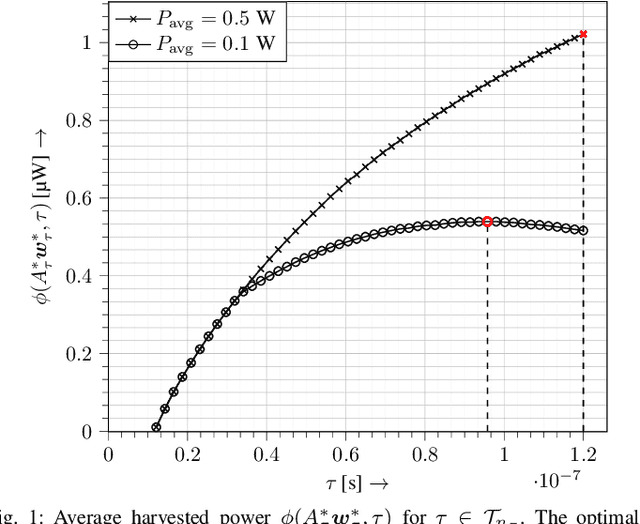

Integrating different functionalities, conventionally implemented as dedicated systems, into a single platform allows utilising the available resources more efficiently. We consider an integrated sensing and power transfer (ISAPT) system and propose the joint optimisation of the rectangular pulse-shaped transmit signal and the beamforming vector to combine sensing and wireless power transfer (WPT) functionalities efficiently. In contrast to prior works, we adopt an accurate non-linear circuit-based energy harvesting (EH) model. We formulate and solve a non-convex optimisation problem for a general number of EH receivers to maximise a weighted sum of the average harvested powers at the EH receivers while ensuring the received echo signal reflected by a sensing target (ST) has sufficient power for estimating the range to the ST with a prescribed accuracy within the considered coverage region. The average harvested power is shown to monotonically increase with the pulse duration when the average transmit power budget is sufficiently large. We discuss the trade-off between sensing performance and power transfer for the considered ISAPT system. The proposed approach significantly outperforms a heuristic baseline scheme based on a linear EH model, which linearly combines energy beamforming with the beamsteering vector in the direction to the ST as its transmit strategy.
Accurate EH Modelling and Achievable Information Rate for SLIPT Systems with Multi-Junction Photovoltaic Receivers
Aug 26, 2023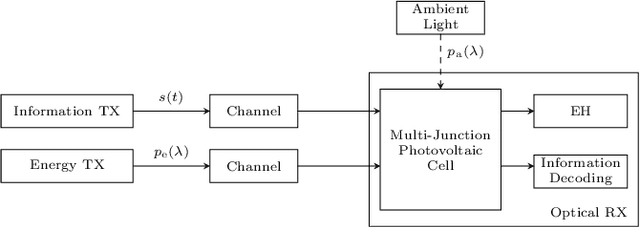
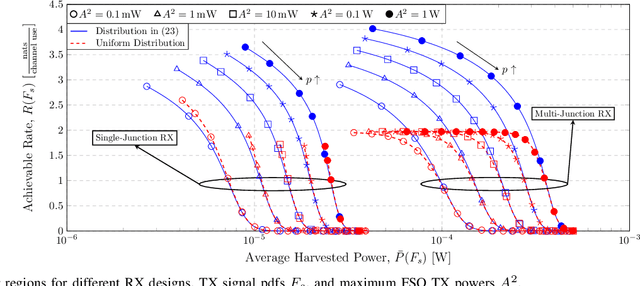
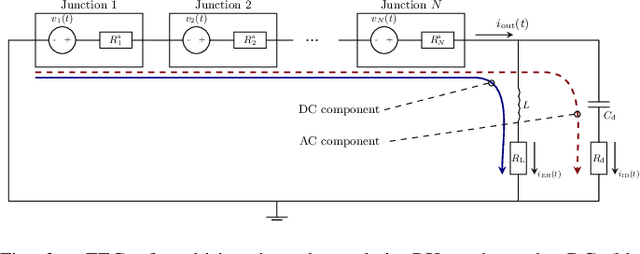
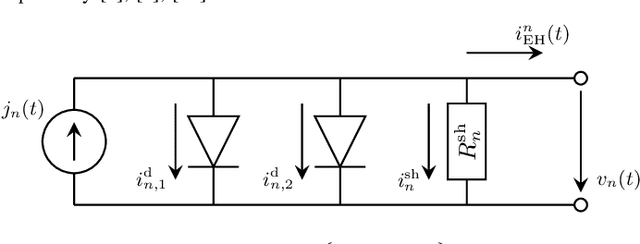
In this paper, we study optical simultaneous lightwave information and power transfer (SLIPT) systems employing photovoltaic optical receivers (RXs). To be able to efficiently harvest energy from broadband light, we propose to employ multi-junction photovoltaic cells at the optical RX. We consider the case, where the optical RX is illuminated by ambient light, an intensity-modulated information free space optical (FSO) signal, and since the ambient light may not be always present, a dedicated energy-providing broadband optical signal. Based on the analysis of the equivalent electrical circuit of the multi-junction photovoltaic RX, we model the current flow through the photovoltaic cell and derive a novel accurate and two novel approximate energy harvesting (EH) models for the two cases, where the optical RX is equipped with a single and multiple p-n junctions, respectively. We derive the optimal distribution of the transmit information signal that maximizes the achievable information rate. We validate the proposed EH models by circuit simulations and show that the photovoltaic RXs saturate for high received signal powers. For single-junction RXs, we compare the proposed EH model with two well-known baseline models and demonstrate that, in contrast to the proposed EH model, they are not able to fully capture the RX non-linearity. Since multi-junction RXs allow a more efficient allocation of the optical power, they are more robust against saturation, and thus, are able to harvest significantly more power and achieve higher data rates than RXs employing a single p-n junction. Finally, we highlight a tradeoff between the information rate and harvested power in SLIPT systems and demonstrate that the proposed optimal distribution yields significantly higher achievable information rates compared to uniformly distributed transmit signals, which are optimal for linear optical information RXs.
Optimal Transmit Antenna Deployment and Power Allocation for Wireless Power Supply in an Indoor Space
Jul 05, 2023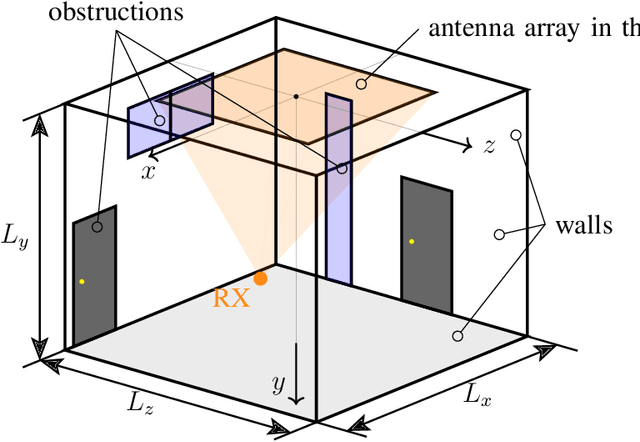
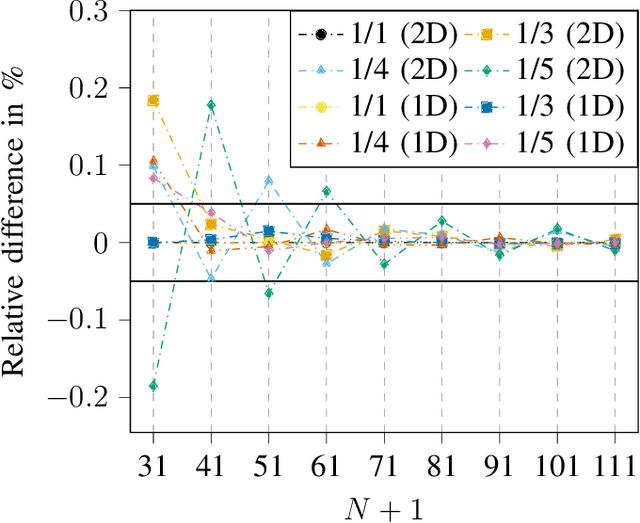
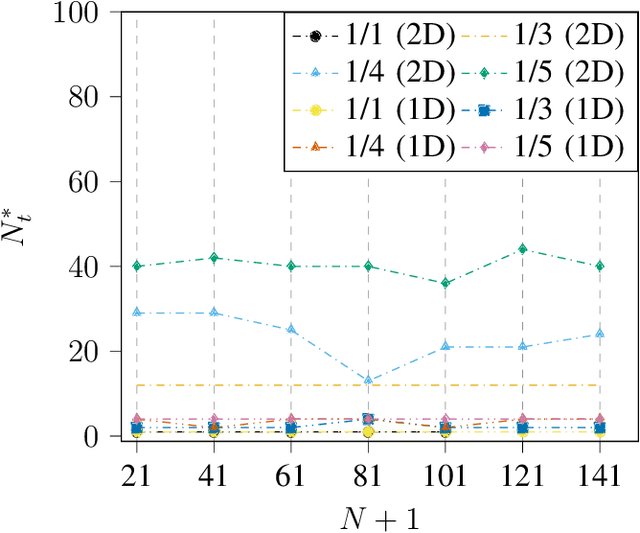
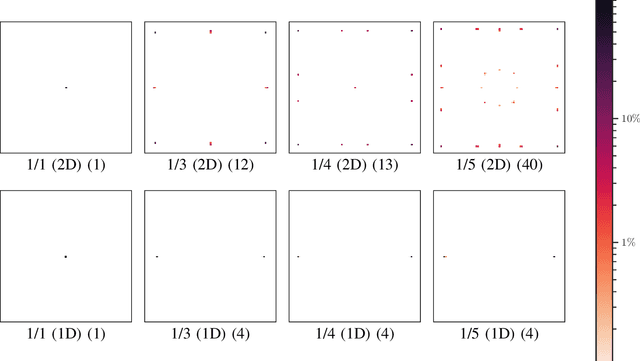
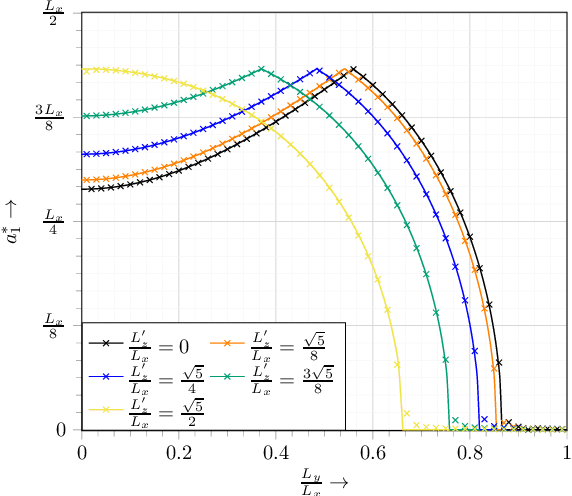
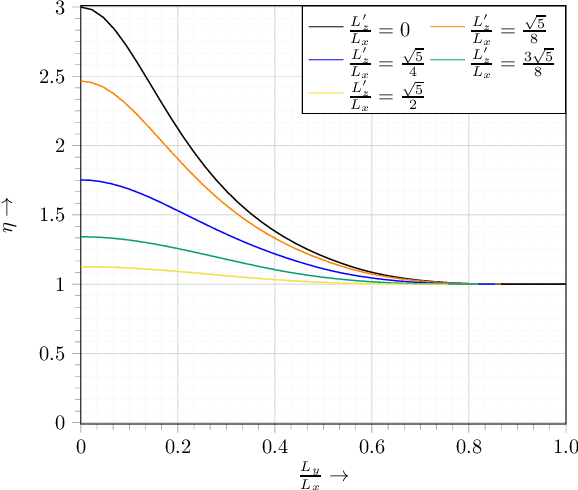
As Internet of Things (IoT) devices proliferate, sustainable methods for powering them are becoming indispensable. The wireless provision of power enables battery-free operation and is crucial for complying with weight and size restrictions. For the energy harvesting components of these devices to be small, a high operating frequency is necessary. In conjunction with an electrically large antenna, the receivers may be located in the radiating near-field (Fresnel) region, e.g., in indoor scenarios. In this paper, we propose a wireless power transfer system to ensure a reliable supply of power to an arbitrary number of mobile, low-power, and single-antenna receivers, which are located in a three-dimensional cuboid room. To this end, we formulate a max-min optimisation problem to determine the optimal allocation of transmit power among an infinite number of radiating elements of the system's transmit antenna array. Thereby, the optimal deployment, i.e, the set of transmit antenna positions that are allocated non-zero transmit power according to the optimal allocation, is obtained implicitly. Generally, the set of transmit antenna positions corresponding to the optimal deployment has Lebesgue measure zero and the closure of the set has empty interior. Moreover, for a one-dimensional transmit antenna array, the set of transmit antenna positions is proven to be finite. The proposed optimal solution is validated through simulation. Simulation results indicate that the optimal deployment requires a finite number of transmit antennas and depends on the geometry of the environment and the dimensionality of the transmit antenna array. The robustness of the solution, which is obtained under a line-of-sight (LoS) assumption between the transmitter and receiver, is assessed in an isotropic scattering environment containing a strong LoS component.
Achievable Rate-Power Tradeoff in THz SWIPT Systems with Resonant Tunnelling Diodes
May 05, 2023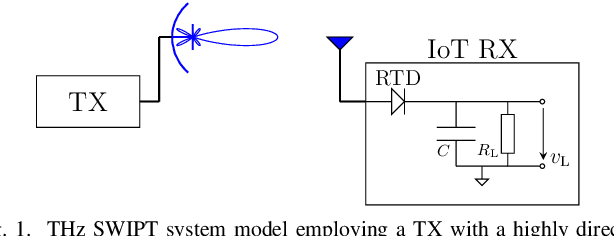
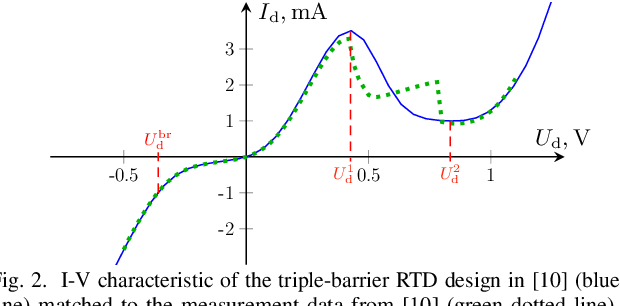
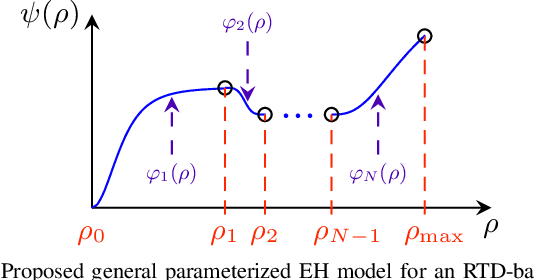
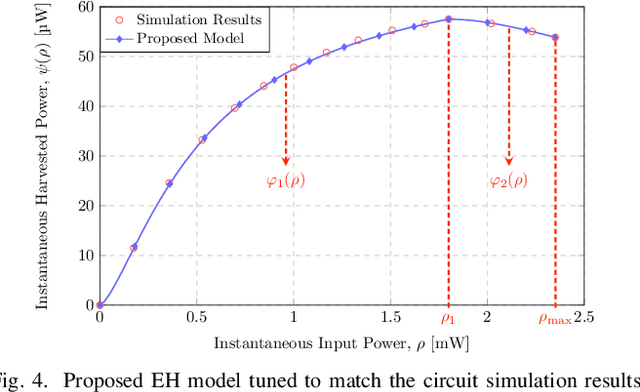
In this paper, we study terahertz (THz) simultaneous wireless information and power transfer (SWIPT) systems. Since coherent information detection is challenging at THz frequencies and Schottky diodes are not usable for THz energy harvesting (EH), we employ unipolar amplitude shift keying (ASK) modulation at the transmitter (TX) and a resonant tunnelling diode (RTD)- based EH circuit at the receiver (RX) to extract both information and power from the received signal. However, the electrical properties of Schottky diodes and RTDs are different, and unlike EH receivers based on a single Schottky diode, an accurate closed-form EH model for RTD-based RXs is not available, yet. In this paper, we model the dependency of the instantaneous RX output power on the instantaneous received power by a non-linear piecewise function, whose parameters are adjusted to fit circuit simulation results. We formulate an optimization problem to maximize the mutual information between the TX and RX signals subject to constraints on the peak amplitude of the transmitted signal and the required average harvested power at the RX. Furthermore, we determine a feasibility condition for the formulated problem, and for high and low required average harvested powers, we derive the achievable information rate numerically and in closed form, respectively. Our simulation results highlight a tradeoff between the information rate and the average harvested power. Finally, we show that this tradeoff is determined by the peak amplitude of the transmitted signal and the maximum instantaneous harvested power for low and high received signal powers, respectively.