 Add to Chrome
 Add to Firefox
 Add to Edge
EGR: Embedding-Native Generative Retrieval with a Shared LLM
Jul 25, 2026
Generative retrieval is increasingly popular in large-scale recommendation and advertising systems, yet current methods introduce practical complications. Semantic-ID methods rely on quantization, mutable identifier vocabularies, and token-to-item grounding; embedding-based pipelines train the item encoder separately from the query generator, which limits user-item alignment. We propose EGR, an Embedding-Native Generative Retrieval framework for recommendation and advertising. EGR uses a single shared LLM to learn item representations from item metadata and user representations from interaction histories in one embedding space. Items are indexed directly as dense vectors, and user histories are encoded as dense retrieval queries. Joint contrastive training groups related items and aligns queries with their target items. We evaluate EGR on public benchmarks, industrial data, and live deployment. EGR outperforms published baselines on Amazon Reviews; on Snap DPA, it scales with data, handles cold-start items, and benefits from multimodal input. In production, EGR delivers a +2.91% conversion-rate lift, simplifying system design while improving retrieval quality and ad performance.

SMART: LLM-Augmented Hybrid Retrieval for Dynamic Product Ads
Jul 25, 2026Dynamic Product Ads (DPA) require retrieving relevant items from multi-million product catalogs, balancing two competing objectives: retargeting (re-surfacing known interests) and prospecting (discovering new categories). While Large Language Models (LLMs) capture semantic intent better than traditional embedding models, deploying them at scale introduces prohibitive inference costs and lexical mismatch issues. Through controlled experiments on millions of users, we demonstrate a critical retrieval decomposition: rule-generated queries excel at retargeting on a lexical BM25 index, while LLM-generated queries excel at prospecting on a dense ANN index. Building on this, we propose SMART (SeMantic-aware Adaptive ReTrieval). To manage costs, a lightweight quality gate identifies coverage gaps in initial keyword results, adaptively routing only the ~10% of users who benefit from semantic prospecting to the LLM path. Offline evaluation demonstrates that this gated approach captures the bulk of semantic prospecting gains in Relevance Score while maintaining competitive re-targeting performance at a 90% reduction in LLM costs. Finally, in a 2-week online A/B test at Snap, SMART improved the ad conversion rate by +27.6% over a strong embedding-based baseline.
FORB: A Flat Object Retrieval Benchmark for Universal Image Embedding
Sep 28, 2023
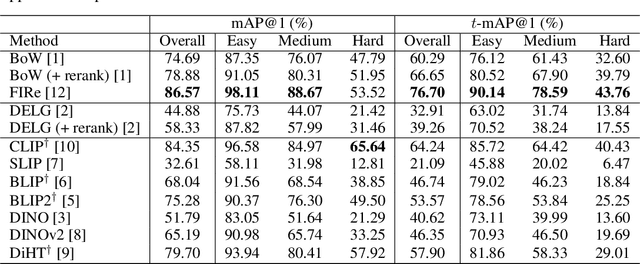
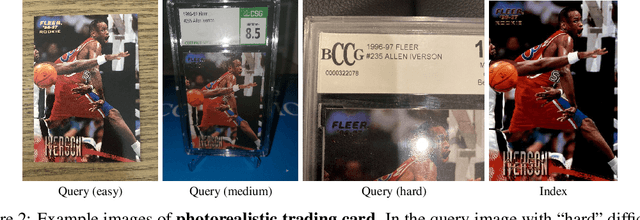
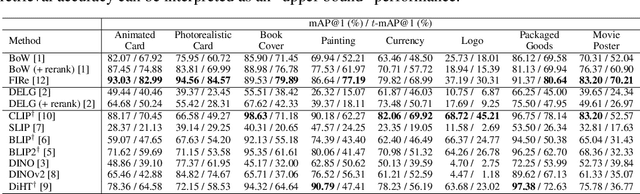
Image retrieval is a fundamental task in computer vision. Despite recent advances in this field, many techniques have been evaluated on a limited number of domains, with a small number of instance categories. Notably, most existing works only consider domains like 3D landmarks, making it difficult to generalize the conclusions made by these works to other domains, e.g., logo and other 2D flat objects. To bridge this gap, we introduce a new dataset for benchmarking visual search methods on flat images with diverse patterns. Our flat object retrieval benchmark (FORB) supplements the commonly adopted 3D object domain, and more importantly, it serves as a testbed for assessing the image embedding quality on out-of-distribution domains. In this benchmark we investigate the retrieval accuracy of representative methods in terms of candidate ranks, as well as matching score margin, a viewpoint which is largely ignored by many works. Our experiments not only highlight the challenges and rich heterogeneity of FORB, but also reveal the hidden properties of different retrieval strategies. The proposed benchmark is a growing project and we expect to expand in both quantity and variety of objects. The dataset and supporting codes are available at https://github.com/pxiangwu/FORB/.