 Add to Chrome
 Add to Firefox
 Add to Edge
Explicit Boundary Markers for Subword Vocabularies
Aug 12, 2026
Subword tokenizers represent many common words twice in space-using writing systems, once with a leading space and once without. The two entries have separate embeddings in models, so occurrences of one word are divided across rows that are trained independently, and the two forms need not even segment the string the same way: " together" may be a single entry while the same word without a preceding space is tokenized as "to|gether". Capitalization divides a word further, into as many as six forms. We introduce an alternative to standard whitespace conventions using an explicit word boundary marker, which prevents such duplication. Words are delimited by the boundary markers, and spaces between words are represented as pairs of such markers. Two shift codes do the same for title case and upper case, allowing one internal representation of a word to be re-used across different settings. Switching to this convention mitigates the duplicate-entry issue, but does not improve tokenization compression: for both vocabulary-learning algorithms, the best marker scheme stays within one percent of the baseline in characters per token, averaged across six languages. It does result in better language modeling performance. Every marker scheme tested downstream reaches lower bits per byte than the baseline, suggesting that duplication carries a cost that compression does not capture.

MinGram: A Minimalist Unigram Tokenizer with High Compression and Competitive Morphological Alignment
Jun 25, 2026The Unigram tokenizer uses an elegant representation which makes it straightforward to edit vocabularies, but its training is comparatively heavy and complex. We introduce MinGram (Minimalist Unigram), which keeps the token-list representation but simplifies training using a BPE-derived seed vocabulary, Hard EM on a minimum-token path, and a single flat score-pruning step. This removes the suffix array, the forward-backward pass, and the iterative prune loop, leaving a procedure that requires little beyond tokenizer inference itself. By making token count the primary objective and using a Unigram score only as a tiebreak, MinGram keeps the compression of pure token-count methods while retaining much of the morphological alignment and downstream quality of probabilistic ones. Across six languages, MinGram compresses better than both BPE and standard Unigram, and a compression-oriented variant matches the strongest token-count compressors while retaining substantially higher morphological alignment. In controlled downstream language-model training, Unigram-family tokenizers, with MinGram among the best, consistently beat BPE in bits-per-byte.
Every Eval Ever: A Unifying Schema and Community Repository for AI Evaluation Results
Jun 12, 2026AI evaluations are widely used for testing and understanding progress. However, the diverse evaluators bring with them inconsistencies that challenge analysis and comparison. First, results are saved in incompatible formats, scattered across leaderboards, papers, blog posts, evaluation harness logs, and custom repositories. Second, results are created by different evaluation frameworks, which produce divergent scores for nominally identical evaluations and record metadata inconsistently, hindering comparison, cross-community evaluation science, cost reduction, and reuse. We introduce Every Eval Ever, the first shared schema and community-crowdsourced repository for AI evaluation results. The schema standardizes how evaluations are represented in a unified, single JSON document. It is source-agnostic by design, ingesting results from evaluation harnesses and papers alike, and optionally stores per-instance outputs for fine-grained analysis. We contribute: (i) a community-governed metadata schema with a companion instance-level schema, the first standardization effort of its kind; (ii) automatic converters from popular formats, evaluation harnesses, and leaderboards to the unified schema; and (iii) a crowdsourced community database hosted on Hugging Face, currently spanning to date 22,235 models, 2,273 unique benchmarks, and 31 evaluation formats.
Auditing LLM Benchmarks with Item Response Theory
May 28, 2026LLM benchmark labels are frozen at release and silently propagated into downstream benchmarks, errors and all. We introduce an Item Response Theory-based indicator that surfaces likely mislabels at 95% precision in the top 200 examples across seven preference and multiple-choice benchmarks using responses from 114 models, outperforming a supervised classifier. We trace these errors to mechanical labeling heuristics, upstream annotation mistakes inherited unchanged from source datasets, and fundamentally ambiguous items without a defensible single label. The same model fit reveals that reward models specialize in stylistic preference rather than factual knowledge, and identifies one frontier reward model that agrees with detected mislabels at 78% accuracy versus 38% for its peers, consistent with benchmark contamination or benchmark-specific over-optimization.
Which Pieces Does Unigram Tokenization Really Need?
Dec 14, 2025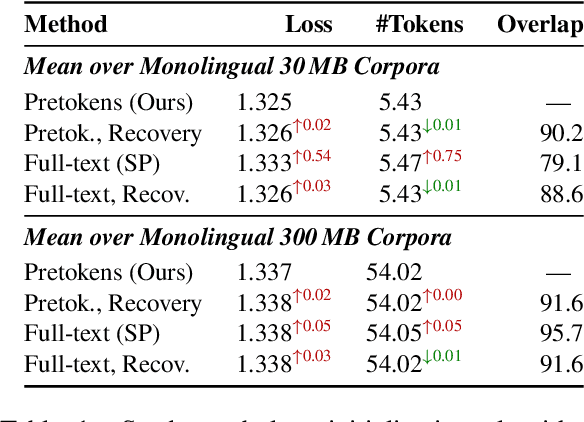
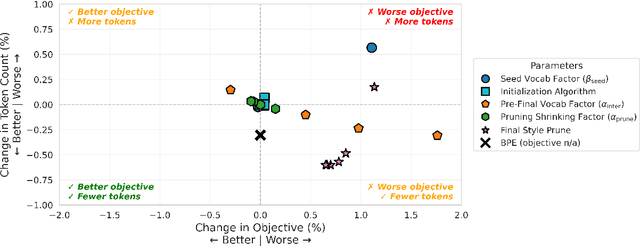
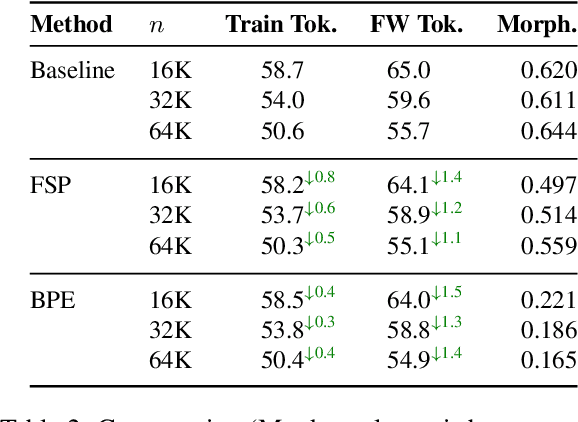
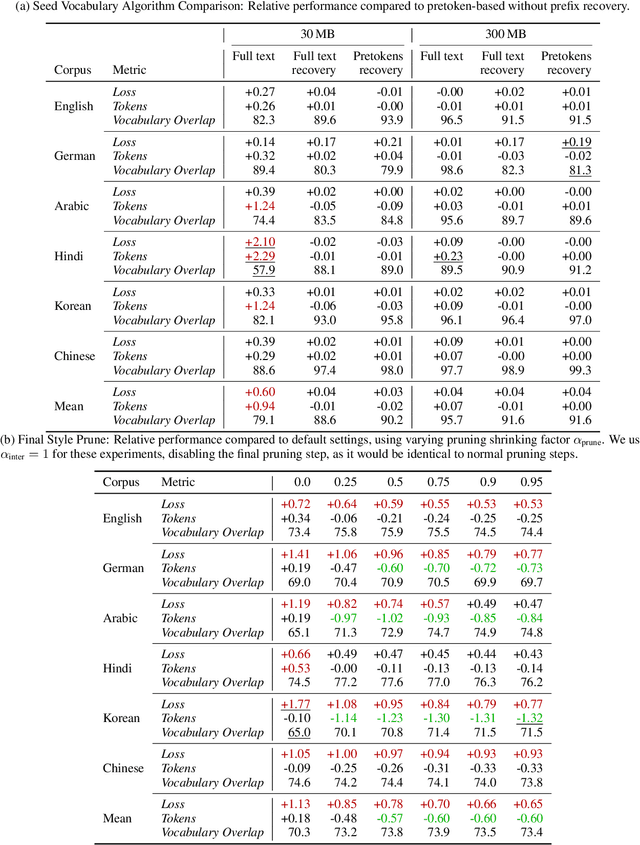
The Unigram tokenization algorithm offers a probabilistic alternative to the greedy heuristics of Byte-Pair Encoding. Despite its theoretical elegance, its implementation in practice is complex, limiting its adoption to the SentencePiece package and adapters thereof. We bridge this gap between theory and practice by providing a clear guide to implementation and parameter choices. We also identify a simpler algorithm that accepts slightly higher training loss in exchange for improved compression.
BPE Stays on SCRIPT: Structured Encoding for Robust Multilingual Pretokenization
May 30, 2025Byte Pair Encoding (BPE) tokenizers, widely used in Large Language Models, face challenges in multilingual settings, including penalization of non-Western scripts and the creation of tokens with partial UTF-8 sequences. Pretokenization, often reliant on complex regular expressions, can also introduce fragility and unexpected edge cases. We propose SCRIPT (Script Category Representation in PreTokenization), a novel encoding scheme that bypasses UTF-8 byte conversion by using initial tokens based on Unicode script and category properties. This approach enables a simple, rule-based pretokenization strategy that respects script boundaries, offering a robust alternative to pretokenization strategies based on regular expressions. We also introduce and validate a constrained BPE merging strategy that enforces character integrity, applicable to both SCRIPT-BPE and byte-based BPE. Our experiments demonstrate that SCRIPT-BPE achieves competitive compression while eliminating encoding-based penalties for non-Latin-script languages.
Command A: An Enterprise-Ready Large Language Model
Apr 01, 2025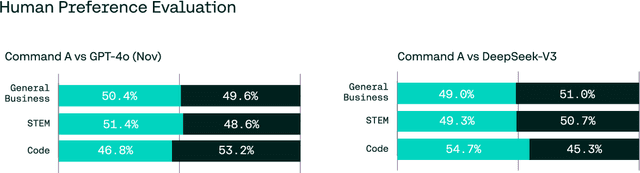
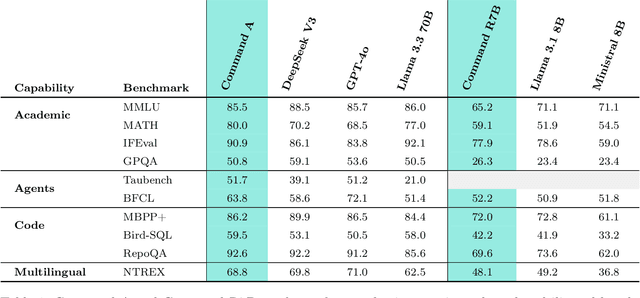
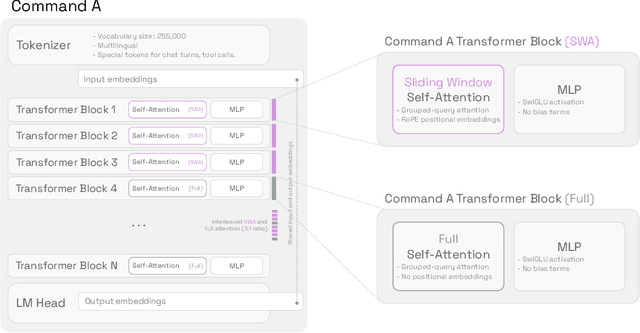
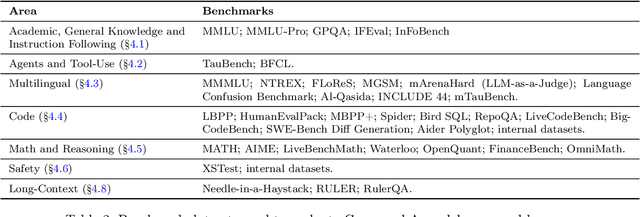
In this report we describe the development of Command A, a powerful large language model purpose-built to excel at real-world enterprise use cases. Command A is an agent-optimised and multilingual-capable model, with support for 23 languages of global business, and a novel hybrid architecture balancing efficiency with top of the range performance. It offers best-in-class Retrieval Augmented Generation (RAG) capabilities with grounding and tool use to automate sophisticated business processes. These abilities are achieved through a decentralised training approach, including self-refinement algorithms and model merging techniques. We also include results for Command R7B which shares capability and architectural similarities to Command A. Weights for both models have been released for research purposes. This technical report details our original training pipeline and presents an extensive evaluation of our models across a suite of enterprise-relevant tasks and public benchmarks, demonstrating excellent performance and efficiency.
Understanding Likelihood Over-optimisation in Direct Alignment Algorithms
Oct 15, 2024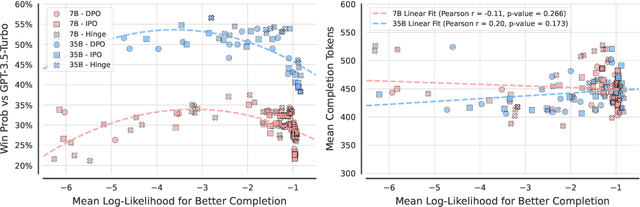
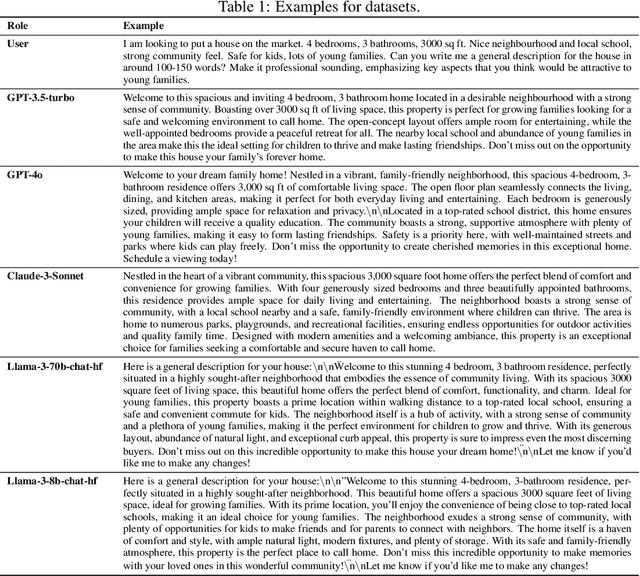

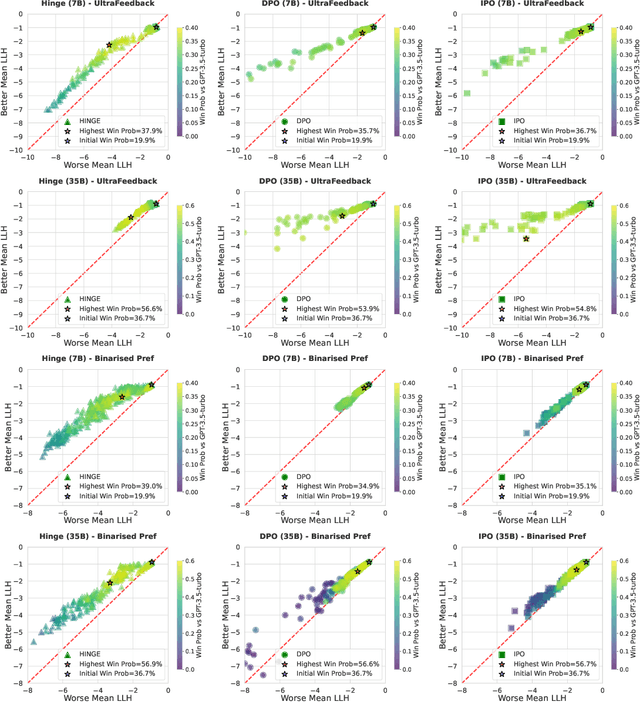
Direct Alignment Algorithms (DAAs), such as Direct Preference Optimisation (DPO) and Identity Preference Optimisation (IPO), have emerged as alternatives to online Reinforcement Learning from Human Feedback (RLHF) algorithms such as Proximal Policy Optimisation (PPO) for aligning language models to human preferences, without the need for explicit reward modelling. These methods generally aim to increase the likelihood of generating better (preferred) completions while discouraging worse (non-preferred) ones, while staying close to the original model's behaviour. In this work, we explore the relationship between completion likelihood and model performance in state-of-the-art DAAs, and identify a critical issue of likelihood over-optimisation. Contrary to expectations, we find that higher likelihood of better completions and larger margins between better and worse completion likelihoods do not necessarily lead to better performance, and may even degrade it. Our analysis reveals that while higher likelihood correlates with better memorisation of factual knowledge patterns, a slightly lower completion likelihood tends to improve output diversity, thus leading to better generalisation to unseen scenarios. Moreover, we identify two key indicators that signal when over-optimised output diversity begins to harm performance: Decreasing Entropy over Top-k Tokens and Diminishing Top-k Probability Mass. Our experimental results validate that these indicators are reliable signs of declining performance under different regularisations, helping prevent over-optimisation and improve alignment with human preferences.
Fishing for Magikarp: Automatically Detecting Under-trained Tokens in Large Language Models
May 08, 2024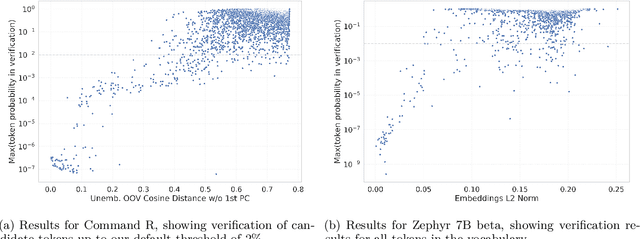
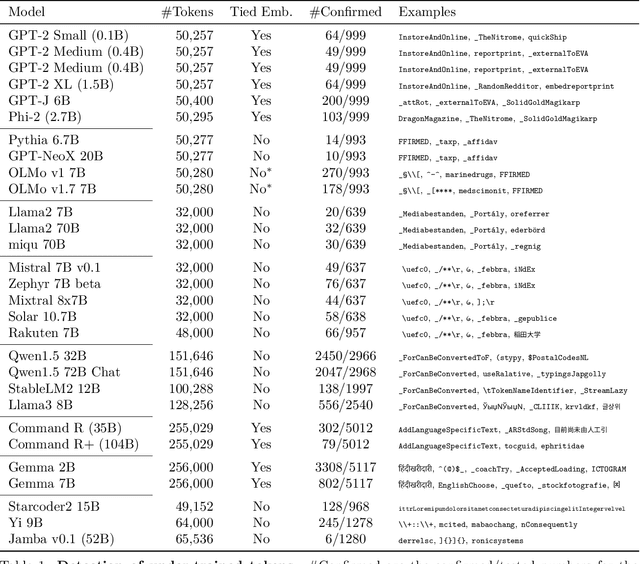
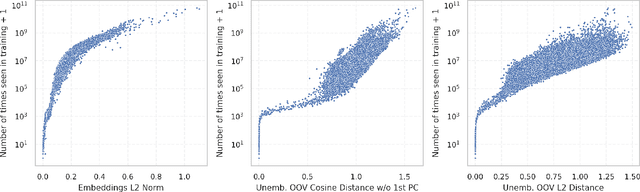
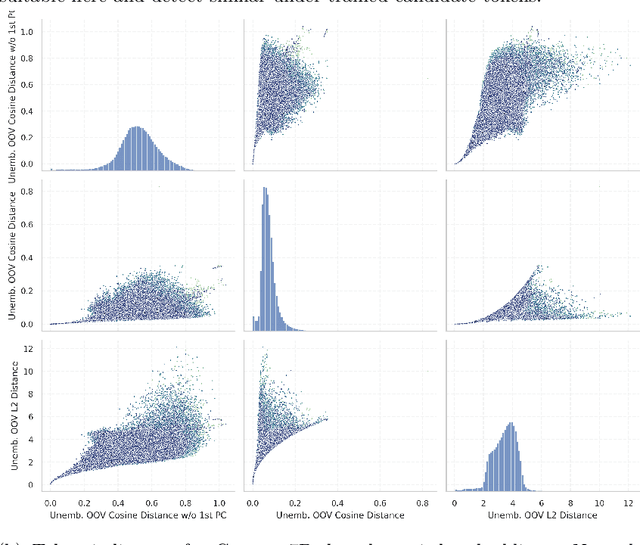
The disconnect between tokenizer creation and model training in language models has been known to allow for certain inputs, such as the infamous SolidGoldMagikarp token, to induce unwanted behaviour. Although such `glitch tokens' that are present in the tokenizer vocabulary, but are nearly or fully absent in training, have been observed across a variety of different models, a consistent way of identifying them has been missing. We present a comprehensive analysis of Large Language Model (LLM) tokenizers, specifically targeting this issue of detecting untrained and under-trained tokens. Through a combination of tokenizer analysis, model weight-based indicators, and prompting techniques, we develop effective methods for automatically detecting these problematic tokens. Our findings demonstrate the prevalence of such tokens across various models and provide insights into improving the efficiency and safety of language models.