 Add to Chrome
 Add to Firefox
 Add to Edge
IMAGINE: Adaptive Schema-Imagery Enhanced Composition for Composed Video Retrieval
Jun 06, 2026
Composed Video Retrieval (CVR) is designed to retrieve a target video that matches a reference video modified by a modification text. While existing methods explore cross-modal correspondences, they often assume modified objects appear directly in videos. However, modification texts frequently describe concepts not explicitly presented but implicitly expressed through semantically related visual cues (e.g., "cake" implying "birthday party"). Current approaches typically rely on aligning explicit feature representations within the concrete space, neglecting critical latent associations. To address this, we propose an adaptIve scheMa-ImAGery enhanced composItional NEtwork (IMAGINE). Unlike standard explicit matching, IMAGINE materializes implicit semantics (termed schema imagery) via dynamic multimodal prototypes. These prototypes capture shared latent concepts to adaptively modulate visual features, effectively injecting implicit guidance into the retrieval process. By bridging the gap between explicit visual contents and implicit retrieval intentions, IMAGINE achieves state-of-the-art performance in both CVR and Composed Image Retrieval (CIR) across three widely used benchmarks.

Nautilus Compass: Black-box Persona Drift Detection for Production LLM Agents
May 11, 2026Production LLM coding agents drift over long sessions: they forget user-specified constraints, slip into mistakes the user already flagged, and confabulate prior agreements. White-box approaches such as persona vectors require model weights and so cannot be applied to closed APIs (Claude, GPT-4) that most users actually interact with. We present Nautilus Compass, a black-box persona drift detector and agent memory layer for production coding agents. The method operates entirely at the prompt-text layer: cosine similarity between user prompts and behavioral anchor texts, aggregated by a weighted top-k mean using BGE-m3 embeddings. Compass is, to our knowledge, the only public agent memory layer (among Mem0, Letta, Cognee, Zep, MemOS, smrti verified May 2026) that does not call an LLM at index time to extract facts or build a graph; raw conversation text is embedded directly. The system ships as a Claude Code plugin, an MCP 2024-11-05 A2A server (Cursor, Cline, Hermes), a CLI, and a REST API on one daemon, with a Merkle-chained audit log for tamper-evident anchor updates. On a held-out test set built from real Claude Code session traces and labeled by an independent LLM judge, Compass reaches ROC AUC 0.83 for drift detection. The embedded retrieval pipeline scores 56.6% on LongMemEval-S v0.8 and 44.4% on EverMemBench-Dynamic (n=500), topping the four published EverMemBench Table 4 baselines. LongMemEval-S 56.6% is ~30 points below recent white-box leaders (90+%); we treat that as the architectural ceiling of the no-extraction design. End-to-end reproduction cost is $3.50 (~14x cheaper than GPT-4o-judged stacks). A paired cross-vendor behavior A/B accompanies these numbers as preliminary system-level evidence. Code, anchors, frozen test data, and audit-log tooling are MIT-licensed at github.com/chunxiaoxx/nautilus-compass.
FedeCouple: Fine-Grained Balancing of Global-Generalization and Local-Adaptability in Federated Learning
Nov 12, 2025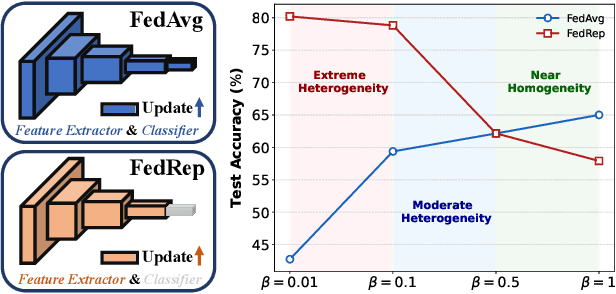
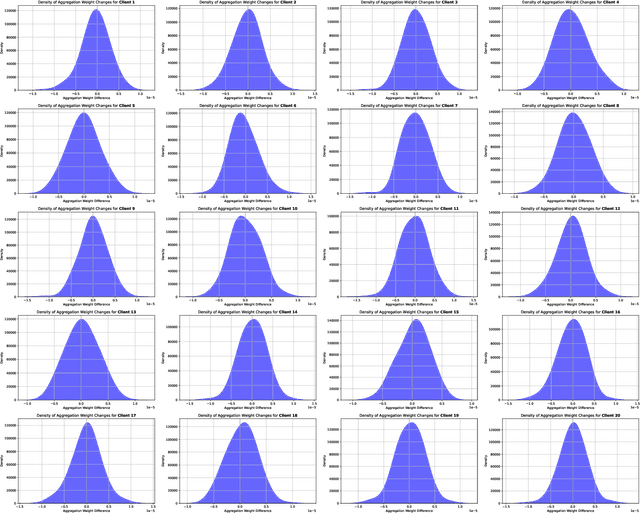
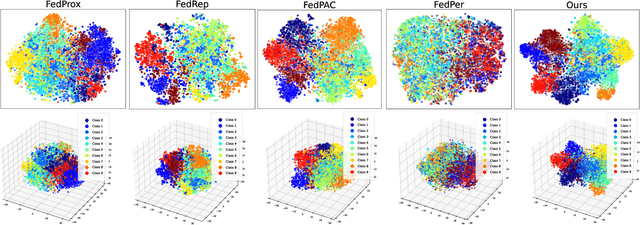
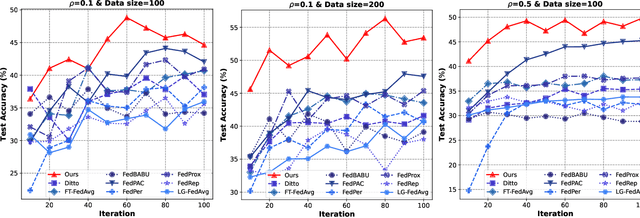
In privacy-preserving mobile network transmission scenarios with heterogeneous client data, personalized federated learning methods that decouple feature extractors and classifiers have demonstrated notable advantages in enhancing learning capability. However, many existing approaches primarily focus on feature space consistency and classification personalization during local training, often neglecting the local adaptability of the extractor and the global generalization of the classifier. This oversight results in insufficient coordination and weak coupling between the components, ultimately degrading the overall model performance. To address this challenge, we propose FedeCouple, a federated learning method that balances global generalization and local adaptability at a fine-grained level. Our approach jointly learns global and local feature representations while employing dynamic knowledge distillation to enhance the generalization of personalized classifiers. We further introduce anchors to refine the feature space; their strict locality and non-transmission inherently preserve privacy and reduce communication overhead. Furthermore, we provide a theoretical analysis proving that FedeCouple converges for nonconvex objectives, with iterates approaching a stationary point as the number of communication rounds increases. Extensive experiments conducted on five image-classification datasets demonstrate that FedeCouple consistently outperforms nine baseline methods in effectiveness, stability, scalability, and security. Notably, in experiments evaluating effectiveness, FedeCouple surpasses the best baseline by a significant margin of 4.3%.
PDSL: Privacy-Preserved Decentralized Stochastic Learning with Heterogeneous Data Distribution
Mar 31, 2025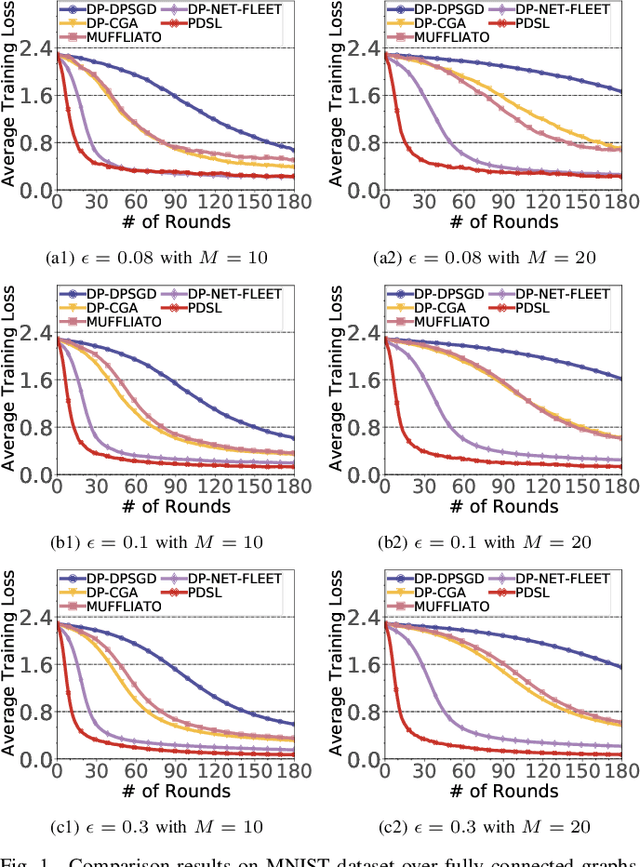
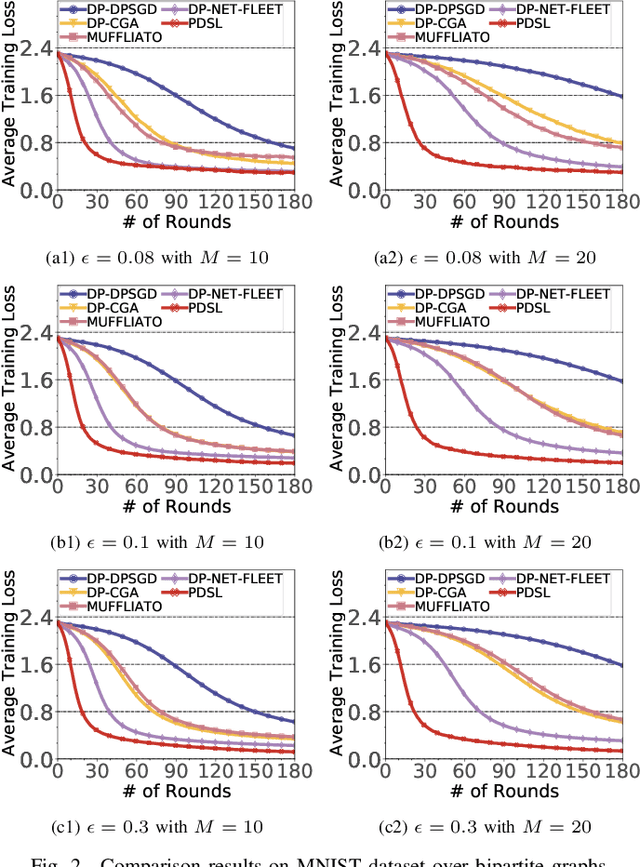
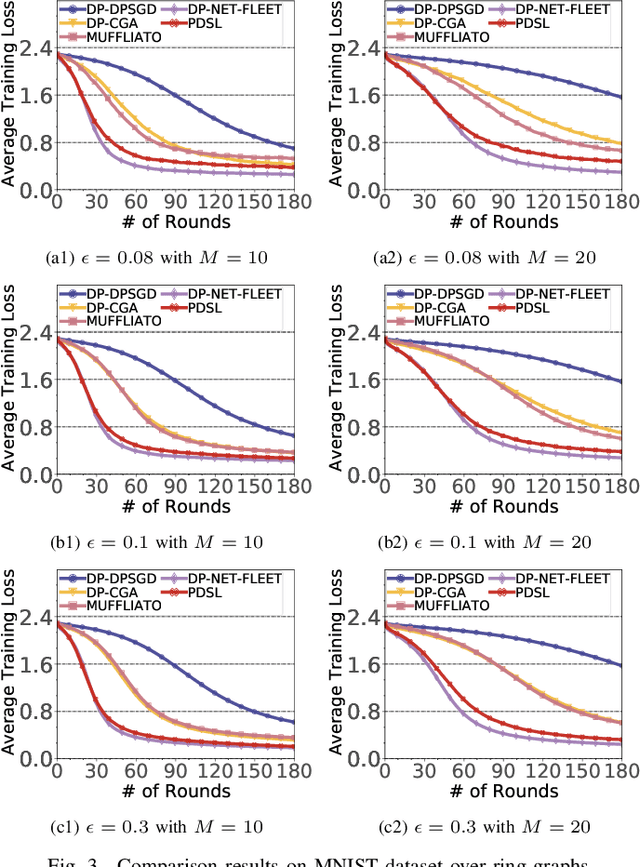
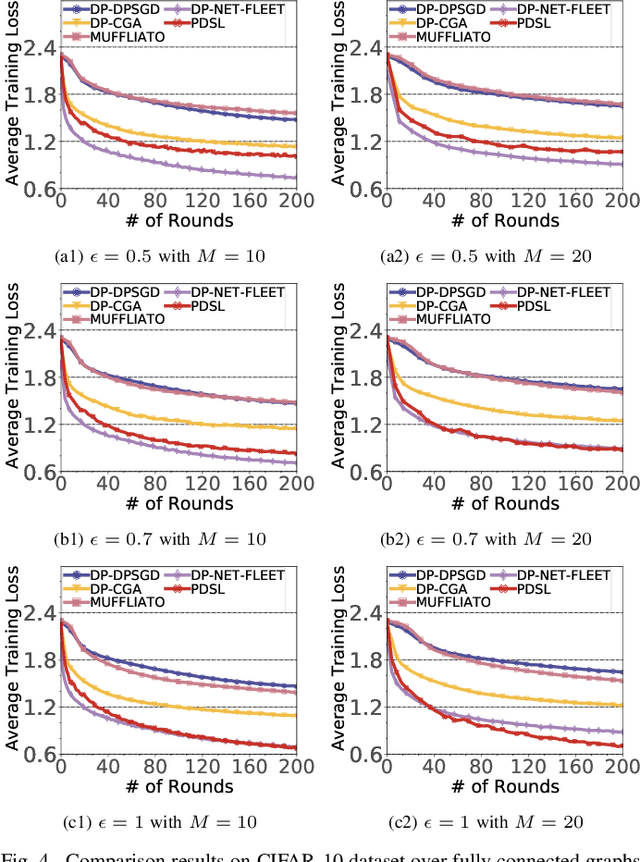
In the paradigm of decentralized learning, a group of agents collaborates to learn a global model using distributed datasets without a central server. However, due to the heterogeneity of the local data across the different agents, learning a robust global model is rather challenging. Moreover, the collaboration of the agents relies on their gradient information exchange, which poses a risk of privacy leakage. In this paper, to address these issues, we propose PDSL, a novel privacy-preserved decentralized stochastic learning algorithm with heterogeneous data distribution. On one hand, we innovate in utilizing the notion of Shapley values such that each agent can precisely measure the contributions of its heterogeneous neighbors to the global learning goal; on the other hand, we leverage the notion of differential privacy to prevent each agent from suffering privacy leakage when it contributes gradient information to its neighbors. We conduct both solid theoretical analysis and extensive experiments to demonstrate the efficacy of our PDSL algorithm in terms of privacy preservation and convergence.
A Supervised Information Enhanced Multi-Granularity Contrastive Learning Framework for EEG Based Emotion Recognition
May 12, 2024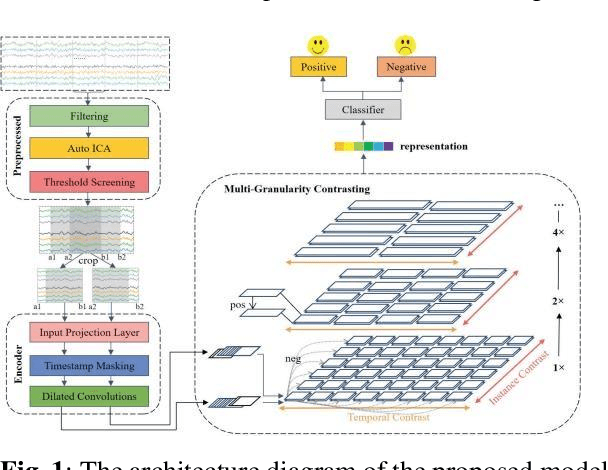

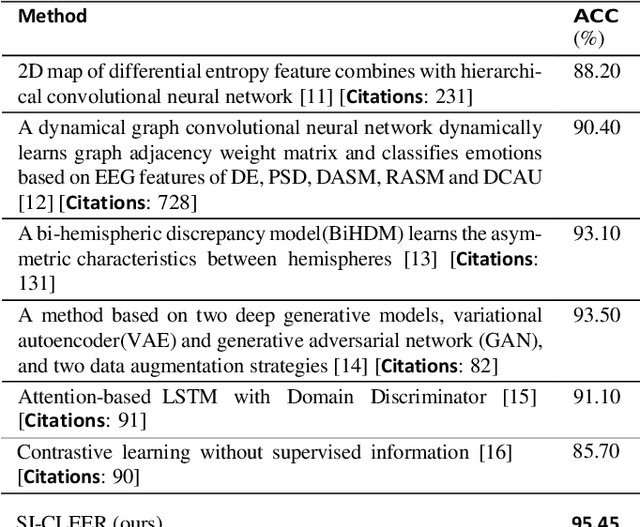
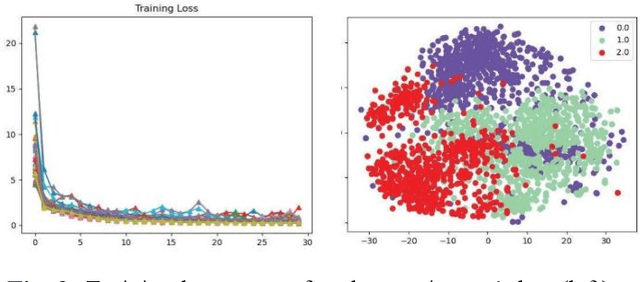
This study introduces a novel Supervised Info-enhanced Contrastive Learning framework for EEG based Emotion Recognition (SICLEER). SI-CLEER employs multi-granularity contrastive learning to create robust EEG contextual representations, potentiallyn improving emotion recognition effectiveness. Unlike existing methods solely guided by classification loss, we propose a joint learning model combining self-supervised contrastive learning loss and supervised classification loss. This model optimizes both loss functions, capturing subtle EEG signal differences specific to emotion detection. Extensive experiments demonstrate SI-CLEER's robustness and superior accuracy on the SEED dataset compared to state-of-the-art methods. Furthermore, we analyze electrode performance, highlighting the significance of central frontal and temporal brain region EEGs in emotion detection. This study offers an universally applicable approach with potential benefits for diverse EEG classification tasks.
Automated Prompting for Non-overlapping Cross-domain Sequential Recommendation
Apr 09, 2023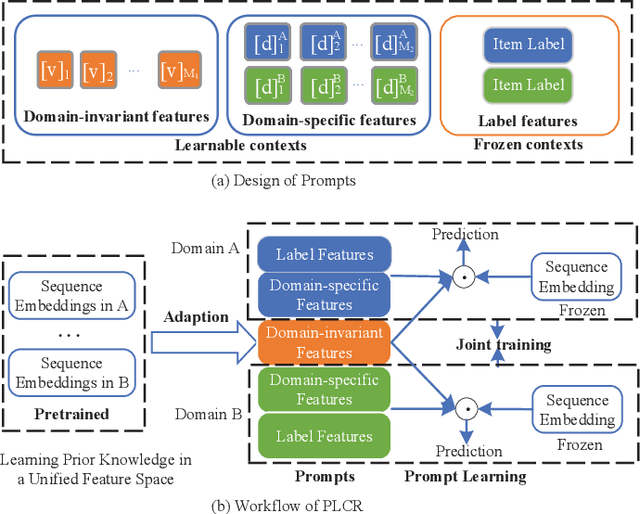
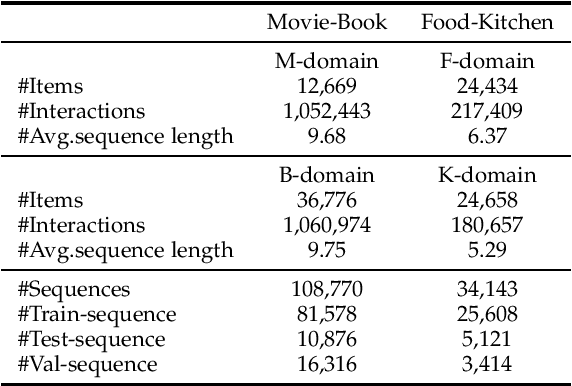
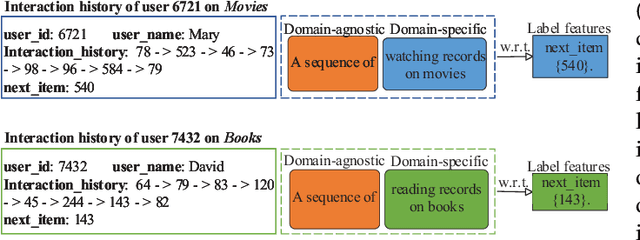
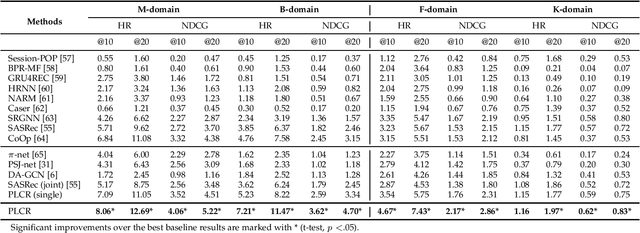
Cross-domain Recommendation (CR) has been extensively studied in recent years to alleviate the data sparsity issue in recommender systems by utilizing different domain information. In this work, we focus on the more general Non-overlapping Cross-domain Sequential Recommendation (NCSR) scenario. NCSR is challenging because there are no overlapped entities (e.g., users and items) between domains, and there is only users' implicit feedback and no content information. Previous CR methods cannot solve NCSR well, since (1) they either need extra content to align domains or need explicit domain alignment constraints to reduce the domain discrepancy from domain-invariant features, (2) they pay more attention to users' explicit feedback (i.e., users' rating data) and cannot well capture their sequential interaction patterns, (3) they usually do a single-target cross-domain recommendation task and seldom investigate the dual-target ones. Considering the above challenges, we propose Prompt Learning-based Cross-domain Recommender (PLCR), an automated prompting-based recommendation framework for the NCSR task. Specifically, to address the challenge (1), PLCR resorts to learning domain-invariant and domain-specific representations via its prompt learning component, where the domain alignment constraint is discarded. For challenges (2) and (3), PLCR introduces a pre-trained sequence encoder to learn users' sequential interaction patterns, and conducts a dual-learning target with a separation constraint to enhance recommendations in both domains. Our empirical study on two sub-collections of Amazon demonstrates the advance of PLCR compared with some related SOTA methods.