 Add to Chrome
 Add to Firefox
 Add to Edge
Gleam: Adaptive Network-Efficient CUDA API Remoting for Cross-Device GPU Sharing over LANs
Jul 25, 2026
This paper aims to enable computation- and communication-efficient GPU sharing across devices within local area networks (LANs), facilitating ubiquitous AI inference on heterogeneous personal devices. We achieve distributed task offloading via CUDA API remoting. However, beyond raw computation, network constraints emerge as the primary bottleneck: limited bandwidth, high-frequency API invocations, and cross-task contention significantly hinder performance. To address these challenges, we propose Gleam, a novel and network-efficient framework for task-generic GPU sharing across local-area CUDA devices, with three key contributions. First, we reduce bandwidth overhead in CUDA API remoting through automatic model weight caching, and mitigate accumulated latency from frequent API calls by asynchronous execution. Second, we design a runtime task scheduler that dynamically determines API remoting pairs between LAN clients and servers, explicitly accounting for both network conditions and GPU resource contention under parallel workloads. Finally, we introduce dedicated mechanisms to ensure CUDA context consistency across distributed executions. Extensive experiments on heterogeneous NVIDIA GPUs and diverse AI workloads show Gleam consistently outperforms state-of-the-art baselines, achieving 1.4-24.2 times improvements in API remoting efficiency and up to 1.79 times higher system throughput.

Pangu Embedded: An Efficient Dual-system LLM Reasoner with Metacognition
May 29, 2025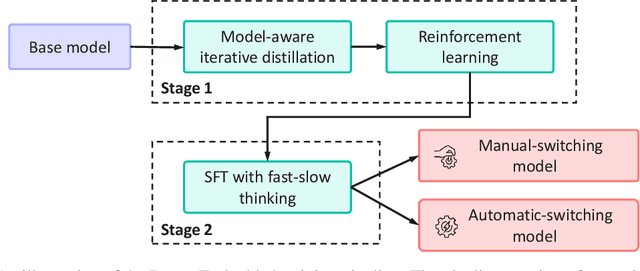
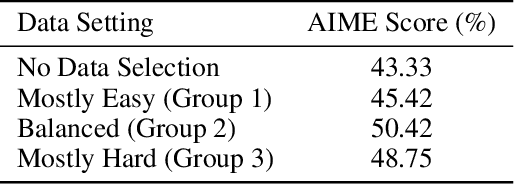
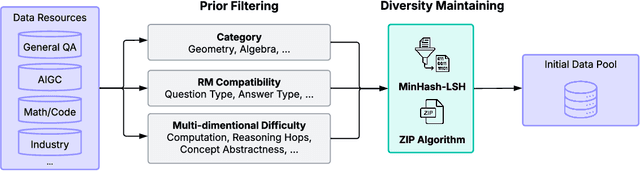
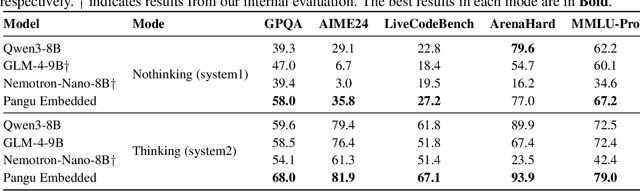
This work presents Pangu Embedded, an efficient Large Language Model (LLM) reasoner developed on Ascend Neural Processing Units (NPUs), featuring flexible fast and slow thinking capabilities. Pangu Embedded addresses the significant computational costs and inference latency challenges prevalent in existing reasoning-optimized LLMs. We propose a two-stage training framework for its construction. In Stage 1, the model is finetuned via an iterative distillation process, incorporating inter-iteration model merging to effectively aggregate complementary knowledge. This is followed by reinforcement learning on Ascend clusters, optimized by a latency-tolerant scheduler that combines stale synchronous parallelism with prioritized data queues. The RL process is guided by a Multi-source Adaptive Reward System (MARS), which generates dynamic, task-specific reward signals using deterministic metrics and lightweight LLM evaluators for mathematics, coding, and general problem-solving tasks. Stage 2 introduces a dual-system framework, endowing Pangu Embedded with a "fast" mode for routine queries and a deeper "slow" mode for complex inference. This framework offers both manual mode switching for user control and an automatic, complexity-aware mode selection mechanism that dynamically allocates computational resources to balance latency and reasoning depth. Experimental results on benchmarks including AIME 2024, GPQA, and LiveCodeBench demonstrate that Pangu Embedded with 7B parameters, outperforms similar-size models like Qwen3-8B and GLM4-9B. It delivers rapid responses and state-of-the-art reasoning quality within a single, unified model architecture, highlighting a promising direction for developing powerful yet practically deployable LLM reasoners.