 Add to Chrome
 Add to Firefox
 Add to Edge
Gleam: Adaptive Network-Efficient CUDA API Remoting for Cross-Device GPU Sharing over LANs
Jul 25, 2026
This paper aims to enable computation- and communication-efficient GPU sharing across devices within local area networks (LANs), facilitating ubiquitous AI inference on heterogeneous personal devices. We achieve distributed task offloading via CUDA API remoting. However, beyond raw computation, network constraints emerge as the primary bottleneck: limited bandwidth, high-frequency API invocations, and cross-task contention significantly hinder performance. To address these challenges, we propose Gleam, a novel and network-efficient framework for task-generic GPU sharing across local-area CUDA devices, with three key contributions. First, we reduce bandwidth overhead in CUDA API remoting through automatic model weight caching, and mitigate accumulated latency from frequent API calls by asynchronous execution. Second, we design a runtime task scheduler that dynamically determines API remoting pairs between LAN clients and servers, explicitly accounting for both network conditions and GPU resource contention under parallel workloads. Finally, we introduce dedicated mechanisms to ensure CUDA context consistency across distributed executions. Extensive experiments on heterogeneous NVIDIA GPUs and diverse AI workloads show Gleam consistently outperforms state-of-the-art baselines, achieving 1.4-24.2 times improvements in API remoting efficiency and up to 1.79 times higher system throughput.

Accelerating Distributed Deep Learning using Lossless Homomorphic Compression
Feb 12, 2024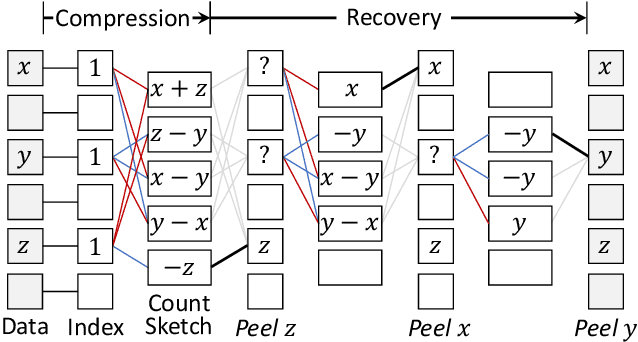

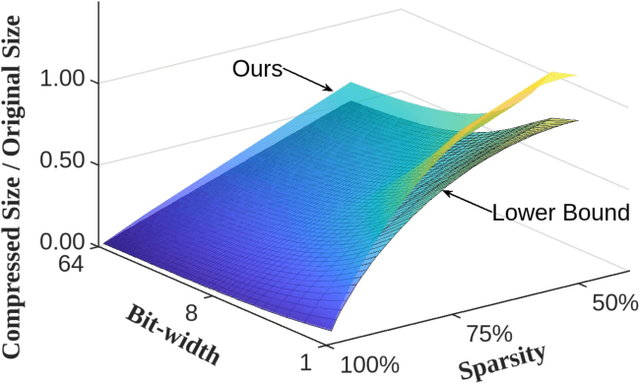
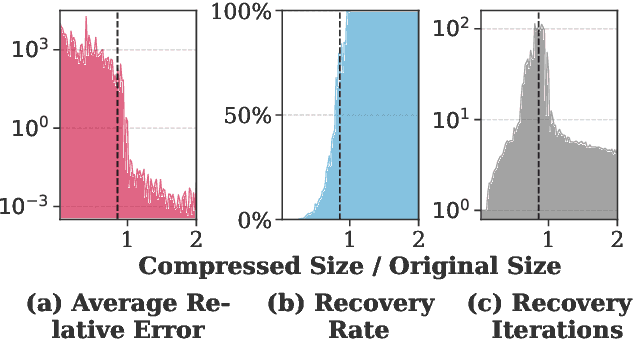
As deep neural networks (DNNs) grow in complexity and size, the resultant increase in communication overhead during distributed training has become a significant bottleneck, challenging the scalability of distributed training systems. Existing solutions, while aiming to mitigate this bottleneck through worker-level compression and in-network aggregation, fall short due to their inability to efficiently reconcile the trade-offs between compression effectiveness and computational overhead, hindering overall performance and scalability. In this paper, we introduce a novel compression algorithm that effectively merges worker-level compression with in-network aggregation. Our solution is both homomorphic, allowing for efficient in-network aggregation without CPU/GPU processing, and lossless, ensuring no compromise on training accuracy. Theoretically optimal in compression and computational efficiency, our approach is empirically validated across diverse DNN models such as NCF, LSTM, VGG19, and BERT-base, showing up to a 6.33$\times$ improvement in aggregation throughput and a 3.74$\times$ increase in per-iteration training speed.