 Add to Chrome
 Add to Firefox
 Add to Edge
EdgeNeRF: Edge-Guided Regularization for Neural Radiance Fields from Sparse Views
Jan 04, 2026
Neural Radiance Fields (NeRF) achieve remarkable performance in dense multi-view scenarios, but their reconstruction quality degrades significantly under sparse inputs due to geometric artifacts. Existing methods utilize global depth regularization to mitigate artifacts, leading to the loss of geometric boundary details. To address this problem, we propose EdgeNeRF, an edge-guided sparse-view 3D reconstruction algorithm. Our method leverages the prior that abrupt changes in depth and normals generate edges. Specifically, we first extract edges from input images, then apply depth and normal regularization constraints to non-edge regions, enhancing geometric consistency while preserving high-frequency details at boundaries. Experiments on LLFF and DTU datasets demonstrate EdgeNeRF's superior performance, particularly in retaining sharp geometric boundaries and suppressing artifacts. Additionally, the proposed edge-guided depth regularization module can be seamlessly integrated into other methods in a plug-and-play manner, significantly improving their performance without substantially increasing training time. Code is available at https://github.com/skyhigh404/edgenerf.

Graph-Guided Scene Reconstruction from Images with 3D Gaussian Splatting
Feb 24, 2025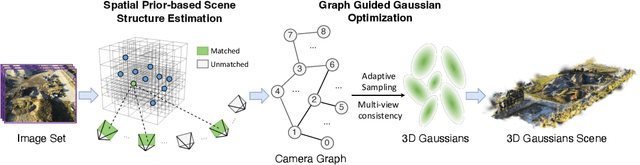
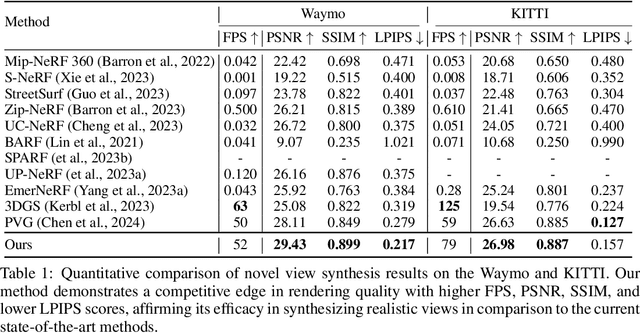
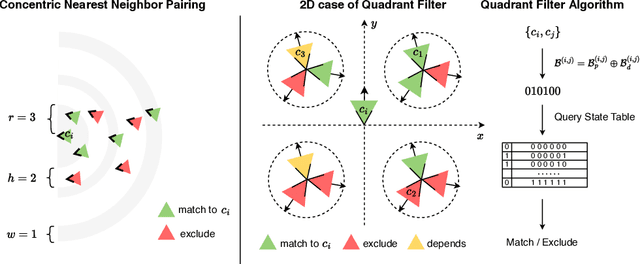

This paper investigates an open research challenge of reconstructing high-quality, large 3D open scenes from images. It is observed existing methods have various limitations, such as requiring precise camera poses for input and dense viewpoints for supervision. To perform effective and efficient 3D scene reconstruction, we propose a novel graph-guided 3D scene reconstruction framework, GraphGS. Specifically, given a set of images captured by RGB cameras on a scene, we first design a spatial prior-based scene structure estimation method. This is then used to create a camera graph that includes information about the camera topology. Further, we propose to apply the graph-guided multi-view consistency constraint and adaptive sampling strategy to the 3D Gaussian Splatting optimization process. This greatly alleviates the issue of Gaussian points overfitting to specific sparse viewpoints and expedites the 3D reconstruction process. We demonstrate GraphGS achieves high-fidelity 3D reconstruction from images, which presents state-of-the-art performance through quantitative and qualitative evaluation across multiple datasets. Project Page: https://3dagentworld.github.io/graphgs.
How to Evaluate the Generalization of Detection? A Benchmark for Comprehensive Open-Vocabulary Detection
Aug 25, 2023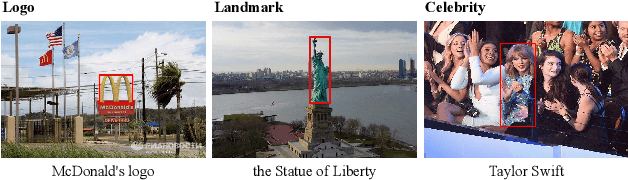
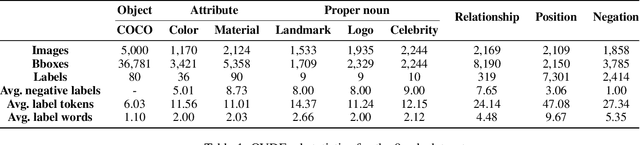
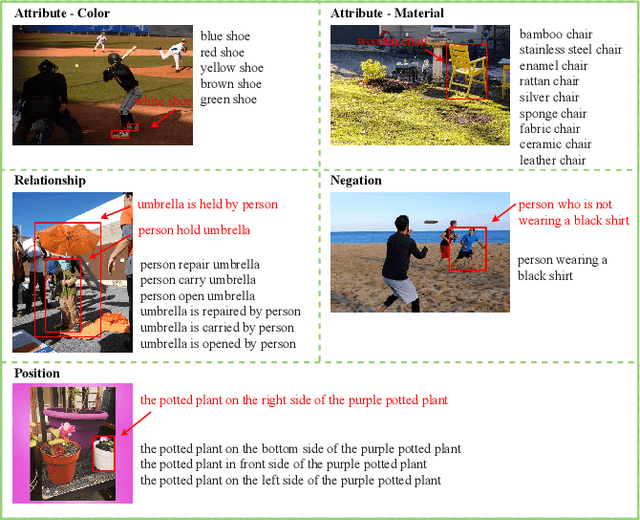

Object detection (OD) in computer vision has made significant progress in recent years, transitioning from closed-set labels to open-vocabulary detection (OVD) based on large-scale vision-language pre-training (VLP). However, current evaluation methods and datasets are limited to testing generalization over object types and referral expressions, which do not provide a systematic, fine-grained, and accurate benchmark of OVD models' abilities. In this paper, we propose a new benchmark named OVDEval, which includes 9 sub-tasks and introduces evaluations on commonsense knowledge, attribute understanding, position understanding, object relation comprehension, and more. The dataset is meticulously created to provide hard negatives that challenge models' true understanding of visual and linguistic input. Additionally, we identify a problem with the popular Average Precision (AP) metric when benchmarking models on these fine-grained label datasets and propose a new metric called Non-Maximum Suppression Average Precision (NMS-AP) to address this issue. Extensive experimental results show that existing top OVD models all fail on the new tasks except for simple object types, demonstrating the value of the proposed dataset in pinpointing the weakness of current OVD models and guiding future research. Furthermore, the proposed NMS-AP metric is verified by experiments to provide a much more truthful evaluation of OVD models, whereas traditional AP metrics yield deceptive results. Data is available at \url{https://github.com/om-ai-lab/OVDEval}