 Add to Chrome
 Add to Firefox
 Add to Edge
Help Me Identify: Is an LLM+VQA System All We Need to Identify Visual Concepts?
Oct 17, 2024


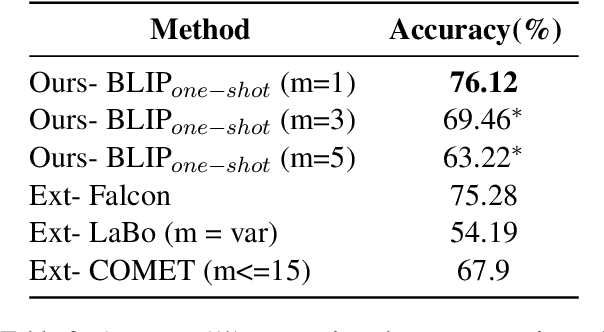
An ability to learn about new objects from a small amount of visual data and produce convincing linguistic justification about the presence/absence of certain concepts (that collectively compose the object) in novel scenarios is an important characteristic of human cognition. This is possible due to abstraction of attributes/properties that an object is composed of e.g. an object `bird' can be identified by the presence of a beak, feathers, legs, wings, etc. Inspired by this aspect of human reasoning, in this work, we present a zero-shot framework for fine-grained visual concept learning by leveraging large language model and Visual Question Answering (VQA) system. Specifically, we prompt GPT-3 to obtain a rich linguistic description of visual objects in the dataset. We convert the obtained concept descriptions into a set of binary questions. We pose these questions along with the query image to a VQA system and aggregate the answers to determine the presence or absence of an object in the test images. Our experiments demonstrate comparable performance with existing zero-shot visual classification methods and few-shot concept learning approaches, without substantial computational overhead, yet being fully explainable from the reasoning perspective.

VL-GLUE: A Suite of Fundamental yet Challenging Visuo-Linguistic Reasoning Tasks
Oct 17, 2024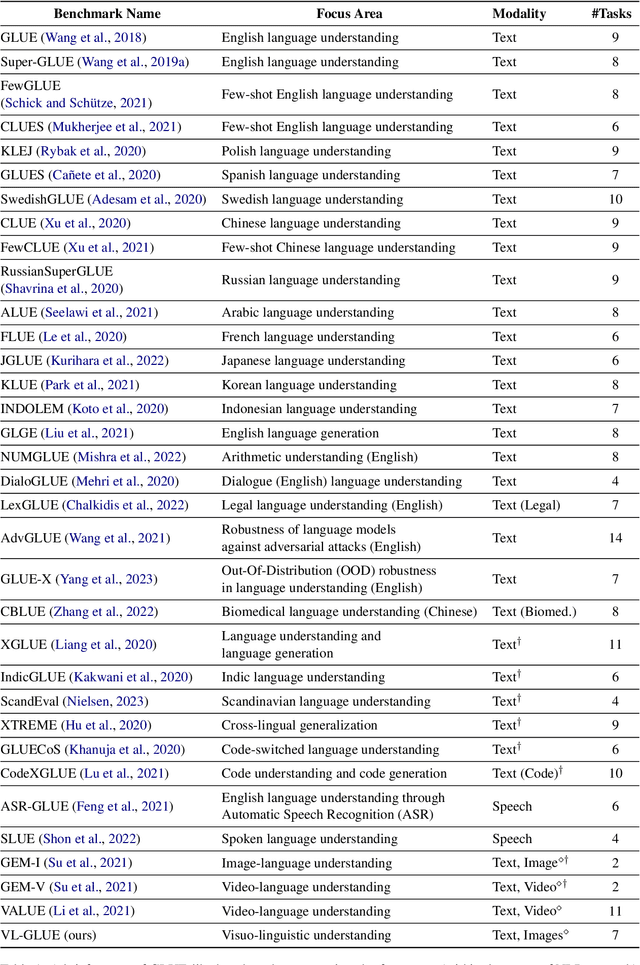


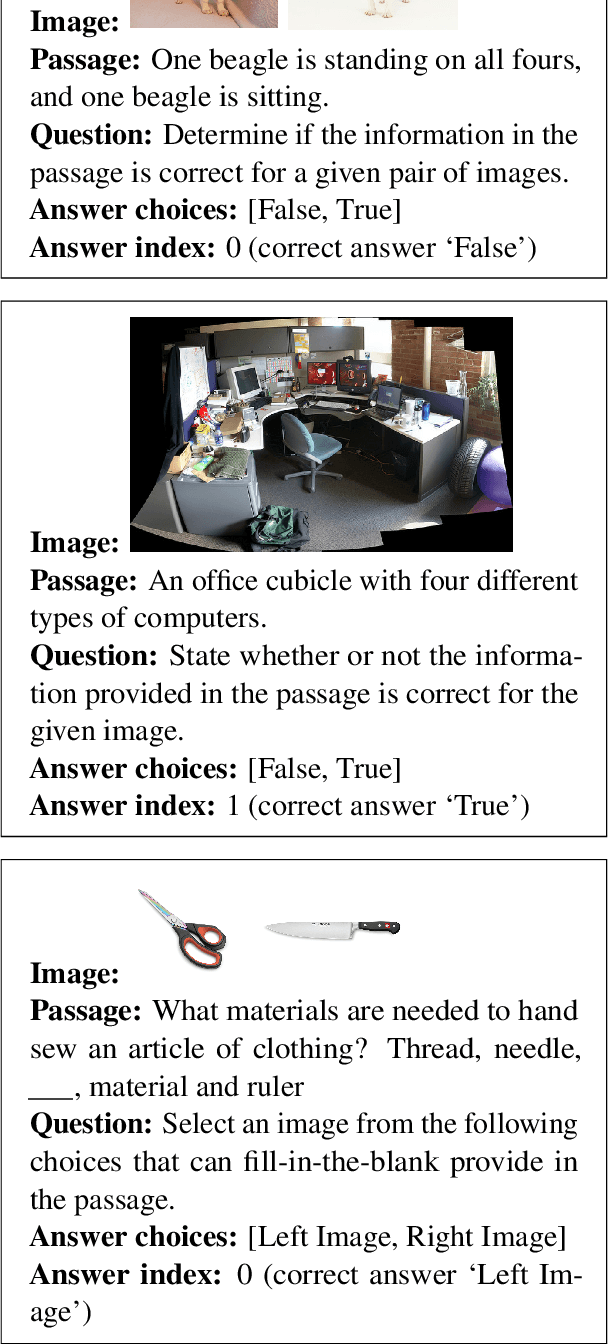
Deriving inference from heterogeneous inputs (such as images, text, and audio) is an important skill for humans to perform day-to-day tasks. A similar ability is desirable for the development of advanced Artificial Intelligence (AI) systems. While state-of-the-art models are rapidly closing the gap with human-level performance on diverse computer vision and NLP tasks separately, they struggle to solve tasks that require joint reasoning over visual and textual modalities. Inspired by GLUE (Wang et. al., 2018)- a multitask benchmark for natural language understanding, we propose VL-GLUE in this paper. VL-GLUE consists of over 100k samples spanned across seven different tasks, which at their core require visuo-linguistic reasoning. Moreover, our benchmark comprises of diverse image types (from synthetically rendered figures, and day-to-day scenes to charts and complex diagrams) and includes a broad variety of domain-specific text (from cooking, politics, and sports to high-school curricula), demonstrating the need for multi-modal understanding in the real-world. We show that this benchmark is quite challenging for existing large-scale vision-language models and encourage development of systems that possess robust visuo-linguistic reasoning capabilities.
REVISION: Rendering Tools Enable Spatial Fidelity in Vision-Language Models
Aug 05, 2024Text-to-Image (T2I) and multimodal large language models (MLLMs) have been adopted in solutions for several computer vision and multimodal learning tasks. However, it has been found that such vision-language models lack the ability to correctly reason over spatial relationships. To tackle this shortcoming, we develop the REVISION framework which improves spatial fidelity in vision-language models. REVISION is a 3D rendering based pipeline that generates spatially accurate synthetic images, given a textual prompt. REVISION is an extendable framework, which currently supports 100+ 3D assets, 11 spatial relationships, all with diverse camera perspectives and backgrounds. Leveraging images from REVISION as additional guidance in a training-free manner consistently improves the spatial consistency of T2I models across all spatial relationships, achieving competitive performance on the VISOR and T2I-CompBench benchmarks. We also design RevQA, a question-answering benchmark to evaluate the spatial reasoning abilities of MLLMs, and find that state-of-the-art models are not robust to complex spatial reasoning under adversarial settings. Our results and findings indicate that utilizing rendering-based frameworks is an effective approach for developing spatially-aware generative models.
Step-by-Step Reasoning to Solve Grid Puzzles: Where do LLMs Falter?
Jul 20, 2024Solving grid puzzles involves a significant amount of logical reasoning. Hence, it is a good domain to evaluate the reasoning capability of a model which can then guide us to improve the reasoning ability of models. However, most existing works evaluate only the final predicted answer of a puzzle, without delving into an in-depth analysis of the LLMs' reasoning chains (such as where they falter) or providing any finer metrics to evaluate them. Since LLMs may rely on simple heuristics or artifacts to predict the final answer, it is crucial to evaluate the generated reasoning chain beyond overall correctness measures, for accurately evaluating the reasoning abilities of LLMs. To this end, we first develop GridPuzzle, an evaluation dataset comprising 274 grid-based puzzles with different complexities. Second, we propose a new error taxonomy derived from manual analysis of reasoning chains from LLMs including GPT-4, Claude-3, Gemini, Mistral, and Llama-2. Then, we develop an LLM-based framework for large-scale subjective evaluation (i.e., identifying errors) and an objective metric, PuzzleEval, to evaluate the correctness of reasoning chains. Evaluating reasoning chains from LLMs leads to several interesting findings. We further show that existing prompting methods used for enhancing models' reasoning abilities do not improve performance on GridPuzzle. This highlights the importance of understanding fine-grained errors and presents a challenge for future research to enhance LLMs' puzzle-solving abilities by developing methods that address these errors. Data and source code are available at https://github.com/Mihir3009/GridPuzzle.
UnSeenTimeQA: Time-Sensitive Question-Answering Beyond LLMs' Memorization
Jul 03, 2024


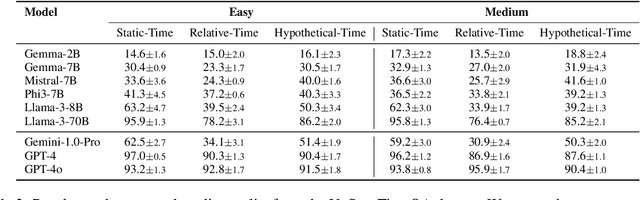
This paper introduces UnSeenTimeQA, a novel time-sensitive question-answering (TSQA) benchmark that diverges from traditional TSQA benchmarks by avoiding factual and web-searchable queries. We present a series of time-sensitive event scenarios decoupled from real-world factual information. It requires large language models (LLMs) to engage in genuine temporal reasoning, disassociating from the knowledge acquired during the pre-training phase. Our evaluation of six open-source LLMs (ranging from 2B to 70B in size) and three closed-source LLMs reveal that the questions from the UnSeenTimeQA present substantial challenges. This indicates the models' difficulties in handling complex temporal reasoning scenarios. Additionally, we present several analyses shedding light on the models' performance in answering time-sensitive questions.
Multi-LogiEval: Towards Evaluating Multi-Step Logical Reasoning Ability of Large Language Models
Jun 24, 2024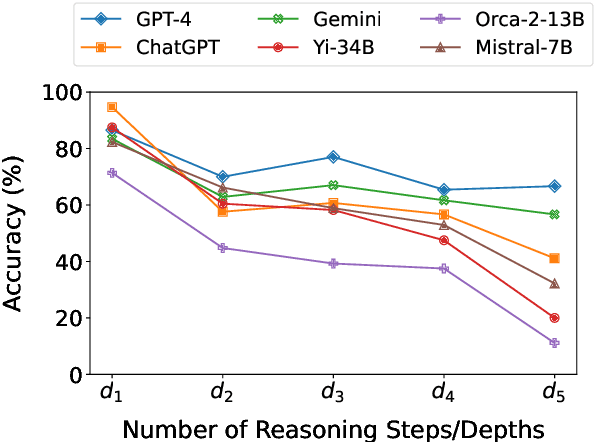
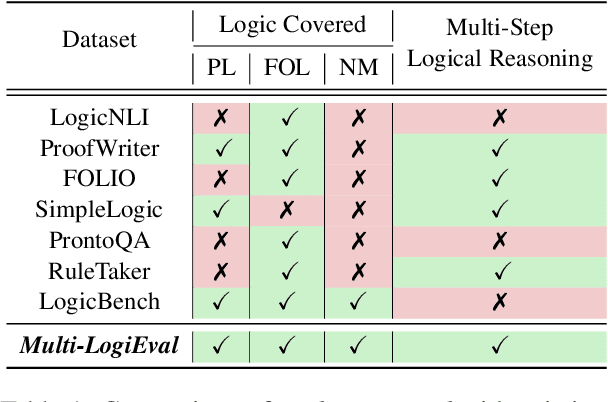
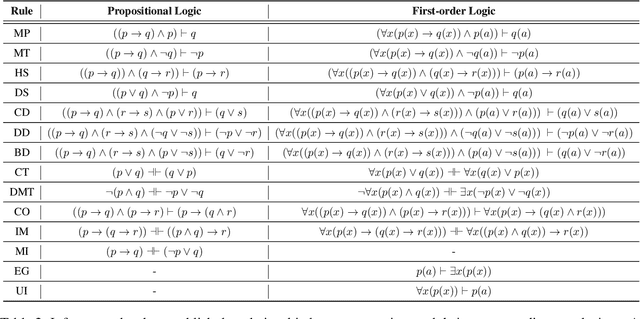
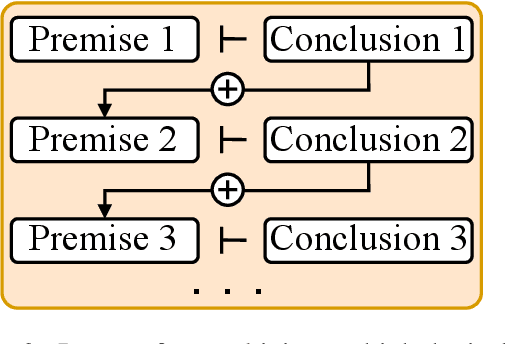
As Large Language Models (LLMs) continue to exhibit remarkable performance in natural language understanding tasks, there is a crucial need to measure their ability for human-like multi-step logical reasoning. Existing logical reasoning evaluation benchmarks often focus primarily on simplistic single-step or multi-step reasoning with a limited set of inference rules. Furthermore, the lack of datasets for evaluating non-monotonic reasoning represents a crucial gap since it aligns more closely with human-like reasoning. To address these limitations, we propose Multi-LogiEval, a comprehensive evaluation dataset encompassing multi-step logical reasoning with various inference rules and depths. Multi-LogiEval covers three logic types--propositional, first-order, and non-monotonic--consisting of more than 30 inference rules and more than 60 of their combinations with various depths. Leveraging this dataset, we conduct evaluations on a range of LLMs including GPT-4, ChatGPT, Gemini-Pro, Yi, Orca, and Mistral, employing a zero-shot chain-of-thought. Experimental results show that there is a significant drop in the performance of LLMs as the reasoning steps/depth increases (average accuracy of ~68% at depth-1 to ~43% at depth-5). We further conduct a thorough investigation of reasoning chains generated by LLMs which reveals several important findings. We believe that Multi-LogiEval facilitates future research for evaluating and enhancing the logical reasoning ability of LLMs. Data is available at https://github.com/Mihir3009/Multi-LogiEval.
Investigating and Addressing Hallucinations of LLMs in Tasks Involving Negation
Jun 08, 2024Large Language Models (LLMs) have achieved remarkable performance across a wide variety of natural language tasks. However, they have been shown to suffer from a critical limitation pertinent to 'hallucination' in their output. Recent research has focused on investigating and addressing this problem for a variety of tasks such as biography generation, question answering, abstractive summarization, and dialogue generation. However, the crucial aspect pertaining to 'negation' has remained considerably underexplored. Negation is important because it adds depth and nuance to the understanding of language and is also crucial for logical reasoning and inference. In this work, we address the above limitation and particularly focus on studying the impact of negation in LLM hallucinations. Specifically, we study four tasks with negation: 'false premise completion', 'constrained fact generation', 'multiple choice question answering', and 'fact generation'. We show that open-source state-of-the-art LLMs such as LLaMA-2-chat, Vicuna, and Orca-2 hallucinate considerably on all these tasks involving negation which underlines a critical shortcoming of these models. Addressing this problem, we further study numerous strategies to mitigate these hallucinations and demonstrate their impact.
Chaos with Keywords: Exposing Large Language Models Sycophancy to Misleading Keywords and Evaluating Defense Strategies
Jun 06, 2024This study explores the sycophantic tendencies of Large Language Models (LLMs), where these models tend to provide answers that match what users want to hear, even if they are not entirely correct. The motivation behind this exploration stems from the common behavior observed in individuals searching the internet for facts with partial or misleading knowledge. Similar to using web search engines, users may recall fragments of misleading keywords and submit them to an LLM, hoping for a comprehensive response. Our empirical analysis of several LLMs shows the potential danger of these models amplifying misinformation when presented with misleading keywords. Additionally, we thoroughly assess four existing hallucination mitigation strategies to reduce LLMs sycophantic behavior. Our experiments demonstrate the effectiveness of these strategies for generating factually correct statements. Furthermore, our analyses delve into knowledge-probing experiments on factual keywords and different categories of sycophancy mitigation.
ActionReasoningBench: Reasoning about Actions with and without Ramification Constraints
Jun 06, 2024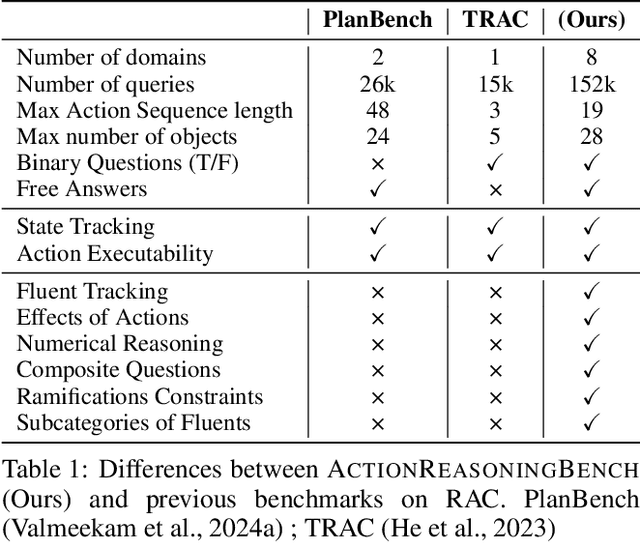
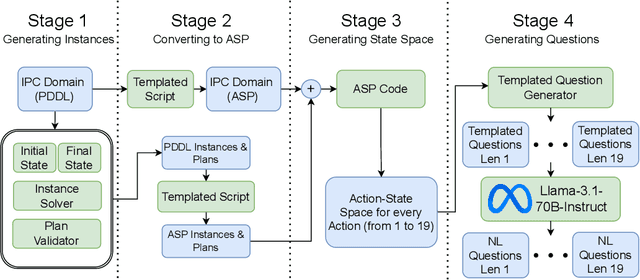
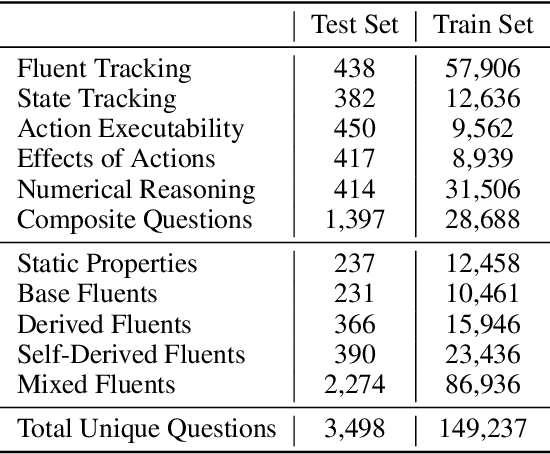
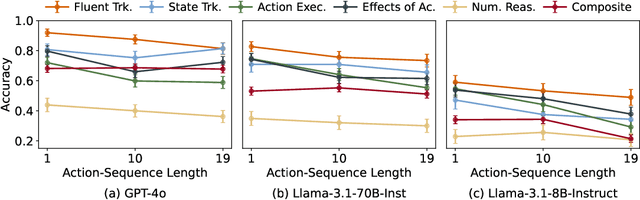
Reasoning about actions and change (RAC) has historically driven the development of many early AI challenges, such as the frame problem, and many AI disciplines, including non-monotonic and commonsense reasoning. The role of RAC remains important even now, particularly for tasks involving dynamic environments, interactive scenarios, and commonsense reasoning. Despite the progress of Large Language Models (LLMs) in various AI domains, their performance on RAC is underexplored. To address this gap, we introduce a new benchmark, ActionReasoningBench, encompassing 13 domains and rigorously evaluating LLMs across eight different areas of RAC. These include - Object Tracking, Fluent Tracking, State Tracking, Action Executability, Effects of Actions, Numerical RAC, Hallucination Detection, and Composite Questions. Furthermore, we also investigate the indirect effect of actions due to ramification constraints for every domain. Finally, we evaluate our benchmark using open-sourced and commercial state-of-the-art LLMs, including GPT-4o, Gemini-1.0-Pro, Llama2-7b-chat, Llama2-13b-chat, Llama3-8b-instruct, Gemma-2b-instruct, and Gemma-7b-instruct. Our findings indicate that these models face significant challenges across all categories included in our benchmark.
Triple Preference Optimization: Achieving Better Alignment with Less Data in a Single Step Optimization
May 26, 2024
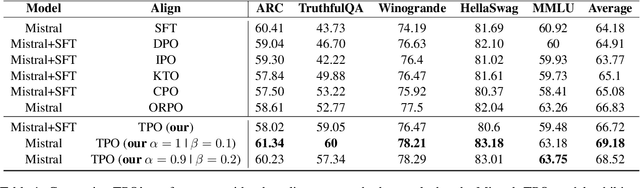
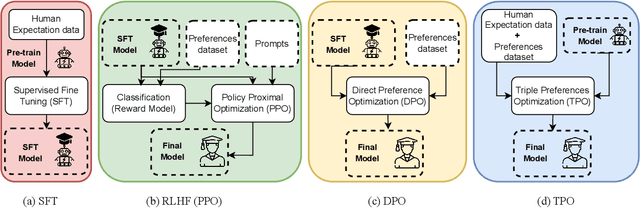

Large Language Models (LLMs) perform well across diverse tasks, but aligning them with human demonstrations is challenging. Recently, Reinforcement Learning (RL)-free methods like Direct Preference Optimization (DPO) have emerged, offering improved stability and scalability while retaining competitive performance relative to RL-based methods. However, while RL-free methods deliver satisfactory performance, they require significant data to develop a robust Supervised Fine-Tuned (SFT) model and an additional step to fine-tune this model on a preference dataset, which constrains their utility and scalability. In this paper, we introduce Triple Preference Optimization (TPO), a new preference learning method designed to align an LLM with three preferences without requiring a separate SFT step and using considerably less data. Through a combination of practical experiments and theoretical analysis, we show the efficacy of TPO as a single-step alignment strategy. Specifically, we fine-tuned the Phi-2 (2.7B) and Mistral (7B) models using TPO directly on the UltraFeedback dataset, achieving superior results compared to models aligned through other methods such as SFT, DPO, KTO, IPO, CPO, and ORPO. Moreover, the performance of TPO without the SFT component led to notable improvements in the MT-Bench score, with increases of +1.27 and +0.63 over SFT and DPO, respectively. Additionally, TPO showed higher average accuracy, surpassing DPO and SFT by 4.2% and 4.97% on the Open LLM Leaderboard benchmarks. Our code is publicly available at https://github.com/sahsaeedi/triple-preference-optimization .