 Add to Chrome
 Add to Firefox
 Add to Edge
Minds on the Move: Decoding Trajectory Prediction in Autonomous Driving with Cognitive Insights
Feb 27, 2025
In mixed autonomous driving environments, accurately predicting the future trajectories of surrounding vehicles is crucial for the safe operation of autonomous vehicles (AVs). In driving scenarios, a vehicle's trajectory is determined by the decision-making process of human drivers. However, existing models primarily focus on the inherent statistical patterns in the data, often neglecting the critical aspect of understanding the decision-making processes of human drivers. This oversight results in models that fail to capture the true intentions of human drivers, leading to suboptimal performance in long-term trajectory prediction. To address this limitation, we introduce a Cognitive-Informed Transformer (CITF) that incorporates a cognitive concept, Perceived Safety, to interpret drivers' decision-making mechanisms. Perceived Safety encapsulates the varying risk tolerances across drivers with different driving behaviors. Specifically, we develop a Perceived Safety-aware Module that includes a Quantitative Safety Assessment for measuring the subject risk levels within scenarios, and Driver Behavior Profiling for characterizing driver behaviors. Furthermore, we present a novel module, Leanformer, designed to capture social interactions among vehicles. CITF demonstrates significant performance improvements on three well-established datasets. In terms of long-term prediction, it surpasses existing benchmarks by 12.0% on the NGSIM, 28.2% on the HighD, and 20.8% on the MoCAD dataset. Additionally, its robustness in scenarios with limited or missing data is evident, surpassing most state-of-the-art (SOTA) baselines, and paving the way for real-world applications.

Scaling Laws for Floating Point Quantization Training
Jan 05, 2025


Low-precision training is considered an effective strategy for reducing both training and downstream inference costs. Previous scaling laws for precision mainly focus on integer quantization, which pay less attention to the constituents in floating-point quantization and thus cannot well fit the LLM losses in this scenario. In contrast, while floating-point quantization training is more commonly implemented in production, the research on it has been relatively superficial. In this paper, we thoroughly explore the effects of floating-point quantization targets, exponent bits, mantissa bits, and the calculation granularity of the scaling factor in floating-point quantization training performance of LLM models. While presenting an accurate floating-point quantization unified scaling law, we also provide valuable suggestions for the community: (1) Exponent bits contribute slightly more to the model performance than mantissa bits. We provide the optimal exponent-mantissa bit ratio for different bit numbers, which is available for future reference by hardware manufacturers; (2) We discover the formation of the critical data size in low-precision LLM training. Too much training data exceeding the critical data size will inversely bring in degradation of LLM performance; (3) The optimal floating-point quantization precision is directly proportional to the computational power, but within a wide computational power range, we estimate that the best cost-performance precision lies between 4-8 bits.
TSceneJAL: Joint Active Learning of Traffic Scenes for 3D Object Detection
Dec 25, 2024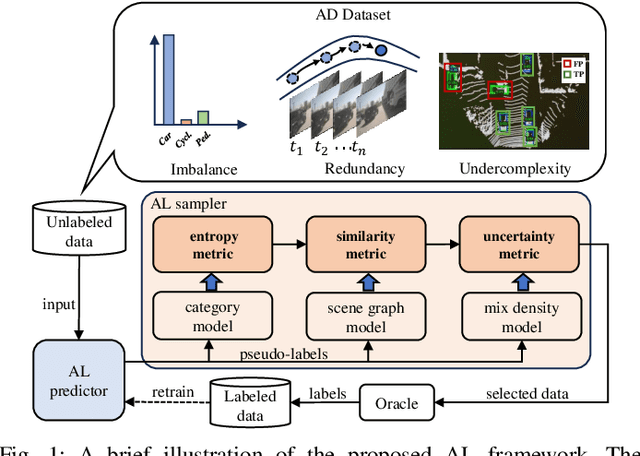
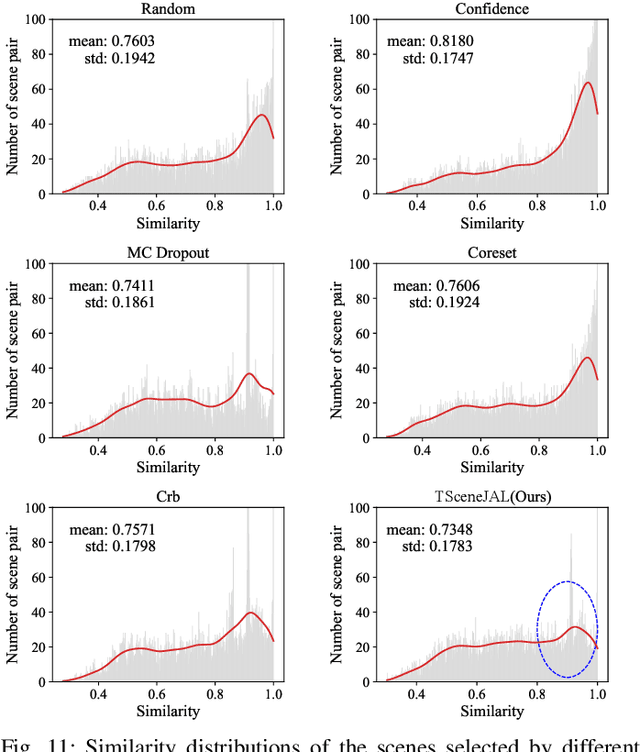
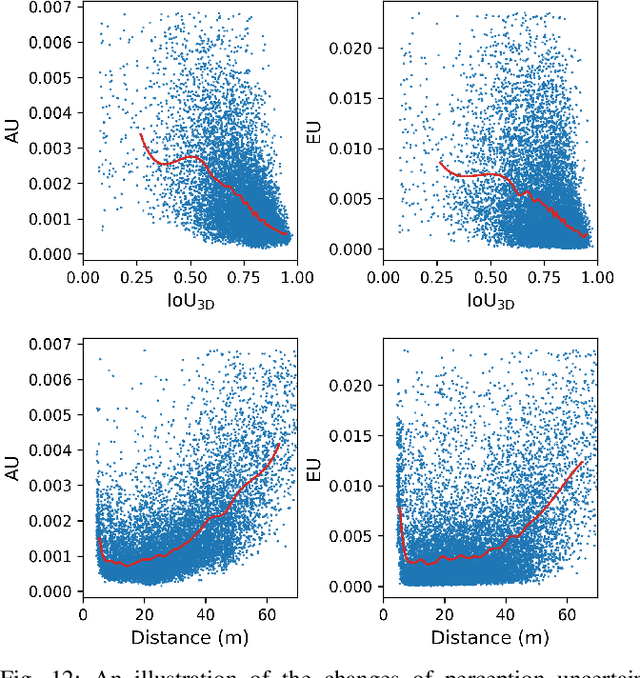
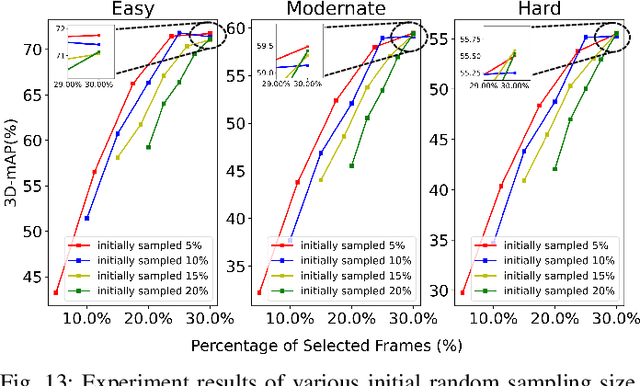
Most autonomous driving (AD) datasets incur substantial costs for collection and labeling, inevitably yielding a plethora of low-quality and redundant data instances, thereby compromising performance and efficiency. Many applications in AD systems necessitate high-quality training datasets using both existing datasets and newly collected data. In this paper, we propose a traffic scene joint active learning (TSceneJAL) framework that can efficiently sample the balanced, diverse, and complex traffic scenes from both labeled and unlabeled data. The novelty of this framework is threefold: 1) a scene sampling scheme based on a category entropy, to identify scenes containing multiple object classes, thus mitigating class imbalance for the active learner; 2) a similarity sampling scheme, estimated through the directed graph representation and a marginalize kernel algorithm, to pick sparse and diverse scenes; 3) an uncertainty sampling scheme, predicted by a mixture density network, to select instances with the most unclear or complex regression outcomes for the learner. Finally, the integration of these three schemes in a joint selection strategy yields an optimal and valuable subdataset. Experiments on the KITTI, Lyft, nuScenes and SUScape datasets demonstrate that our approach outperforms existing state-of-the-art methods on 3D object detection tasks with up to 12% improvements.
Clutter Resilient Occlusion Avoidance for Tightly-Coupled Motion-Assisted Detection
Dec 24, 2024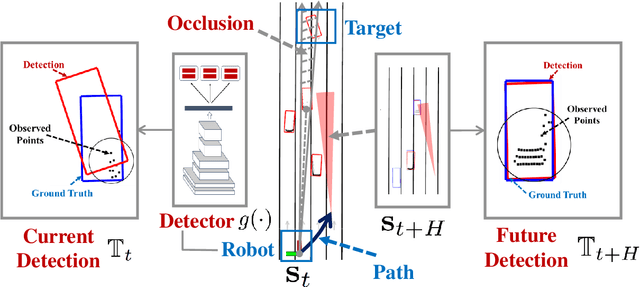
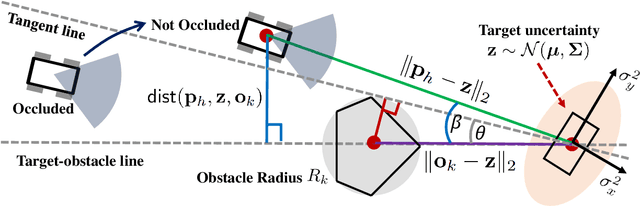
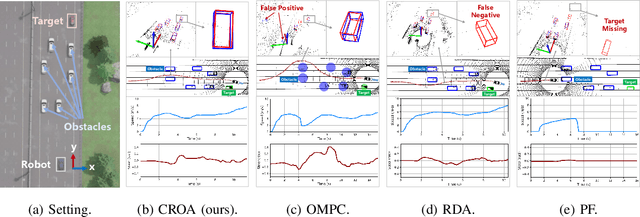
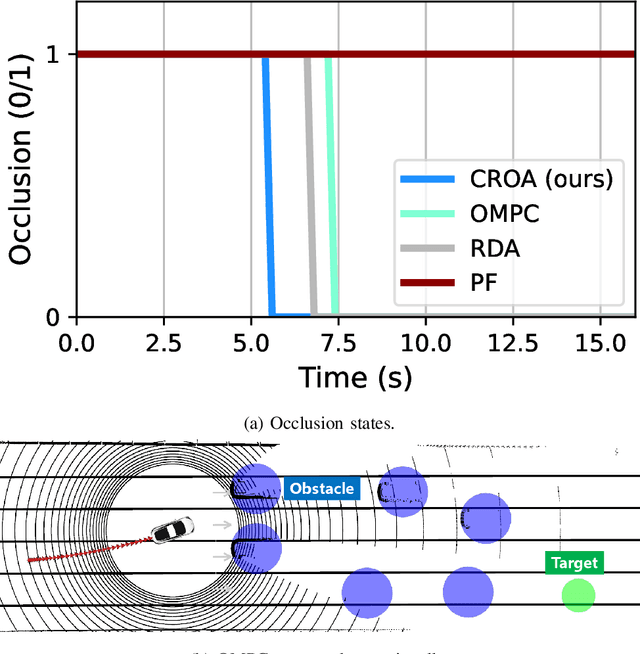
Occlusion is a key factor leading to detection failures. This paper proposes a motion-assisted detection (MAD) method that actively plans an executable path, for the robot to observe the target at a new viewpoint with potentially reduced occlusion. In contrast to existing MAD approaches that may fail in cluttered environments, the proposed framework is robust in such scenarios, therefore termed clutter resilient occlusion avoidance (CROA). The crux to CROA is to minimize the occlusion probability under polyhedron-based collision avoidance constraints via the convex-concave procedure and duality-based bilevel optimization. The system implementation supports lidar-based MAD with intertwined execution of learning-based detection and optimization-based planning. Experiments show that CROA outperforms various MAD schemes under a sparse convolutional neural network detector, in terms of point density, occlusion ratio, and detection error, in a multi-lane urban driving scenario.
NEST: A Neuromodulated Small-world Hypergraph Trajectory Prediction Model for Autonomous Driving
Dec 16, 2024Accurate trajectory prediction is essential for the safety and efficiency of autonomous driving. Traditional models often struggle with real-time processing, capturing non-linearity and uncertainty in traffic environments, efficiency in dense traffic, and modeling temporal dynamics of interactions. We introduce NEST (Neuromodulated Small-world Hypergraph Trajectory Prediction), a novel framework that integrates Small-world Networks and hypergraphs for superior interaction modeling and prediction accuracy. This integration enables the capture of both local and extended vehicle interactions, while the Neuromodulator component adapts dynamically to changing traffic conditions. We validate the NEST model on several real-world datasets, including nuScenes, MoCAD, and HighD. The results consistently demonstrate that NEST outperforms existing methods in various traffic scenarios, showcasing its exceptional generalization capability, efficiency, and temporal foresight. Our comprehensive evaluation illustrates that NEST significantly improves the reliability and operational efficiency of autonomous driving systems, making it a robust solution for trajectory prediction in complex traffic environments.
Hunyuan-Large: An Open-Source MoE Model with 52 Billion Activated Parameters by Tencent
Nov 05, 2024


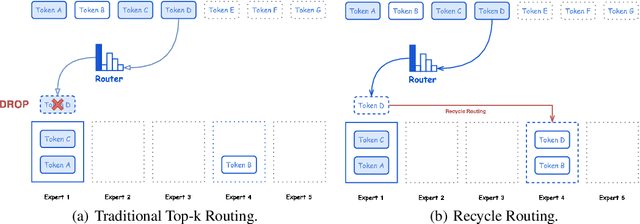
In this paper, we introduce Hunyuan-Large, which is currently the largest open-source Transformer-based mixture of experts model, with a total of 389 billion parameters and 52 billion activation parameters, capable of handling up to 256K tokens. We conduct a thorough evaluation of Hunyuan-Large's superior performance across various benchmarks including language understanding and generation, logical reasoning, mathematical problem-solving, coding, long-context, and aggregated tasks, where it outperforms LLama3.1-70B and exhibits comparable performance when compared to the significantly larger LLama3.1-405B model. Key practice of Hunyuan-Large include large-scale synthetic data that is orders larger than in previous literature, a mixed expert routing strategy, a key-value cache compression technique, and an expert-specific learning rate strategy. Additionally, we also investigate the scaling laws and learning rate schedule of mixture of experts models, providing valuable insights and guidances for future model development and optimization. The code and checkpoints of Hunyuan-Large are released to facilitate future innovations and applications. Codes: https://github.com/Tencent/Hunyuan-Large Models: https://huggingface.co/tencent/Tencent-Hunyuan-Large
Multi-Uncertainty Aware Autonomous Cooperative Planning
Nov 01, 2024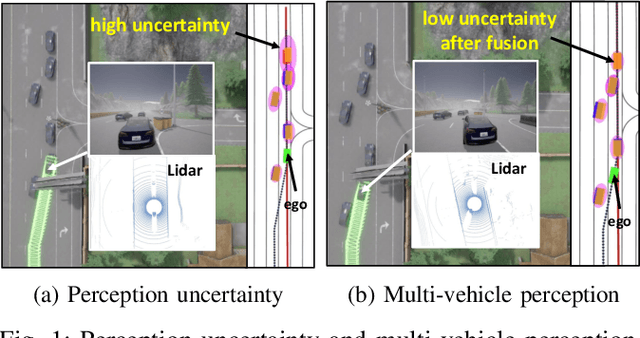
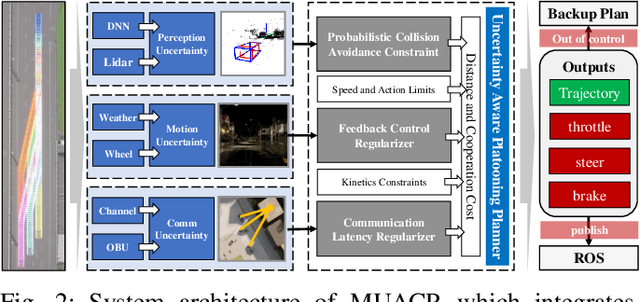
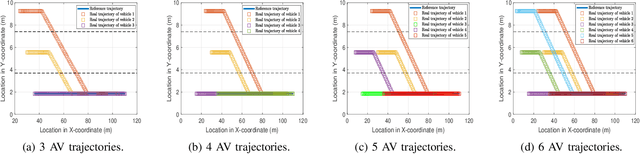
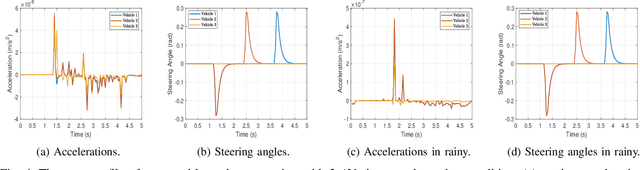
Autonomous cooperative planning (ACP) is a promising technique to improve the efficiency and safety of multi-vehicle interactions for future intelligent transportation systems. However, realizing robust ACP is a challenge due to the aggregation of perception, motion, and communication uncertainties. This paper proposes a novel multi-uncertainty aware ACP (MUACP) framework that simultaneously accounts for multiple types of uncertainties via regularized cooperative model predictive control (RC-MPC). The regularizers and constraints for perception, motion, and communication are constructed according to the confidence levels, weather conditions, and outage probabilities, respectively. The effectiveness of the proposed method is evaluated in the Car Learning to Act (CARLA) simulation platform. Results demonstrate that the proposed MUACP efficiently performs cooperative formation in real time and outperforms other benchmark approaches in various scenarios under imperfect knowledge of the environment.
Real-time Accident Anticipation for Autonomous Driving Through Monocular Depth-Enhanced 3D Modeling
Sep 02, 2024


The primary goal of traffic accident anticipation is to foresee potential accidents in real time using dashcam videos, a task that is pivotal for enhancing the safety and reliability of autonomous driving technologies. In this study, we introduce an innovative framework, AccNet, which significantly advances the prediction capabilities beyond the current state-of-the-art (SOTA) 2D-based methods by incorporating monocular depth cues for sophisticated 3D scene modeling. Addressing the prevalent challenge of skewed data distribution in traffic accident datasets, we propose the Binary Adaptive Loss for Early Anticipation (BA-LEA). This novel loss function, together with a multi-task learning strategy, shifts the focus of the predictive model towards the critical moments preceding an accident. {We rigorously evaluate the performance of our framework on three benchmark datasets--Dashcam Accident Dataset (DAD), Car Crash Dataset (CCD), and AnAn Accident Detection (A3D), and DADA-2000 Dataset--demonstrating its superior predictive accuracy through key metrics such as Average Precision (AP) and mean Time-To-Accident (mTTA).
When, Where, and What? A Novel Benchmark for Accident Anticipation and Localization with Large Language Models
Jul 26, 2024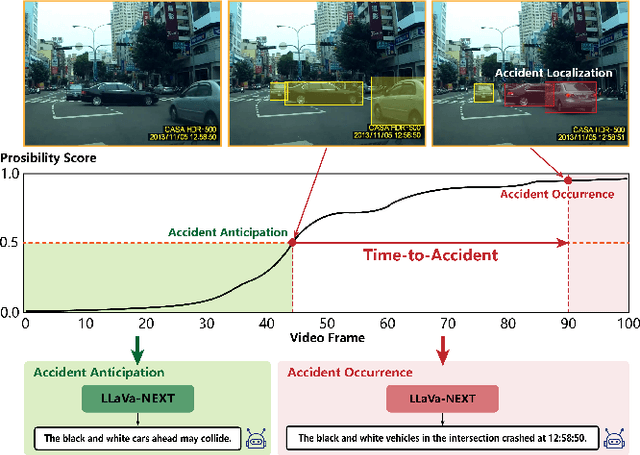
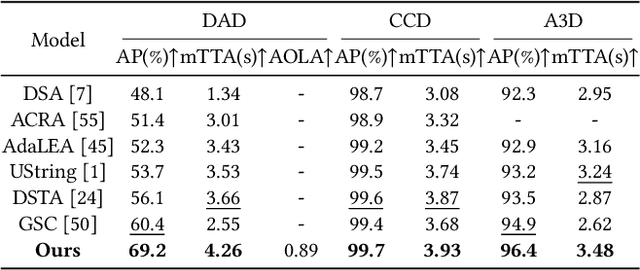
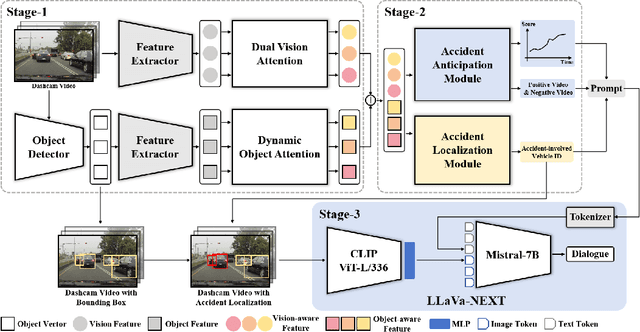
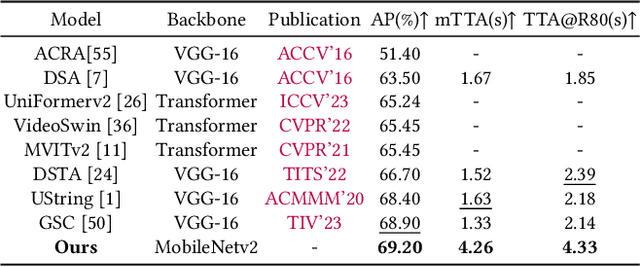
As autonomous driving systems increasingly become part of daily transportation, the ability to accurately anticipate and mitigate potential traffic accidents is paramount. Traditional accident anticipation models primarily utilizing dashcam videos are adept at predicting when an accident may occur but fall short in localizing the incident and identifying involved entities. Addressing this gap, this study introduces a novel framework that integrates Large Language Models (LLMs) to enhance predictive capabilities across multiple dimensions--what, when, and where accidents might occur. We develop an innovative chain-based attention mechanism that dynamically adjusts to prioritize high-risk elements within complex driving scenes. This mechanism is complemented by a three-stage model that processes outputs from smaller models into detailed multimodal inputs for LLMs, thus enabling a more nuanced understanding of traffic dynamics. Empirical validation on the DAD, CCD, and A3D datasets demonstrates superior performance in Average Precision (AP) and Mean Time-To-Accident (mTTA), establishing new benchmarks for accident prediction technology. Our approach not only advances the technological framework for autonomous driving safety but also enhances human-AI interaction, making predictive insights generated by autonomous systems more intuitive and actionable.
CRASH: Crash Recognition and Anticipation System Harnessing with Context-Aware and Temporal Focus Attentions
Jul 25, 2024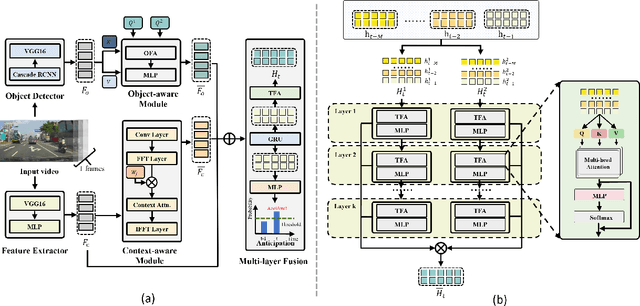
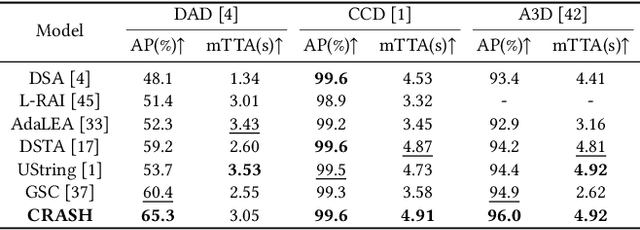

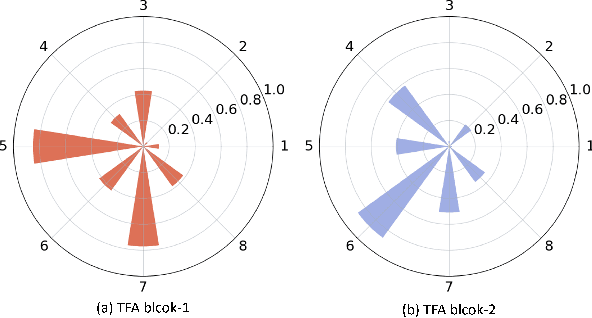
Accurately and promptly predicting accidents among surrounding traffic agents from camera footage is crucial for the safety of autonomous vehicles (AVs). This task presents substantial challenges stemming from the unpredictable nature of traffic accidents, their long-tail distribution, the intricacies of traffic scene dynamics, and the inherently constrained field of vision of onboard cameras. To address these challenges, this study introduces a novel accident anticipation framework for AVs, termed CRASH. It seamlessly integrates five components: object detector, feature extractor, object-aware module, context-aware module, and multi-layer fusion. Specifically, we develop the object-aware module to prioritize high-risk objects in complex and ambiguous environments by calculating the spatial-temporal relationships between traffic agents. In parallel, the context-aware is also devised to extend global visual information from the temporal to the frequency domain using the Fast Fourier Transform (FFT) and capture fine-grained visual features of potential objects and broader context cues within traffic scenes. To capture a wider range of visual cues, we further propose a multi-layer fusion that dynamically computes the temporal dependencies between different scenes and iteratively updates the correlations between different visual features for accurate and timely accident prediction. Evaluated on real-world datasets--Dashcam Accident Dataset (DAD), Car Crash Dataset (CCD), and AnAn Accident Detection (A3D) datasets--our model surpasses existing top baselines in critical evaluation metrics like Average Precision (AP) and mean Time-To-Accident (mTTA). Importantly, its robustness and adaptability are particularly evident in challenging driving scenarios with missing or limited training data, demonstrating significant potential for application in real-world autonomous driving systems.