 Add to Chrome
 Add to Firefox
 Add to Edge
Theoretically Optimal Attention/FFN Ratios in Disaggregated LLM Serving
Jan 29, 2026
Attention-FFN disaggregation (AFD) is an emerging architecture for LLM decoding that separates state-heavy, KV-cache-dominated Attention computation from stateless, compute-intensive FFN computation, connected by per-step communication. While AFD enables independent scaling of memory and compute resources, its performance is highly sensitive to the Attention/FFN provisioning ratio: mis-sizing induces step-level blocking and costly device idle time. We develop a tractable analytical framework for sizing AFD bundles in an $r$A-$1$F topology, where the key difficulty is that Attention-side work is nonstationary-token context grows and requests are continuously replenished with random lengths-while FFN work is stable given the aggregated batch. Using a probabilistic workload model, we derive closed-form rules for the optimal A/F ratio that maximize average throughput per instance across the system. A trace-calibrated AFD simulator validates the theory: across workloads, the theoretical optimal A/F ratio matches the simulation-optimal within 10%, and consistently reduces idle time.

A Universal Load Balancing Principle and Its Application to Large Language Model Serving
Jan 25, 2026Load balancing-the allocation of work across parallel resources to reduce delay, energy and cost-is a pervasive challenge in science and engineering, from large-scale simulation and data processing to cloud and manufacturing operations. Motivated by the emerging bottleneck in large language model (LLM) serving, we study a particularly stringent regime of load balancing that arises in barrier-synchronized, stateful systems: work cannot be freely migrated and progress is gated by the slowest participant at each step, so heterogeneity and temporal drift in workloads create persistent stragglers and substantial idle time. LLM serving under data-parallel decoding provides a prominent modern instance: in production traces, barrier-induced idle can exceed 40% of compute time per decode step. Here we develop a universal load-balancing principle, which admits a step-wise finite-horizon integer-optimization formulation and yields worst-case guarantees: across LLM decode models and a broader class of non-decreasing workload drift processes, it reduces long-run imbalance by a factor that grows with batch size and system scale. Extensive experiments corroborate the theory, showing substantial improvements in throughput and latency together with reductions in energy consumption. These results provide a general, theoretically grounded framework for load balancing, with immediate implications for sustainable LLM serving and broad relevance to other synchronization-gated resource-allocation problems.
LeanGeo: Formalizing Competitional Geometry problems in Lean
Aug 20, 2025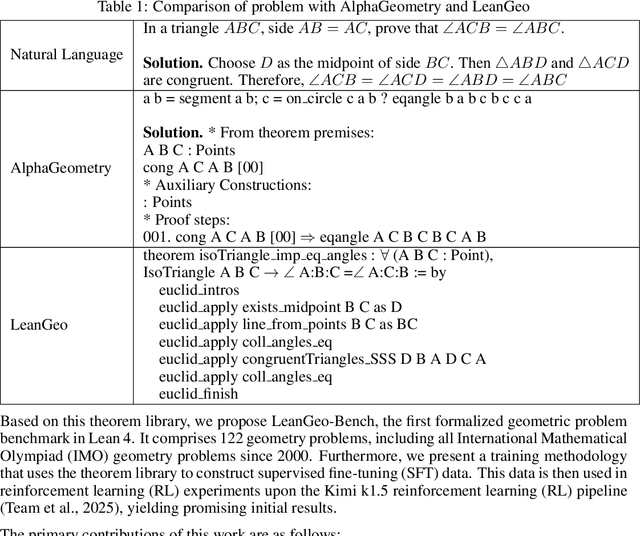
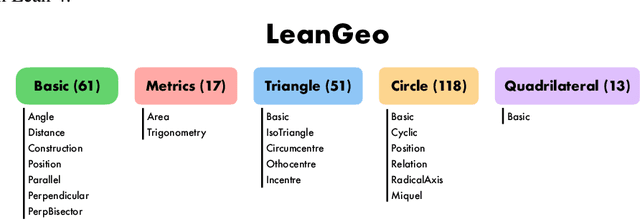
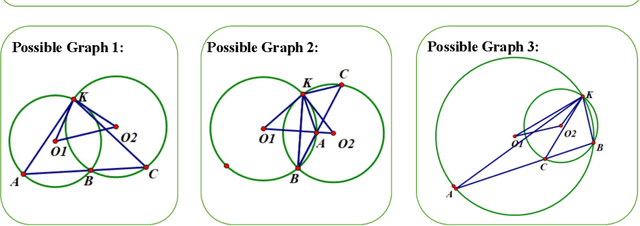
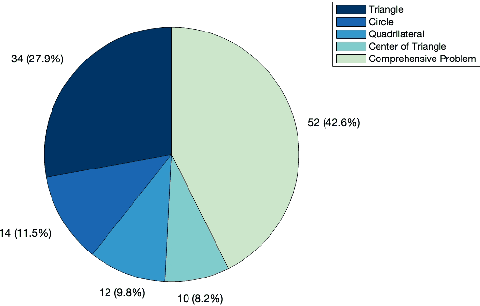
Geometry problems are a crucial testbed for AI reasoning capabilities. Most existing geometry solving systems cannot express problems within a unified framework, thus are difficult to integrate with other mathematical fields. Besides, since most geometric proofs rely on intuitive diagrams, verifying geometry problems is particularly challenging. To address these gaps, we introduce LeanGeo, a unified formal system for formalizing and solving competition-level geometry problems within the Lean 4 theorem prover. LeanGeo features a comprehensive library of high-level geometric theorems with Lean's foundational logic, enabling rigorous proof verification and seamless integration with Mathlib. We also present LeanGeo-Bench, a formal geometry benchmark in LeanGeo, comprising problems from the International Mathematical Olympiad (IMO) and other advanced sources. Our evaluation demonstrates the capabilities and limitations of state-of-the-art Large Language Models on this benchmark, highlighting the need for further advancements in automated geometric reasoning. We open source the theorem library and the benchmark of LeanGeo at https://github.com/project-numina/LeanGeo/tree/master.
Kimina-Prover Preview: Towards Large Formal Reasoning Models with Reinforcement Learning
Apr 15, 2025We introduce Kimina-Prover Preview, a large language model that pioneers a novel reasoning-driven exploration paradigm for formal theorem proving, as showcased in this preview release. Trained with a large-scale reinforcement learning pipeline from Qwen2.5-72B, Kimina-Prover demonstrates strong performance in Lean 4 proof generation by employing a structured reasoning pattern we term \textit{formal reasoning pattern}. This approach allows the model to emulate human problem-solving strategies in Lean, iteratively generating and refining proof steps. Kimina-Prover sets a new state-of-the-art on the miniF2F benchmark, reaching 80.7% with pass@8192. Beyond improved benchmark performance, our work yields several key insights: (1) Kimina-Prover exhibits high sample efficiency, delivering strong results even with minimal sampling (pass@1) and scaling effectively with computational budget, stemming from its unique reasoning pattern and RL training; (2) we demonstrate clear performance scaling with model size, a trend previously unobserved for neural theorem provers in formal mathematics; (3) the learned reasoning style, distinct from traditional search algorithms, shows potential to bridge the gap between formal verification and informal mathematical intuition. We open source distilled versions with 1.5B and 7B parameters of Kimina-Prover