 Add to Chrome
 Add to Firefox
 Add to Edge
BALTO: Balanced Token-Level Policy Optimization for Hallucination Mitigation
Jun 14, 2026
Hallucinations remain a major obstacle to deploying large language models (LLMs) in knowledge-intensive settings, where generated responses must be faithfully grounded in provided evidence. Reinforcement learning (RL) is a promising direction for hallucination mitigation, but response-level faithfulness rewards suffer from a granularity mismatch: localized hallucinations can cause supported content to receive spurious penalties. Although recent work introduces fine-grained feedback such as claim-level verification and token-level rewards, unbalanced credit assignment can still induce length, verbosity, or optimization-noise biases. We propose BALTO, a Balanced Token-level Policy Optimization framework for hallucination mitigation. BALTO extracts checkable factual claims, verifies them against the reference context, and projects claim-level judgments to token-level labels. A balanced token-level credit assignment mechanism is introduced into the framework. This design redistributes probability mass from unsupported content toward faithful content, rather than suppressing the entire response. We systematically analyze the limitations of response-level rewards from a theoretical standpoint, and prove BALTO's advantages in training stability and optimization efficiency for hallucination mitigation. Experiments on ConFiQA, RAGTruth, and FinLLM-Eval show that BALTO achieves the highest faithfulness across all six model--benchmark settings and consistently outperforms existing post-training baselines in Q-Score, demonstrating a stronger faithfulness--informativeness trade-off.

Motion2VecSets: 4D Latent Vector Set Diffusion for Non-rigid Shape Reconstruction and Tracking
Jan 12, 2024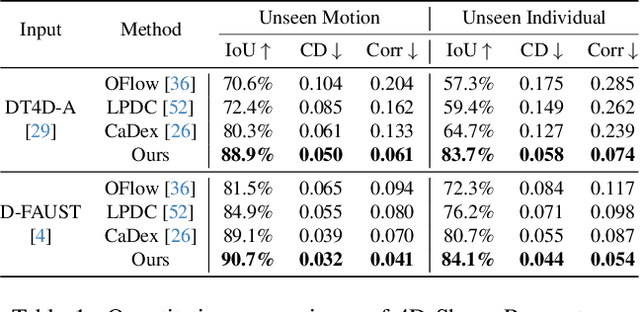
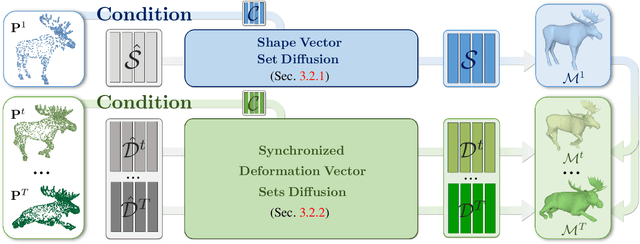
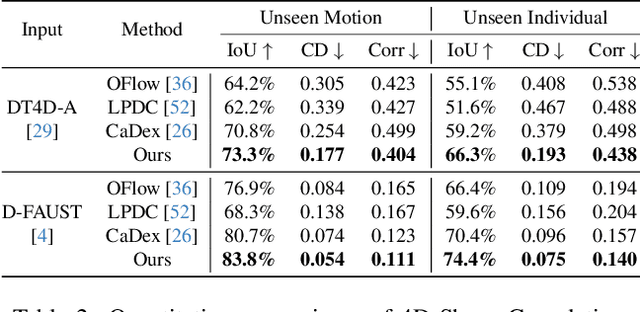
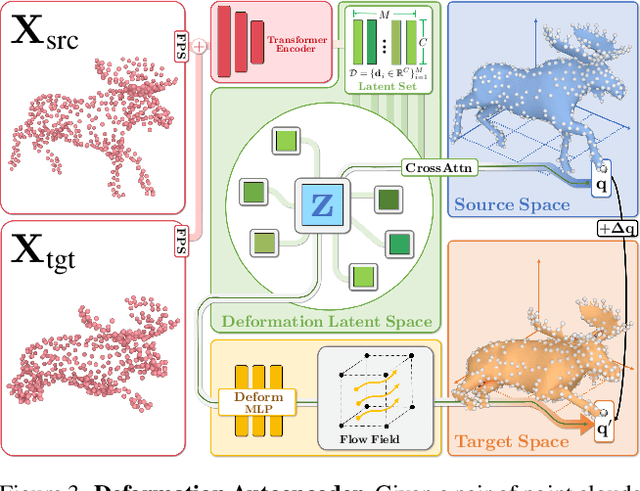
We introduce Motion2VecSets, a 4D diffusion model for dynamic surface reconstruction from point cloud sequences. While existing state-of-the-art methods have demonstrated success in reconstructing non-rigid objects using neural field representations, conventional feed-forward networks encounter challenges with ambiguous observations from noisy, partial, or sparse point clouds. To address these challenges, we introduce a diffusion model that explicitly learns the shape and motion distribution of non-rigid objects through an iterative denoising process of compressed latent representations. The diffusion-based prior enables more plausible and probabilistic reconstructions when handling ambiguous inputs. We parameterize 4D dynamics with latent vector sets instead of using a global latent. This novel 4D representation allows us to learn local surface shape and deformation patterns, leading to more accurate non-linear motion capture and significantly improving generalizability to unseen motions and identities. For more temporal-coherent object tracking, we synchronously denoise deformation latent sets and exchange information across multiple frames. To avoid the computational overhead, we design an interleaved space and time attention block to alternately aggregate deformation latents along spatial and temporal domains. Extensive comparisons against the state-of-the-art methods demonstrate the superiority of our Motion2VecSets in 4D reconstruction from various imperfect observations, notably achieving a 19% improvement in Intersection over Union (IoU) compared to CaDex for reconstructing unseen individuals from sparse point clouds on the DeformingThings4D-Animals dataset. More detailed information can be found at https://vveicao.github.io/projects/Motion2VecSets/.
WHU-Hi: UAV-borne hyperspectral with high spatial resolution benchmark datasets for hyperspectral image classification
Dec 27, 2020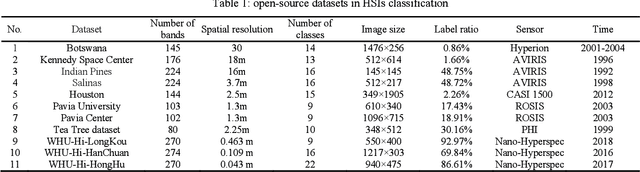
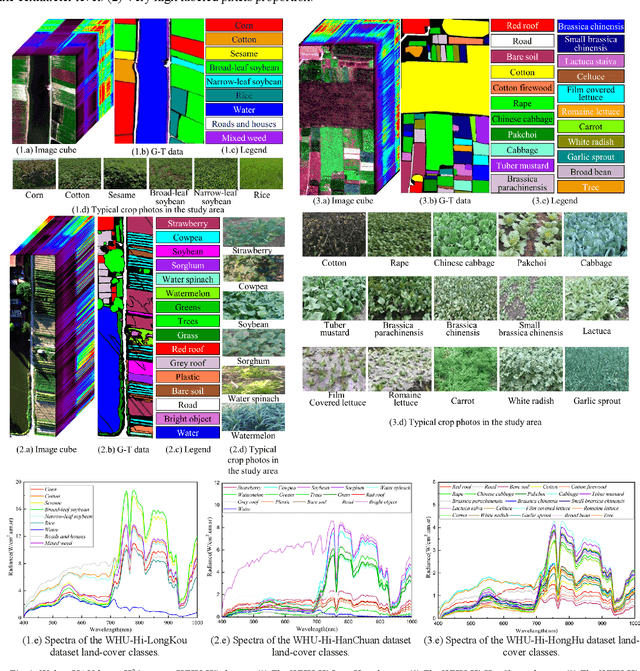
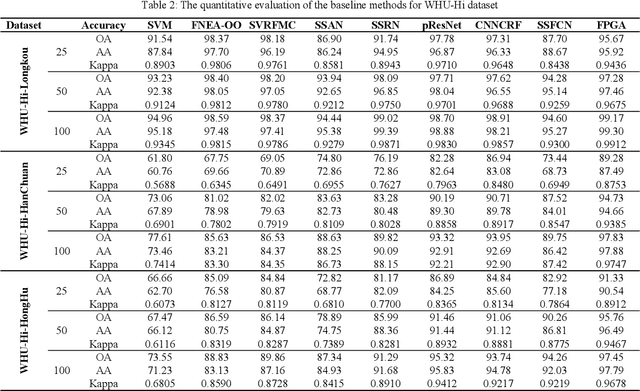
Classification is an important aspect of hyperspectral images processing and application. At present, the researchers mostly use the classic airborne hyperspectral imagery as the benchmark dataset. However, existing datasets suffer from three bottlenecks: (1) low spatial resolution; (2) low labeled pixels proportion; (3) low degree of subclasses distinction. In this paper, a new benchmark dataset named the Wuhan UAV-borne hyperspectral image (WHU-Hi) dataset was built for hyperspectral image classification. The WHU-Hi dataset with a high spectral resolution (nm level) and a very high spatial resolution (cm level), which we refer to here as H2 imager. Besides, the WHU-Hi dataset has a higher pixel labeling ratio and finer subclasses. Some start-of-art hyperspectral image classification methods benchmarked the WHU-Hi dataset, and the experimental results show that WHU-Hi is a challenging dataset. We hope WHU-Hi dataset can become a strong benchmark to accelerate future research.