 Add to Chrome
 Add to Firefox
 Add to Edge
Deep Generative Classification of Blood Cell Morphology
Aug 16, 2024


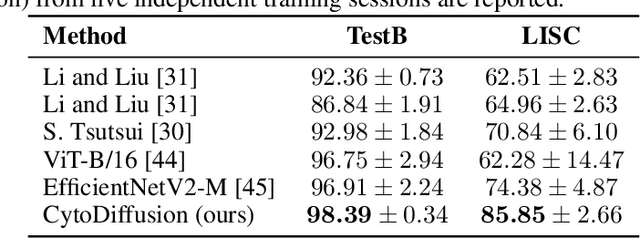
Accurate classification of haematological cells is critical for diagnosing blood disorders, but presents significant challenges for machine automation owing to the complexity of cell morphology, heterogeneities of biological, pathological, and imaging characteristics, and the imbalance of cell type frequencies. We introduce CytoDiffusion, a diffusion-based classifier that effectively models blood cell morphology, combining accurate classification with robust anomaly detection, resistance to distributional shifts, interpretability, data efficiency, and superhuman uncertainty quantification. Our approach outperforms state-of-the-art discriminative models in anomaly detection (AUC 0.976 vs. 0.919), resistance to domain shifts (85.85% vs. 74.38% balanced accuracy), and performance in low-data regimes (95.88% vs. 94.95% balanced accuracy). Notably, our model generates synthetic blood cell images that are nearly indistinguishable from real images, as demonstrated by a Turing test in which expert haematologists achieved only 52.3% accuracy (95% CI: [50.5%, 54.2%]). Furthermore, we enhance model explainability through the generation of directly interpretable counterfactual heatmaps. Our comprehensive evaluation framework, encompassing these multiple performance dimensions, establishes a new benchmark for medical image analysis in haematology, ultimately enabling improved diagnostic accuracy in clinical settings. Our code is available at https://github.com/Deltadahl/CytoDiffusion.

Learned denoising with simulated and experimental low-dose CT data
Aug 15, 2024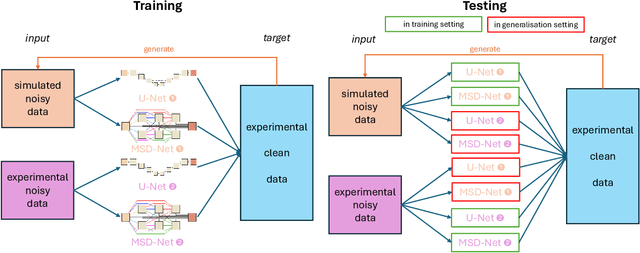
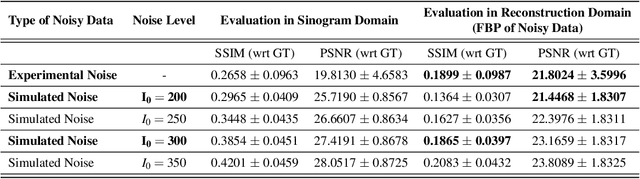
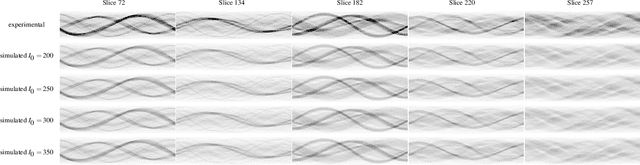
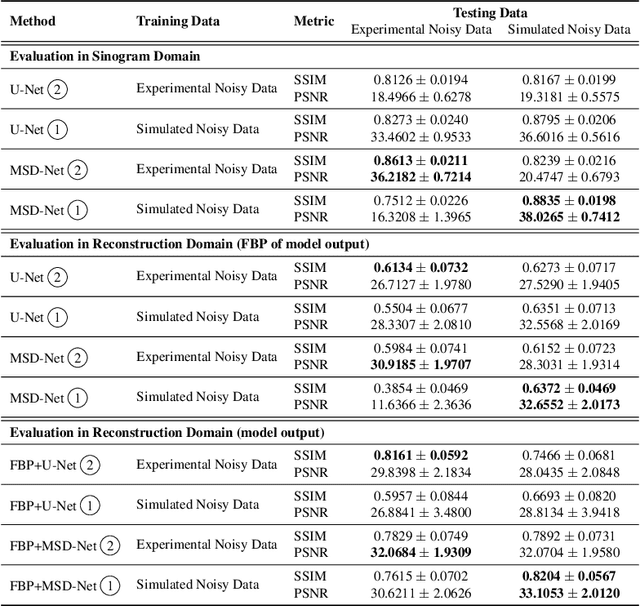
Like in many other research fields, recent developments in computational imaging have focused on developing machine learning (ML) approaches to tackle its main challenges. To improve the performance of computational imaging algorithms, machine learning methods are used for image processing tasks such as noise reduction. Generally, these ML methods heavily rely on the availability of high-quality data on which they are trained. This work explores the application of ML methods, specifically convolutional neural networks (CNNs), in the context of noise reduction for computed tomography (CT) imaging. We utilize a large 2D computed tomography dataset for machine learning to carry out for the first time a comprehensive study on the differences between the observed performances of algorithms trained on simulated noisy data and on real-world experimental noisy data. The study compares the performance of two common CNN architectures, U-Net and MSD-Net, that are trained and evaluated on both simulated and experimental noisy data. The results show that while sinogram denoising performed better with simulated noisy data if evaluated in the sinogram domain, the performance did not carry over to the reconstruction domain where training on experimental noisy data shows a higher performance in denoising experimental noisy data. Training the algorithms in an end-to-end fashion from sinogram to reconstruction significantly improved model performance, emphasizing the importance of matching raw measurement data to high-quality CT reconstructions. The study furthermore suggests the need for more sophisticated noise simulation approaches to bridge the gap between simulated and real-world data in CT image denoising applications and gives insights into the challenges and opportunities in leveraging simulated data for machine learning in computational imaging.
Blessing of Dimensionality for Approximating Sobolev Classes on Manifolds
Aug 13, 2024The manifold hypothesis says that natural high-dimensional data is actually supported on or around a low-dimensional manifold. Recent success of statistical and learning-based methods empirically supports this hypothesis, due to outperforming classical statistical intuition in very high dimensions. A natural step for analysis is thus to assume the manifold hypothesis and derive bounds that are independent of any embedding space. Theoretical implications in this direction have recently been explored in terms of generalization of ReLU networks and convergence of Langevin methods. We complement existing results by providing theoretical statistical complexity results, which directly relates to generalization properties. In particular, we demonstrate that the statistical complexity required to approximate a class of bounded Sobolev functions on a compact manifold is bounded from below, and moreover that this bound is dependent only on the intrinsic properties of the manifold. These provide complementary bounds for existing approximation results for ReLU networks on manifolds, which give upper bounds on generalization capacity.
Contrastive Learning with Dynamic Localized Repulsion for Brain Age Prediction on 3D Stiffness Maps
Aug 01, 2024In the field of neuroimaging, accurate brain age prediction is pivotal for uncovering the complexities of brain aging and pinpointing early indicators of neurodegenerative conditions. Recent advancements in self-supervised learning, particularly in contrastive learning, have demonstrated greater robustness when dealing with complex datasets. However, current approaches often fall short in generalizing across non-uniformly distributed data, prevalent in medical imaging scenarios. To bridge this gap, we introduce a novel contrastive loss that adapts dynamically during the training process, focusing on the localized neighborhoods of samples. Moreover, we expand beyond traditional structural features by incorporating brain stiffness, a mechanical property previously underexplored yet promising due to its sensitivity to age-related changes. This work presents the first application of self-supervised learning to brain mechanical properties, using compiled stiffness maps from various clinical studies to predict brain age. Our approach, featuring dynamic localized loss, consistently outperforms existing state-of-the-art methods, demonstrating superior performance and laying the way for new directions in brain aging research.
Artificial Immunofluorescence in a Flash: Rapid Synthetic Imaging from Brightfield Through Residual Diffusion
Jul 25, 2024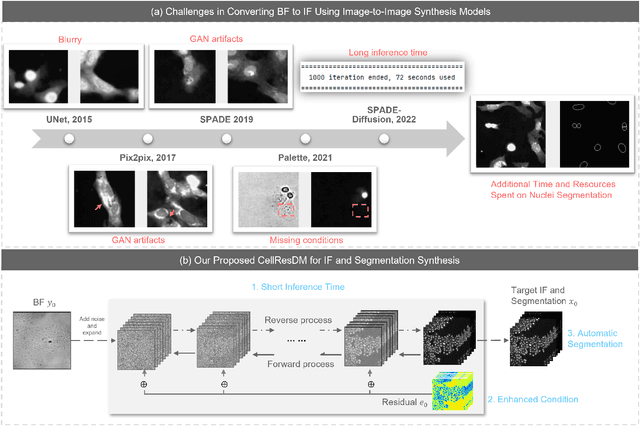
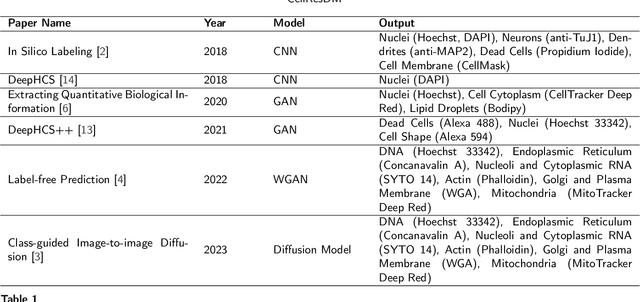
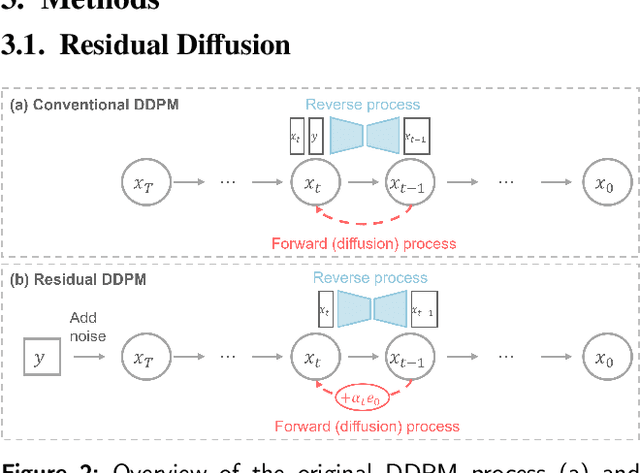
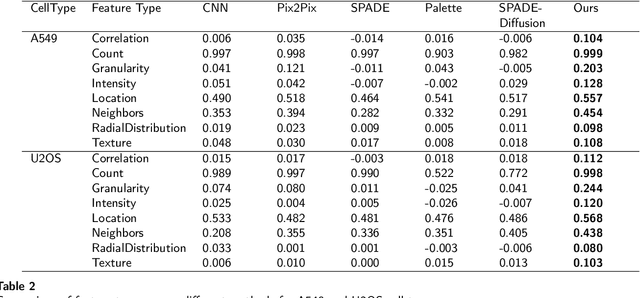
Immunofluorescent (IF) imaging is crucial for visualizing biomarker expressions, cell morphology and assessing the effects of drug treatments on sub-cellular components. IF imaging needs extra staining process and often requiring cell fixation, therefore it may also introduce artefects and alter endogenouous cell morphology. Some IF stains are expensive or not readily available hence hindering experiments. Recent diffusion models, which synthesise high-fidelity IF images from easy-to-acquire brightfield (BF) images, offer a promising solution but are hindered by training instability and slow inference times due to the noise diffusion process. This paper presents a novel method for the conditional synthesis of IF images directly from BF images along with cell segmentation masks. Our approach employs a Residual Diffusion process that enhances stability and significantly reduces inference time. We performed a critical evaluation against other image-to-image synthesis models, including UNets, GANs, and advanced diffusion models. Our model demonstrates significant improvements in image quality (p<0.05 in MSE, PSNR, and SSIM), inference speed (26 times faster than competing diffusion models), and accurate segmentation results for both nuclei and cell bodies (0.77 and 0.63 mean IOU for nuclei and cell true positives, respectively). This paper is a substantial advancement in the field, providing robust and efficient tools for cell image analysis.
NODE-Adapter: Neural Ordinary Differential Equations for Better Vision-Language Reasoning
Jul 11, 2024

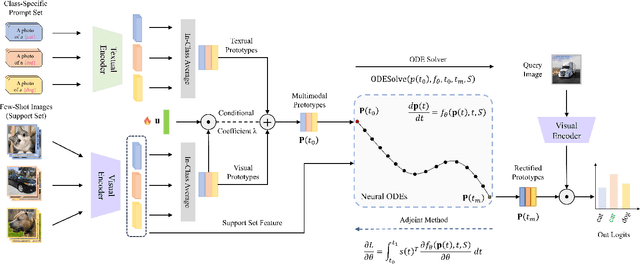
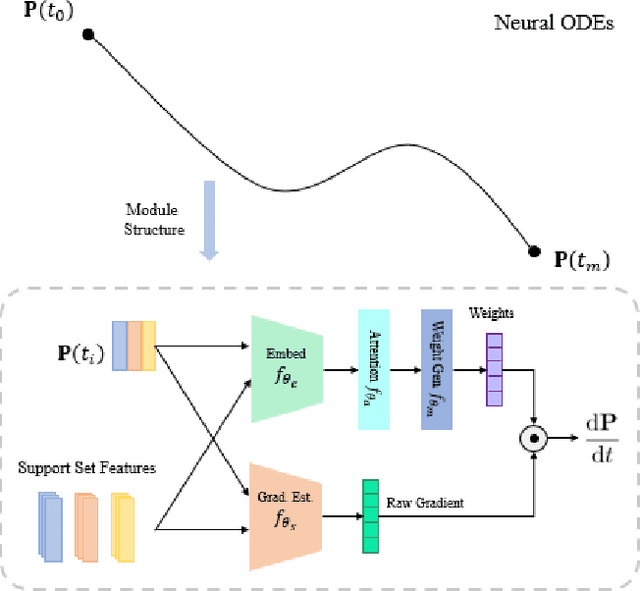
In this paper, we consider the problem of prototype-based vision-language reasoning problem. We observe that existing methods encounter three major challenges: 1) escalating resource demands and prolonging training times, 2) contending with excessive learnable parameters, and 3) fine-tuning based only on a single modality. These challenges will hinder their capability to adapt Vision-Language Models (VLMs) to downstream tasks. Motivated by this critical observation, we propose a novel method called NODE-Adapter, which utilizes Neural Ordinary Differential Equations for better vision-language reasoning. To fully leverage both visual and textual modalities and estimate class prototypes more effectively and accurately, we divide our method into two stages: cross-modal prototype construction and cross-modal prototype optimization using neural ordinary differential equations. Specifically, we exploit VLM to encode hand-crafted prompts into textual features and few-shot support images into visual features. Then, we estimate the textual prototype and visual prototype by averaging the textual features and visual features, respectively, and adaptively combine the textual prototype and visual prototype to construct the cross-modal prototype. To alleviate the prototype bias, we then model the prototype optimization process as an initial value problem with Neural ODEs to estimate the continuous gradient flow. Our extensive experimental results, which cover few-shot classification, domain generalization, and visual reasoning on human-object interaction, demonstrate that the proposed method significantly outperforms existing state-of-the-art approaches.
G-Adaptive mesh refinement -- leveraging graph neural networks and differentiable finite element solvers
Jul 05, 2024We present a novel, and effective, approach to the long-standing problem of mesh adaptivity in finite element methods (FEM). FE solvers are powerful tools for solving partial differential equations (PDEs), but their cost and accuracy are critically dependent on the choice of mesh points. To keep computational costs low, mesh relocation (r-adaptivity) seeks to optimise the position of a fixed number of mesh points to obtain the best FE solution accuracy. Classical approaches to this problem require the solution of a separate nonlinear "meshing" PDE to find the mesh point locations. This incurs significant cost at remeshing and relies on certain a-priori assumptions and guiding heuristics for optimal mesh point location. Recent machine learning approaches to r-adaptivity have mainly focused on the construction of fast surrogates for such classical methods. Our new approach combines a graph neural network (GNN) powered architecture, with training based on direct minimisation of the FE solution error with respect to the mesh point locations. The GNN employs graph neural diffusion (GRAND), closely aligning the mesh solution space to that of classical meshing methodologies, thus replacing heuristics with a learnable strategy, and providing a strong inductive bias. This allows for rapid and robust training and results in an extremely efficient and effective GNN approach to online r-adaptivity. This method outperforms classical and prior ML approaches to r-adaptive meshing on the test problems we consider, in particular achieving lower FE solution error, whilst retaining the significant speed-up over classical methods observed in prior ML work.
DiGRAF: Diffeomorphic Graph-Adaptive Activation Function
Jul 02, 2024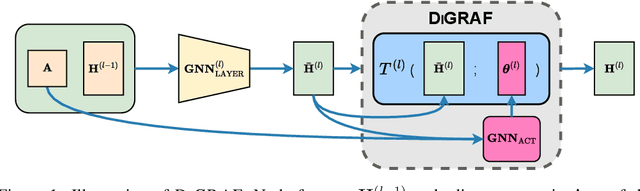
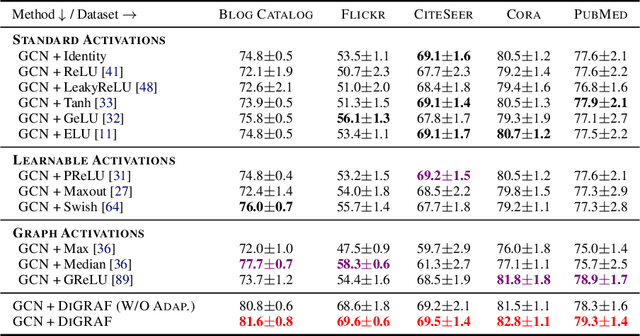
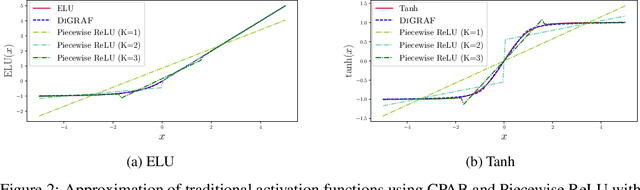

In this paper, we propose a novel activation function tailored specifically for graph data in Graph Neural Networks (GNNs). Motivated by the need for graph-adaptive and flexible activation functions, we introduce DiGRAF, leveraging Continuous Piecewise-Affine Based (CPAB) transformations, which we augment with an additional GNN to learn a graph-adaptive diffeomorphic activation function in an end-to-end manner. In addition to its graph-adaptivity and flexibility, DiGRAF also possesses properties that are widely recognized as desirable for activation functions, such as differentiability, boundness within the domain and computational efficiency. We conduct an extensive set of experiments across diverse datasets and tasks, demonstrating a consistent and superior performance of DiGRAF compared to traditional and graph-specific activation functions, highlighting its effectiveness as an activation function for GNNs.
Spatiotemporal Graph Neural Network Modelling Perfusion MRI
Jun 10, 2024Perfusion MRI (pMRI) offers valuable insights into tumor vascularity and promises to predict tumor genotypes, thus benefiting prognosis for glioma patients, yet effective models tailored to 4D pMRI are still lacking. This study presents the first attempt to model 4D pMRI using a GNN-based spatiotemporal model PerfGAT, integrating spatial information and temporal kinetics to predict Isocitrate DeHydrogenase (IDH) mutation status in glioma patients. Specifically, we propose a graph structure learning approach based on edge attention and negative graphs to optimize temporal correlations modeling. Moreover, we design a dual-attention feature fusion module to integrate spatiotemporal features while addressing tumor-related brain regions. Further, we develop a class-balanced augmentation methods tailored to spatiotemporal data, which could mitigate the common label imbalance issue in clinical datasets. Our experimental results demonstrate that the proposed method outperforms other state-of-the-art approaches, promising to model pMRI effectively for patient characterization.
Optimised ProPainter for Video Diminished Reality Inpainting
Jun 04, 2024In this paper, part of the DREAMING Challenge - Diminished Reality for Emerging Applications in Medicine through Inpainting, we introduce a refined video inpainting technique optimised from the ProPainter method to meet the specialised demands of medical imaging, specifically in the context of oral and maxillofacial surgery. Our enhanced algorithm employs the zero-shot ProPainter, featuring optimized parameters and pre-processing, to adeptly manage the complex task of inpainting surgical video sequences, without requiring any training process. It aims to produce temporally coherent and detail-rich reconstructions of occluded regions, facilitating clearer views of operative fields. The efficacy of our approach is evaluated using comprehensive metrics, positioning it as a significant advancement in the application of diminished reality for medical purposes.