 Add to Chrome
 Add to Firefox
 Add to Edge
Building Damage Detection using Satellite Images and Patch-Based Transformer Methods
Feb 08, 2026
Rapid building damage assessment is critical for post-disaster response. Damage classification models built on satellite imagery provide a scalable means of obtaining situational awareness. However, label noise and severe class imbalance in satellite data create major challenges. The xBD dataset offers a standardized benchmark for building-level damage across diverse geographic regions. In this study, we evaluate Vision Transformer (ViT) model performance on the xBD dataset, specifically investigating how these models distinguish between types of structural damage when training on noisy, imbalanced data. In this study, we specifically evaluate DINOv2-small and DeiT for multi-class damage classification. We propose a targeted patch-based pre-processing pipeline to isolate structural features and minimize background noise in training. We adopt a frozen-head fine-tuning strategy to keep computational requirements manageable. Model performance is evaluated through accuracy, precision, recall, and macro-averaged F1 scores. We show that small ViT architectures with our novel training method achieves competitive macro-averaged F1 relative to prior CNN baselines for disaster classification.

Artificial Immunofluorescence in a Flash: Rapid Synthetic Imaging from Brightfield Through Residual Diffusion
Jul 25, 2024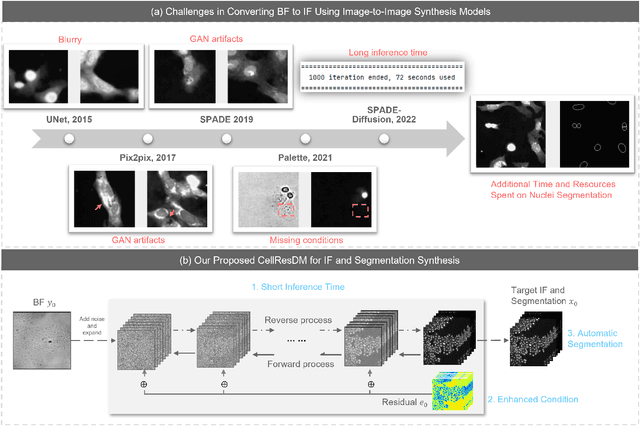
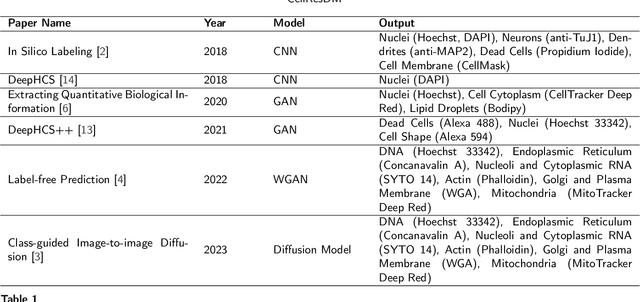
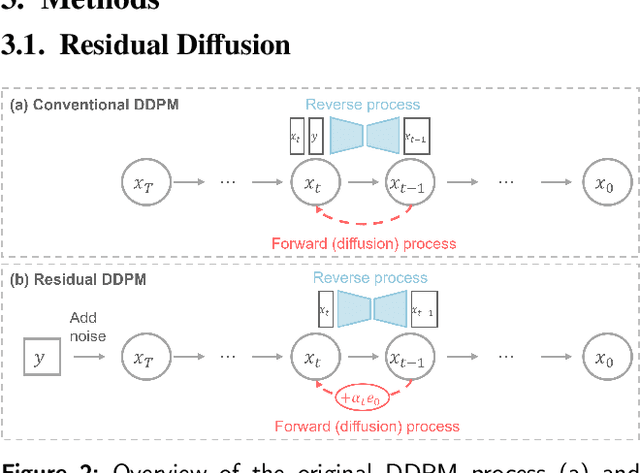
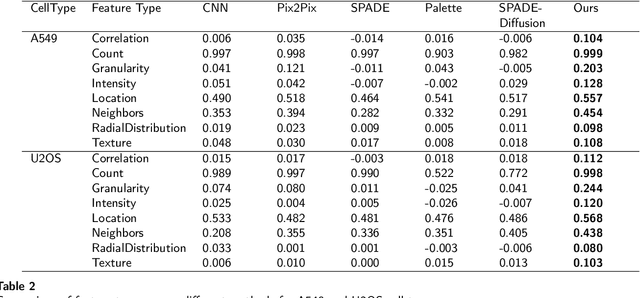
Immunofluorescent (IF) imaging is crucial for visualizing biomarker expressions, cell morphology and assessing the effects of drug treatments on sub-cellular components. IF imaging needs extra staining process and often requiring cell fixation, therefore it may also introduce artefects and alter endogenouous cell morphology. Some IF stains are expensive or not readily available hence hindering experiments. Recent diffusion models, which synthesise high-fidelity IF images from easy-to-acquire brightfield (BF) images, offer a promising solution but are hindered by training instability and slow inference times due to the noise diffusion process. This paper presents a novel method for the conditional synthesis of IF images directly from BF images along with cell segmentation masks. Our approach employs a Residual Diffusion process that enhances stability and significantly reduces inference time. We performed a critical evaluation against other image-to-image synthesis models, including UNets, GANs, and advanced diffusion models. Our model demonstrates significant improvements in image quality (p<0.05 in MSE, PSNR, and SSIM), inference speed (26 times faster than competing diffusion models), and accurate segmentation results for both nuclei and cell bodies (0.77 and 0.63 mean IOU for nuclei and cell true positives, respectively). This paper is a substantial advancement in the field, providing robust and efficient tools for cell image analysis.