 Add to Chrome
 Add to Firefox
 Add to Edge
Multi-Level Monte Carlo Training of Neural Operators
May 19, 2025
Operator learning is a rapidly growing field that aims to approximate nonlinear operators related to partial differential equations (PDEs) using neural operators. These rely on discretization of input and output functions and are, usually, expensive to train for large-scale problems at high-resolution. Motivated by this, we present a Multi-Level Monte Carlo (MLMC) approach to train neural operators by leveraging a hierarchy of resolutions of function dicretization. Our framework relies on using gradient corrections from fewer samples of fine-resolution data to decrease the computational cost of training while maintaining a high level accuracy. The proposed MLMC training procedure can be applied to any architecture accepting multi-resolution data. Our numerical experiments on a range of state-of-the-art models and test-cases demonstrate improved computational efficiency compared to traditional single-resolution training approaches, and highlight the existence of a Pareto curve between accuracy and computational time, related to the number of samples per resolution.

Approximation theory for 1-Lipschitz ResNets
May 17, 20251-Lipschitz neural networks are fundamental for generative modelling, inverse problems, and robust classifiers. In this paper, we focus on 1-Lipschitz residual networks (ResNets) based on explicit Euler steps of negative gradient flows and study their approximation capabilities. Leveraging the Restricted Stone-Weierstrass Theorem, we first show that these 1-Lipschitz ResNets are dense in the set of scalar 1-Lipschitz functions on any compact domain when width and depth are allowed to grow. We also show that these networks can exactly represent scalar piecewise affine 1-Lipschitz functions. We then prove a stronger statement: by inserting norm-constrained linear maps between the residual blocks, the same density holds when the hidden width is fixed. Because every layer obeys simple norm constraints, the resulting models can be trained with off-the-shelf optimisers. This paper provides the first universal approximation guarantees for 1-Lipschitz ResNets, laying a rigorous foundation for their practical use.
Potential Contrast: Properties, Equivalences, and Generalization to Multiple Classes
May 02, 2025Potential contrast is typically used as an image quality measure and quantifies the maximal possible contrast between samples from two classes of pixels in an image after an arbitrary grayscale transformation. It has been valuable in cultural heritage applications, identifying and visualizing relevant information in multispectral images while requiring a small number of pixels to be manually sampled. In this work, we introduce a normalized version of potential contrast that removes dependence on image format and also prove equalities that enable generalization to more than two classes and to continuous settings. Finally, we exemplify the utility of multi-class normalized potential contrast through an application to a medieval music manuscript with visible bleedthrough from the back page. We share our implementations, based on both original algorithms and our new equalities, including generalization to multiple classes, at https://github.com/wallacepeaslee/Multiple-Class-Normalized-Potential-Contrast.
Brain Foundation Models with Hypergraph Dynamic Adapter for Brain Disease Analysis
May 01, 2025Brain diseases, such as Alzheimer's disease and brain tumors, present profound challenges due to their complexity and societal impact. Recent advancements in brain foundation models have shown significant promise in addressing a range of brain-related tasks. However, current brain foundation models are limited by task and data homogeneity, restricted generalization beyond segmentation or classification, and inefficient adaptation to diverse clinical tasks. In this work, we propose SAM-Brain3D, a brain-specific foundation model trained on over 66,000 brain image-label pairs across 14 MRI sub-modalities, and Hypergraph Dynamic Adapter (HyDA), a lightweight adapter for efficient and effective downstream adaptation. SAM-Brain3D captures detailed brain-specific anatomical and modality priors for segmenting diverse brain targets and broader downstream tasks. HyDA leverages hypergraphs to fuse complementary multi-modal data and dynamically generate patient-specific convolutional kernels for multi-scale feature fusion and personalized patient-wise adaptation. Together, our framework excels across a broad spectrum of brain disease segmentation and classification tasks. Extensive experiments demonstrate that our method consistently outperforms existing state-of-the-art approaches, offering a new paradigm for brain disease analysis through multi-modal, multi-scale, and dynamic foundation modeling.
FLASH: Flexible Learning of Adaptive Sampling from History in Temporal Graph Neural Networks
Apr 09, 2025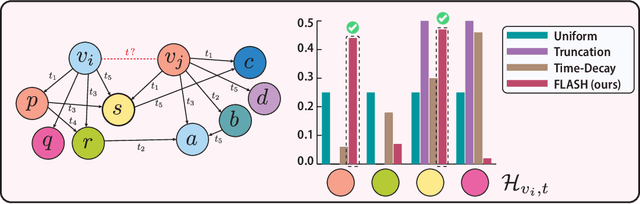
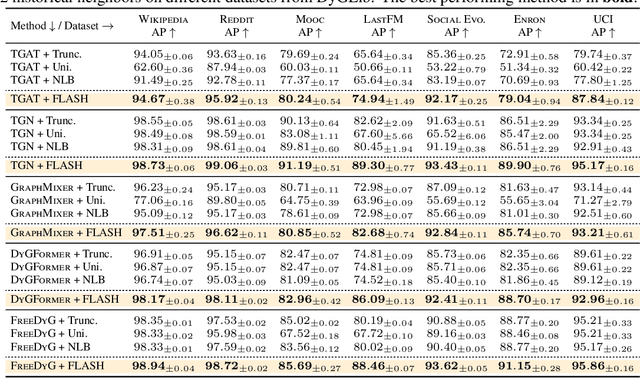
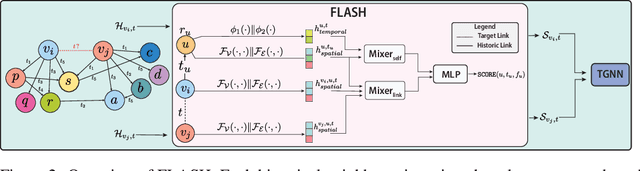
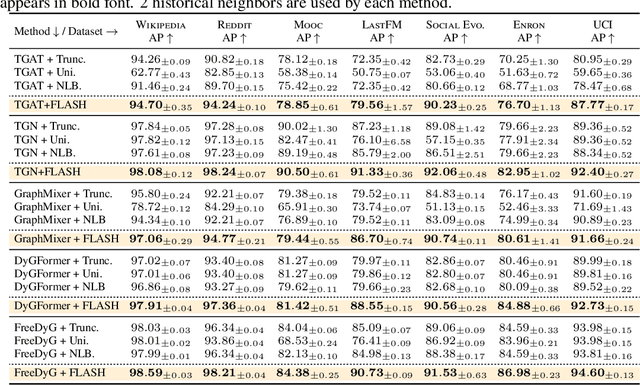
Aggregating temporal signals from historic interactions is a key step in future link prediction on dynamic graphs. However, incorporating long histories is resource-intensive. Hence, temporal graph neural networks (TGNNs) often rely on historical neighbors sampling heuristics such as uniform sampling or recent neighbors selection. These heuristics are static and fail to adapt to the underlying graph structure. We introduce FLASH, a learnable and graph-adaptive neighborhood selection mechanism that generalizes existing heuristics. FLASH integrates seamlessly into TGNNs and is trained end-to-end using a self-supervised ranking loss. We provide theoretical evidence that commonly used heuristics hinders TGNNs performance, motivating our design. Extensive experiments across multiple benchmarks demonstrate consistent and significant performance improvements for TGNNs equipped with FLASH.
SurvSurf: a partially monotonic neural network for first-hitting time prediction of intermittently observed discrete and continuous sequential events
Apr 07, 2025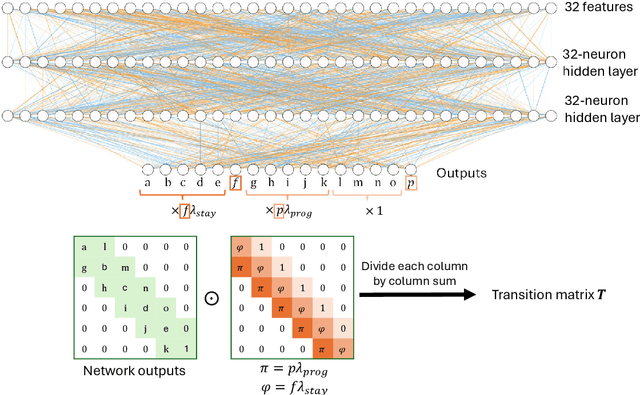
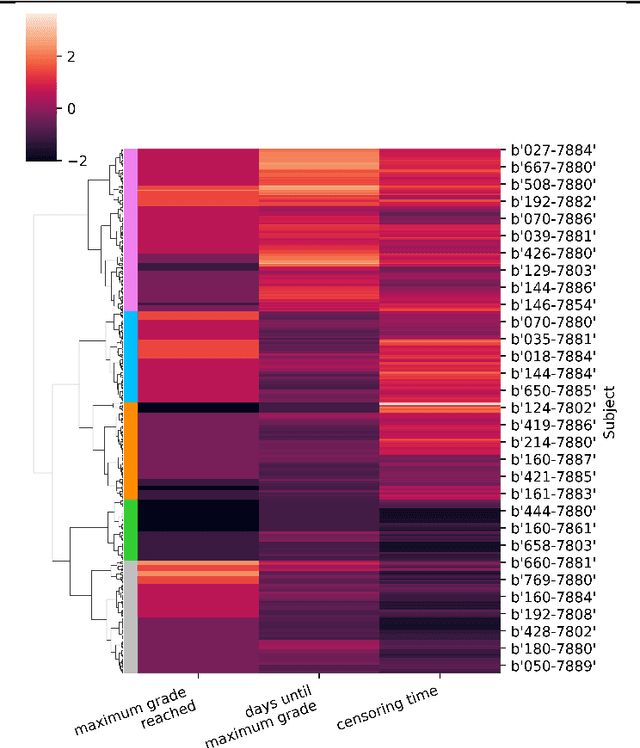
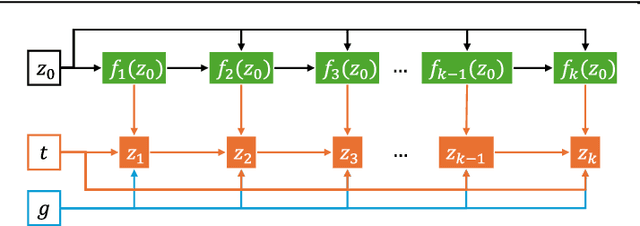
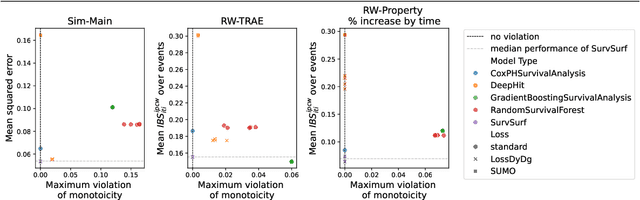
We propose a neural-network based survival model (SurvSurf) specifically designed for direct and simultaneous probabilistic prediction of the first hitting time of sequential events from baseline. Unlike existing models, SurvSurf is theoretically guaranteed to never violate the monotonic relationship between the cumulative incidence functions of sequential events, while allowing nonlinear influence from predictors. It also incorporates implicit truths for unobserved intermediate events in model fitting, and supports both discrete and continuous time and events. We also identified a variant of the Integrated Brier Score (IBS) that showed robust correlation with the mean squared error (MSE) between the true and predicted probabilities by accounting for implied truths about the missing intermediate events. We demonstrated the superiority of SurvSurf compared to modern and traditional predictive survival models in two simulated datasets and two real-world datasets, using MSE, the more robust IBS and by measuring the extent of monotonicity violation.
Towards Efficient Training of Graph Neural Networks: A Multiscale Approach
Mar 26, 2025Graph Neural Networks (GNNs) have emerged as a powerful tool for learning and inferring from graph-structured data, and are widely used in a variety of applications, often considering large amounts of data and large graphs. However, training on such data requires large memory and extensive computations. In this paper, we introduce a novel framework for efficient multiscale training of GNNs, designed to integrate information across multiscale representations of a graph. Our approach leverages a hierarchical graph representation, taking advantage of coarse graph scales in the training process, where each coarse scale graph has fewer nodes and edges. Based on this approach, we propose a suite of GNN training methods: such as coarse-to-fine, sub-to-full, and multiscale gradient computation. We demonstrate the effectiveness of our methods on various datasets and learning tasks.
D2SA: Dual-Stage Distribution and Slice Adaptation for Efficient Test-Time Adaptation in MRI Reconstruction
Mar 25, 2025Variations in Magnetic resonance imaging (MRI) scanners and acquisition protocols cause distribution shifts that degrade reconstruction performance on unseen data. Test-time adaptation (TTA) offers a promising solution to address this discrepancies. However, previous single-shot TTA approaches are inefficient due to repeated training and suboptimal distributional models. Self-supervised learning methods are also limited by scarce date scenarios. To address these challenges, we propose a novel Dual-Stage Distribution and Slice Adaptation (D2SA) via MRI implicit neural representation (MR-INR) to improve MRI reconstruction performance and efficiency, which features two stages. In the first stage, an MR-INR branch performs patient-wise distribution adaptation by learning shared representations across slices and modelling patient-specific shifts with mean and variance adjustments. In the second stage, single-slice adaptation refines the output from frozen convolutional layers with a learnable anisotropic diffusion module, preventing over-smoothing and reducing computation. Experiments across four MRI distribution shifts demonstrate that our method can integrate well with various self-supervised learning (SSL) framework, improving performance and accelerating convergence under diverse conditions.
Enhanced Denoising and Convergent Regularisation Using Tweedie Scaling
Mar 07, 2025The inherent ill-posed nature of image reconstruction problems, due to limitations in the physical acquisition process, is typically addressed by introducing a regularisation term that incorporates prior knowledge about the underlying image. The iterative framework of Plug-and-Play methods, specifically designed for tackling such inverse problems, achieves state-of-the-art performance by replacing the regularisation with a generic denoiser, which may be parametrised by a neural network architecture. However, these deep learning approaches suffer from a critical limitation: the absence of a control parameter to modulate the regularisation strength, which complicates the design of a convergent regularisation. To address this issue, this work introduces a novel scaling method that explicitly integrates and adjusts the strength of regularisation. The scaling parameter enhances interpretability by reflecting the quality of the denoiser's learning process, and also systematically improves its optimisation. Furthermore, the proposed approach ensures that the resulting family of regularisations is provably stable and convergent.
Implicit U-KAN2.0: Dynamic, Efficient and Interpretable Medical Image Segmentation
Mar 05, 2025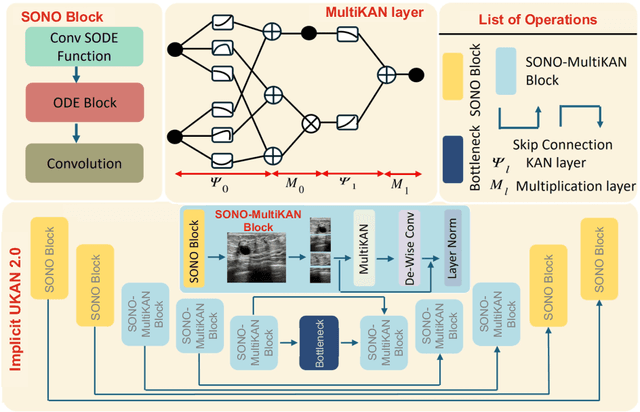
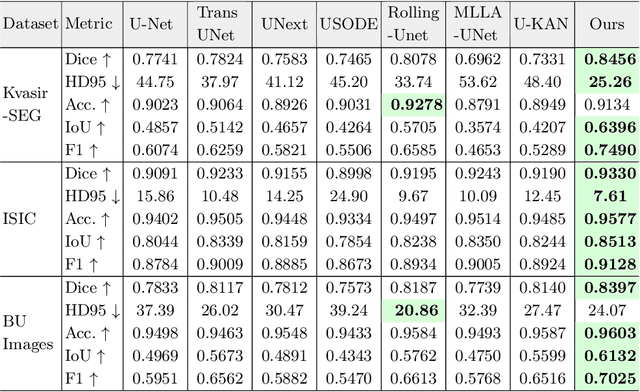
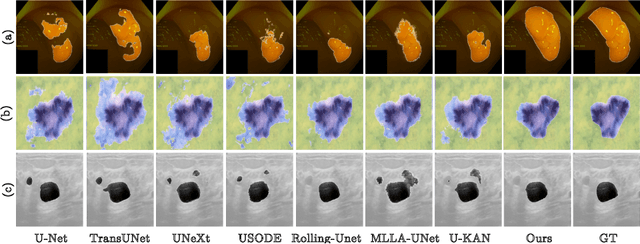

Image segmentation is a fundamental task in both image analysis and medical applications. State-of-the-art methods predominantly rely on encoder-decoder architectures with a U-shaped design, commonly referred to as U-Net. Recent advancements integrating transformers and MLPs improve performance but still face key limitations, such as poor interpretability, difficulty handling intrinsic noise, and constrained expressiveness due to discrete layer structures, often lacking a solid theoretical foundation.In this work, we introduce Implicit U-KAN 2.0, a novel U-Net variant that adopts a two-phase encoder-decoder structure. In the SONO phase, we use a second-order neural ordinary differential equation (NODEs), called the SONO block, for a more efficient, expressive, and theoretically grounded modeling approach. In the SONO-MultiKAN phase, we integrate the second-order NODEs and MultiKAN layer as the core computational block to enhance interpretability and representation power. Our contributions are threefold. First, U-KAN 2.0 is an implicit deep neural network incorporating MultiKAN and second order NODEs, improving interpretability and performance while reducing computational costs. Second, we provide a theoretical analysis demonstrating that the approximation ability of the MultiKAN block is independent of the input dimension. Third, we conduct extensive experiments on a variety of 2D and a single 3D dataset, demonstrating that our model consistently outperforms existing segmentation networks.