 Add to Chrome
 Add to Firefox
 Add to Edge
Learning piecewise-smooth dynamical systems
Aug 20, 2026
Discovering dynamical systems from trajectory data is a central problem in applied mathematics and engineering. Whilst recent advances in machine learning have led to strong progress in data-driven system identification, much less attention has been given to systems with discontinuous dynamics. These systems are nevertheless highly relevant in applications, including climate dynamics and mechanical systems with friction. In this work, we consider the problem of identifying piecewise-smooth dynamical systems directly from trajectory data. Compared with the smooth setting, this requires recovering the governing equations and detecting the switching hyperplanes that separate different dynamical regimes and characterising their behaviour, such as sliding motion. We present a modular framework for discovering such systems by first estimating switching hyperplanes from data and then learning smooth dynamics within each region using geometry-constrained neural networks. The geometry-learning phase is studied from a statistical perspective, analysing the identifiability of the discontinuities and the robustness of the procedure. We also introduce a novel neural network architecture with a prescribed discontinuity set, and provide a theoretical analysis of its approximation properties. The approach is tested on low-dimensional benchmark problems, including dry-friction oscillators and the PP04 climate model for the ice ages.

1-Lipschitz Neural Networks on Hadamard Manifolds
Jul 21, 2026Controlling the Lipschitz constant of a neural network is a standard way to promote robustness and stability. Most existing constraining strategies are designed for Euclidean spaces. In this work, we construct and analyze a class of 1-Lipschitz neural networks on Hadamard manifolds. Our layers are of gradient-descent type, $1$-Lipschitz, and quasi-$α$-firmly nonexpansive. The core building blocks of the proposed architecture are Busemann functions, and we exploit the properties of Busemann gradient flows to design $1$-Lipschitz geometry-preserving layers. We provide explicit constructions and examples for hyperbolic manifolds and the manifold of symmetric positive definite (SPD) matrices. We test the proposed architecture in two numerical experiments: robust classification on the Poincaré disk and masked-Wishart covariance reconstruction. On the Poincaré disk, the proposed networks yield robust classifiers under hyperbolic perturbations. On the SPD manifold, we train SPD-valued denoisers and adopt them as a Plug-and-Play prior for a masked-Wishart covariance reconstruction problem. We show improved results from the nonexpansive denoiser over static, data-only, and Log-Euclidean denoising baselines, and empirically test its convergence properties.
Approximation Theory for Lipschitz Continuous Transformers
Feb 17, 2026Stability and robustness are critical for deploying Transformers in safety-sensitive settings. A principled way to enforce such behavior is to constrain the model's Lipschitz constant. However, approximation-theoretic guarantees for architectures that explicitly preserve Lipschitz continuity have yet to be established. In this work, we bridge this gap by introducing a class of gradient-descent-type in-context Transformers that are Lipschitz-continuous by construction. We realize both MLP and attention blocks as explicit Euler steps of negative gradient flows, ensuring inherent stability without sacrificing expressivity. We prove a universal approximation theorem for this class within a Lipschitz-constrained function space. Crucially, our analysis adopts a measure-theoretic formalism, interpreting Transformers as operators on probability measures, to yield approximation guarantees independent of token count. These results provide a rigorous theoretical foundation for the design of robust, Lipschitz continuous Transformer architectures.
Stable neural networks and connections to continuous dynamical systems
Oct 25, 2025The existence of instabilities, for example in the form of adversarial examples, has given rise to a highly active area of research concerning itself with understanding and enhancing the stability of neural networks. We focus on a popular branch within this area which draws on connections to continuous dynamical systems and optimal control, giving a bird's eye view of this area. We identify and describe the fundamental concepts that underlie much of the existing work in this area. Following this, we go into more detail on a specific approach to designing stable neural networks, developing the theoretical background and giving a description of how these networks can be implemented. We provide code that implements the approach that can be adapted and extended by the reader. The code further includes a notebook with a fleshed-out toy example on adversarial robustness of image classification that can be run without heavy requirements on the reader's computer. We finish by discussing this toy example so that the reader can interactively follow along on their computer. This work will be included as a chapter of a book on scientific machine learning, which is currently under revision and aimed at students.
Approximation theory for 1-Lipschitz ResNets
May 17, 20251-Lipschitz neural networks are fundamental for generative modelling, inverse problems, and robust classifiers. In this paper, we focus on 1-Lipschitz residual networks (ResNets) based on explicit Euler steps of negative gradient flows and study their approximation capabilities. Leveraging the Restricted Stone-Weierstrass Theorem, we first show that these 1-Lipschitz ResNets are dense in the set of scalar 1-Lipschitz functions on any compact domain when width and depth are allowed to grow. We also show that these networks can exactly represent scalar piecewise affine 1-Lipschitz functions. We then prove a stronger statement: by inserting norm-constrained linear maps between the residual blocks, the same density holds when the hidden width is fixed. Because every layer obeys simple norm constraints, the resulting models can be trained with off-the-shelf optimisers. This paper provides the first universal approximation guarantees for 1-Lipschitz ResNets, laying a rigorous foundation for their practical use.
Approximation properties of neural ODEs
Mar 19, 2025We study the approximation properties of shallow neural networks whose activation function is defined as the flow of a neural ordinary differential equation (neural ODE) at the final time of the integration interval. We prove the universal approximation property (UAP) of such shallow neural networks in the space of continuous functions. Furthermore, we investigate the approximation properties of shallow neural networks whose parameters are required to satisfy some constraints. In particular, we constrain the Lipschitz constant of the flow of the neural ODE to increase the stability of the shallow neural network, and we restrict the norm of the weight matrices of the linear layers to one to make sure that the restricted expansivity of the flow is not compensated by the increased expansivity of the linear layers. For this setting, we prove approximation bounds that tell us the accuracy to which we can approximate a continuous function with a shallow neural network with such constraints. We prove that the UAP holds if we consider only the constraint on the Lipschitz constant of the flow or the unit norm constraint on the weight matrices of the linear layers.
Symplectic Neural Flows for Modeling and Discovery
Dec 21, 2024Hamilton's equations are fundamental for modeling complex physical systems, where preserving key properties such as energy and momentum is crucial for reliable long-term simulations. Geometric integrators are widely used for this purpose, but neural network-based methods that incorporate these principles remain underexplored. This work introduces SympFlow, a time-dependent symplectic neural network designed using parameterized Hamiltonian flow maps. This design allows for backward error analysis and ensures the preservation of the symplectic structure. SympFlow allows for two key applications: (i) providing a time-continuous symplectic approximation of the exact flow of a Hamiltonian system--purely based on the differential equations it satisfies, and (ii) approximating the flow map of an unknown Hamiltonian system relying on trajectory data. We demonstrate the effectiveness of SympFlow on diverse problems, including chaotic and dissipative systems, showing improved energy conservation compared to general-purpose numerical methods and accurate
Hamiltonian Matching for Symplectic Neural Integrators
Oct 23, 2024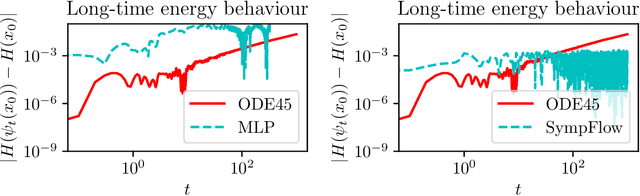
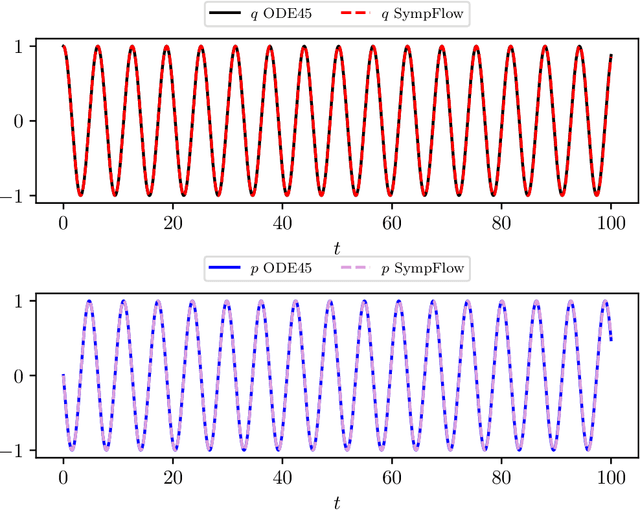
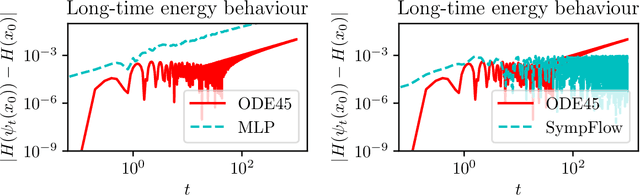
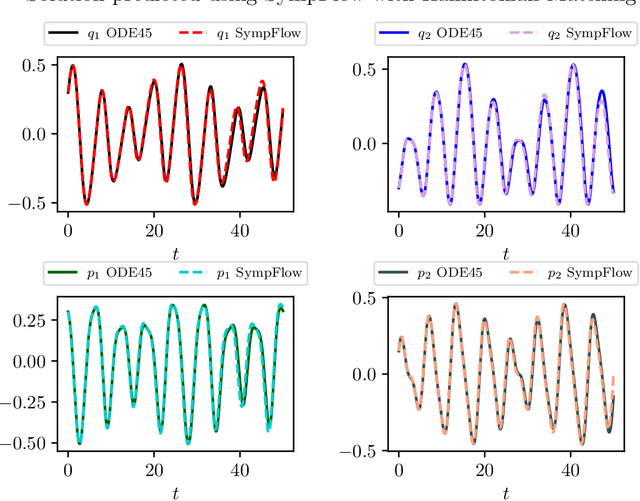
Hamilton's equations of motion form a fundamental framework in various branches of physics, including astronomy, quantum mechanics, particle physics, and climate science. Classical numerical solvers are typically employed to compute the time evolution of these systems. However, when the system spans multiple spatial and temporal scales numerical errors can accumulate, leading to reduced accuracy. To address the challenges of evolving such systems over long timescales, we propose SympFlow, a novel neural network-based symplectic integrator, which is the composition of a sequence of exact flow maps of parametrised time-dependent Hamiltonian functions. This architecture allows for a backward error analysis: we can identify an underlying Hamiltonian function of the architecture and use it to define a Hamiltonian matching objective function, which we use for training. In numerical experiments, we show that SympFlow exhibits promising results, with qualitative energy conservation behaviour similar to that of time-stepping symplectic integrators.
Parallel-in-Time Solutions with Random Projection Neural Networks
Aug 19, 2024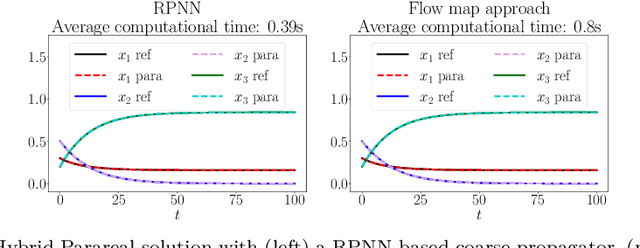


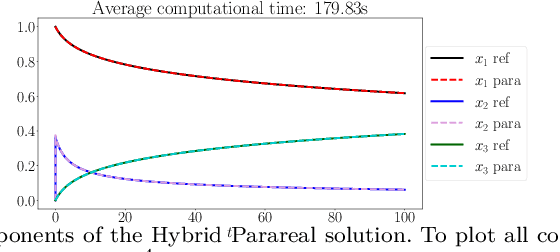
This paper considers one of the fundamental parallel-in-time methods for the solution of ordinary differential equations, Parareal, and extends it by adopting a neural network as a coarse propagator. We provide a theoretical analysis of the convergence properties of the proposed algorithm and show its effectiveness for several examples, including Lorenz and Burgers' equations. In our numerical simulations, we further specialize the underpinning neural architecture to Random Projection Neural Networks (RPNNs), a 2-layer neural network where the first layer weights are drawn at random rather than optimized. This restriction substantially increases the efficiency of fitting RPNN's weights in comparison to a standard feedforward network without negatively impacting the accuracy, as demonstrated in the SIR system example.
Contractive Systems Improve Graph Neural Networks Against Adversarial Attacks
Nov 12, 2023Graph Neural Networks (GNNs) have established themselves as a key component in addressing diverse graph-based tasks. Despite their notable successes, GNNs remain susceptible to input perturbations in the form of adversarial attacks. This paper introduces an innovative approach to fortify GNNs against adversarial perturbations through the lens of contractive dynamical systems. Our method introduces graph neural layers based on differential equations with contractive properties, which, as we show, improve the robustness of GNNs. A distinctive feature of the proposed approach is the simultaneous learned evolution of both the node features and the adjacency matrix, yielding an intrinsic enhancement of model robustness to perturbations in the input features and the connectivity of the graph. We mathematically derive the underpinnings of our novel architecture and provide theoretical insights to reason about its expected behavior. We demonstrate the efficacy of our method through numerous real-world benchmarks, reading on par or improved performance compared to existing methods.