 Add to Chrome
 Add to Firefox
 Add to Edge
Height Control and Optimal Torque Planning for Jumping With Wheeled-Bipedal Robots
May 05, 2026
This paper mainly studies the accurate height jumping control of wheeled-bipedal robots based on torque planning and energy consumption optimization. Due to the characteristics of underactuated, nonlinear estimation, and instantaneous impact in the jumping process, accurate control of the wheeled-bipedal robot's jumping height is complicated. In reality, robots often jump at excessive height to ensure safety, causing additional motor loss, greater ground reaction force and more energy consumption. To solve this problem, a novel wheeled-bipedal jumping dynamical model(W-JBD) is proposed to achieve accurate height control. It performs well but not suitable for the real robot because the torque has a striking step. Therefore, the Bayesian optimization for torque planning method(BOTP) is proposed, which can obtain the optimal torque planning without accurate dynamic model and within few iterations. BOTP method can reduce 82.3% height error, 26.9% energy cost with continuous torque curve. This result is validated in the Webots simulation platform. Based on the torque curve obtained in the W-JBD model to narrow the searching space, BOTP can quickly converge (40 times on average). Cooperating W-JBD model and BOTP method, it is possible to achieve the height control of real robots with reasonable times of experiments.

Kinodynamic Model Predictive Control for Energy Efficient Locomotion of Legged Robots with Parallel Elasticity
Mar 07, 2025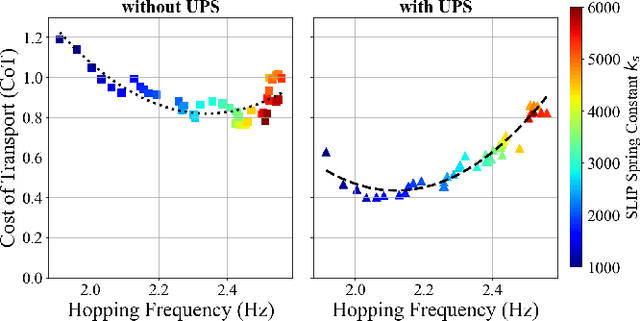
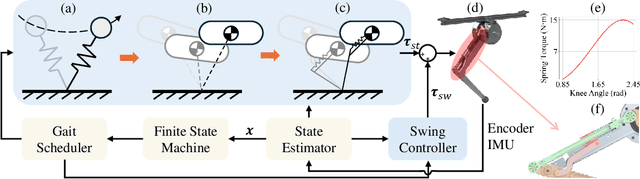
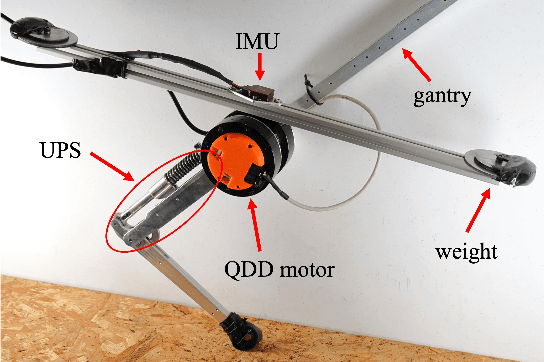
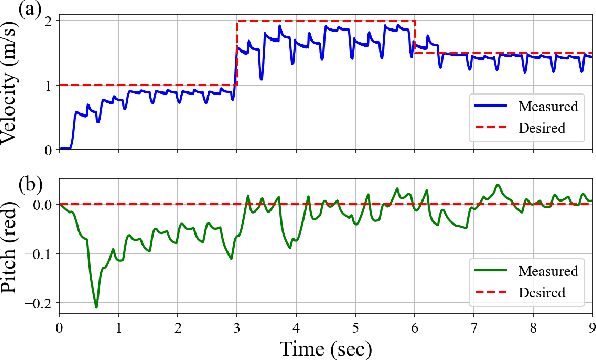
In this paper, we introduce a kinodynamic model predictive control (MPC) framework that exploits unidirectional parallel springs (UPS) to improve the energy efficiency of dynamic legged robots. The proposed method employs a hierarchical control structure, where the solution of MPC with simplified dynamic models is used to warm-start the kinodynamic MPC, which accounts for nonlinear centroidal dynamics and kinematic constraints. The proposed approach enables energy efficient dynamic hopping on legged robots by using UPS to reduce peak motor torques and energy consumption during stance phases. Simulation results demonstrated a 38.8% reduction in the cost of transport (CoT) for a monoped robot equipped with UPS during high-speed hopping. Additionally, preliminary hardware experiments show a 14.8% reduction in energy consumption. Video: https://youtu.be/AF11qMXJD48
Sense, Imagine, Act: Multimodal Perception Improves Model-Based Reinforcement Learning for Head-to-Head Autonomous Racing
May 08, 2023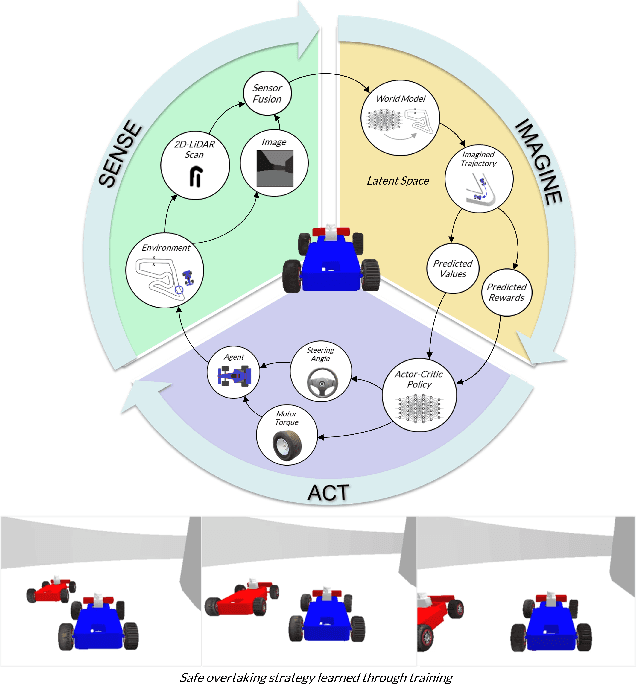
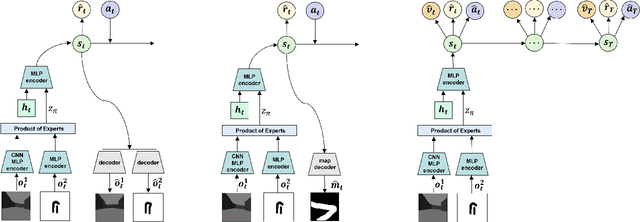
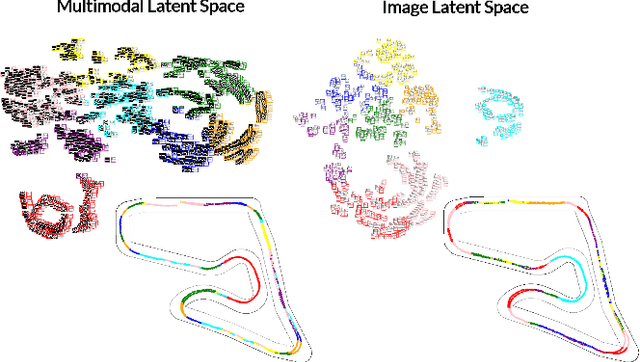
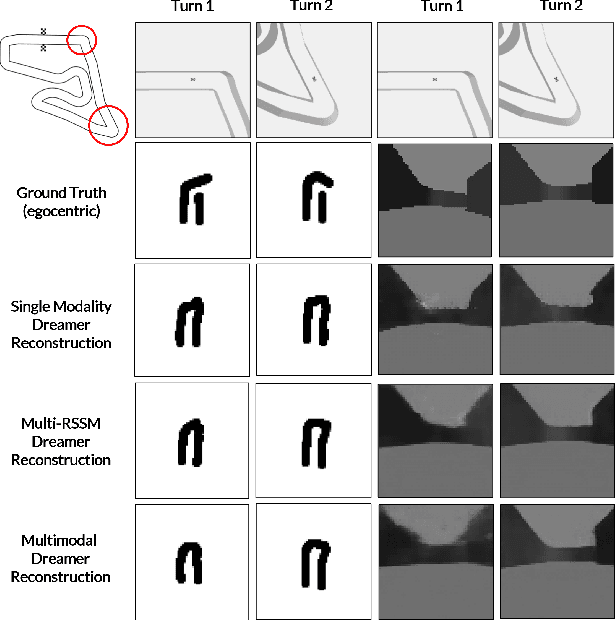
Model-based reinforcement learning (MBRL) techniques have recently yielded promising results for real-world autonomous racing using high-dimensional observations. MBRL agents, such as Dreamer, solve long-horizon tasks by building a world model and planning actions by latent imagination. This approach involves explicitly learning a model of the system dynamics and using it to learn the optimal policy for continuous control over multiple timesteps. As a result, MBRL agents may converge to sub-optimal policies if the world model is inaccurate. To improve state estimation for autonomous racing, this paper proposes a self-supervised sensor fusion technique that combines egocentric LiDAR and RGB camera observations collected from the F1TENTH Gym. The zero-shot performance of MBRL agents is empirically evaluated on unseen tracks and against a dynamic obstacle. This paper illustrates that multimodal perception improves robustness of the world model without requiring additional training data. The resulting multimodal Dreamer agent safely avoided collisions and won the most races compared to other tested baselines in zero-shot head-to-head autonomous racing.