 Add to Chrome
 Add to Firefox
 Add to Edge
H-PAC Hand: Control-Oriented Modeling and Tendon-Elasticity Compensation for an Underactuated Robotic Hand
Aug 17, 2026
Underactuated tendon-driven hands offer compact actuation and passive compliance, but tendon elongation under restoring-spring loading introduces configuration-dependent joint deviations. This paper presents H-PAC, a modular 6-actuator, 15-DoF robotic hand with a control-oriented modeling and implementation framework. A sparse analytical actuator-joint model is derived from the tendon-routing geometry, and a mechanics-based compensation model is developed to account for tendon-elasticity-induced joint errors. The proposed method is implemented in a hierarchical architecture: a host computer performs workspace-constrained posture mapping and compensation, while an ESP32 generates synchronized commands for six position-controlled servos. The same control parameters and execution strategy are used across all tasks without task-specific retuning. Monotonic servo-sweep experiments show that the compensation substantially improves joint-angle prediction. The MAE of the index DIP joint decreases from 1.15 degrees to 0.18 degrees, and all nine evaluated joints achieve an MAE below 0.23 degrees. Representative postures and grasping configurations are further executed using the same control pipeline without external joint or force sensing in the control loop. The results demonstrate a practical approach to improving posture reproducibility in compact underactuated robotic end-effectors.

SafeBuild-Bench: A Temporal-Robust Construction Safety Benchmark with Graph-Enhanced Data Mining
Jul 29, 2026Construction-safety models must handle concrete deployment risks, such as a worker standing near a scaffold edge without guardrails, rather than only recognize common objects in curated images. Yet real inspection archives are redundant, long-tailed, and collected across changing sites and months. We introduce SafeBuild-Bench, a metadata-driven benchmark for evaluating multimodal large language models on construction safety under realistic temporal and site variation. It is mined from 100K+ industrial image-text records and contains 3,314 task instances from over 3,000 expert-verified images, covering multiple-choice hazard identification and free-form hazard description. To make expert verification scalable, we develop GEMS, a graph-enhanced multimodal selection pipeline that combines a proxy-model confusion signal with graph-based diversity to identify informative candidates from redundant streams. On public instruction-tuning data, GEMS-selected subsets preserve robustness-oriented performance under small data budgets. On SafeBuild-Bench, current MLLMs remain far from reliable construction-safety understanding, with the best overall score near 60. We release the benchmark, evaluation scripts, and GEMS codebase at https://github.com/safebuild/gems.
Bridging Discrete Planning and Continuous Execution for Redundant Robot
Apr 02, 2026Voxel-grid reinforcement learning is widely adopted for path planning in redundant manipulators due to its simplicity and reproducibility. However, direct execution through point-wise numerical inverse kinematics on 7-DoF arms often yields step-size jitter, abrupt joint transitions, and instability near singular configurations. This work proposes a bridging framework between discrete planning and continuous execution without modifying the discrete planner itself. On the planning side, step-normalized 26-neighbor Cartesian actions and a geometric tie-breaking mechanism are introduced to suppress unnecessary turns and eliminate step-size oscillations. On the execution side, a task-priority damped least-squares (TP-DLS) inverse kinematics layer is implemented. This layer treats end-effector position as a primary task, while posture and joint centering are handled as subordinate tasks projected into the null space, combined with trust-region clipping and joint velocity constraints. On a 7-DoF manipulator in random sparse, medium, and dense environments, this bridge raises planning success in dense scenes from about 0.58 to 1.00, shortens representative path length from roughly 1.53 m to 1.10 m, and while keeping end-effector error below 1 mm, reduces peak joint accelerations by over an order of magnitude, substantially improving the continuous execution quality of voxel-based RL paths on redundant manipulators.
Agile-VLA: Few-Shot Industrial Pose Rectification via Implicit Affordance Anchoring
Mar 24, 2026Deploying Vision-Language-Action (VLA) models on resource-constrained edge platforms encounters a fundamental conflict between high-latency semantic inference and the high-frequency control required for dynamic manipulation. To address the challenge, this paper presents Agile-VLA, a hierarchical framework designed for industrial pose reorientation tasks on edge devices such as the NVIDIA Jetson Orin Nano. The core innovation is an Implicit Affordance Anchoring mechanism that directly maps geometric visual cues, specifically centroid and rim keypoint anchors, into structured parametric action primitives, thereby substantially reducing reliance on high-latency semantic inference during closed-loop control. By decoupling perception (10 Hz) from control (50 Hz) via an asynchronous dual-stream architecture, the system effectively mitigates the frequency mismatch inherent in edge-based robot learning. Experimental results on a standard 6-DoF manipulator demonstrate that Agile-VLA achieves robust rectification of complex, irregular workpieces using only 5-shot demonstrations through extrinsic dexterity.
PiCo: Active Manifold Canonicalization for Robust Robotic Visual Anomaly Detection
Mar 24, 2026Industrial deployment of robotic visual anomaly detection (VAD) is fundamentally constrained by passive perception under diverse 6-DoF pose configurations and unstable operating conditions such as illumination changes and shadows, where intrinsic semantic anomalies and physical disturbances coexist and interact. To overcome these limitations, a paradigm shift from passive feature learning to Active Canonicalization is proposed. PiCo (Pose-in-Condition Canonicalization) is introduced as a unified framework that actively projects observations onto a condition-invariant canonical manifold. PiCo operates through a cascaded mechanism. The first stage, Active Physical Canonicalization, enables a robotic agent to reorient objects in order to reduce geometric uncertainty at its source. The second stage, Neural Latent Canonicalization, adopts a three-stage denoising hierarchy consisting of photometric processing at the input level, latent refinement at the feature level, and contextual reasoning at the semantic level, progressively eliminating nuisance factors across representational scales. Extensive evaluations on the large-scale M2AD benchmark demonstrate the superiority of this paradigm. PiCo achieves a state-of-the-art 93.7% O-AUROC, representing a 3.7% improvement over prior methods in static settings, and attains 98.5% accuracy in active closed-loop scenarios. These results demonstrate that active manifold canonicalization is critical for robust embodied perception.
PHANTOM Hand
Mar 24, 2026Tendon-driven underactuated hands excel in adaptive grasping but often suffer from kinematic unpredictability and highly non-linear force transmission. This ambiguity limits their ability to perform precise free-motion shaping and deliver reliable payloads for complex manipulation tasks. To address this, we introduce the PHANTOM Hand (Hybrid Precision-Augmented Compliance): a modular, 1:1 human-scale system featuring 6 actuators and 15 degrees of freedom (DoFs). We propose a unified framework that bridges the gap between precise analytic shaping and robust compliant grasping. By deriving a sparse mapping from physical geometry and integrating a mechanics-based compensation model, we effectively suppress kinematic drift caused by spring counter-tension and tendon elasticity. This approach achieves sub-degree kinematic reproducibility for free-motion planning while retaining the inherent mechanical compliance required for stable physical interaction. Experimental validation confirms the system's capabilities through (1) kinematic analysis verifying sub-degree global accuracy across the workspace; (2) static expressibility tests demonstrating complex hand gestures; (3) diverse grasping experiments covering power, precision, and tool-use categories; and (4) quantitative fingertip force characterization. The results demonstrate that the PHANTOM hand successfully combines analytic kinematic precision with continuous, predictable force output, significantly expanding the payload and dexterity of underactuated hands. To drive the development of the underactuated manipulation ecosystem, all hardware designs and control scripts are fully open-sourced for community engagement.
AR2-4FV: Anchored Referring and Re-identification for Long-Term Grounding in Fixed-View Videos
Mar 08, 2026Long-term language-guided referring in fixed-view videos is challenging: the referent may be occluded or leave the scene for long intervals and later re-enter, while framewise referring pipelines drift as re-identification (ReID) becomes unreliable. AR2-4FV leverages background stability for long-term referring. An offline Anchor Bank is distilled from static background structures; at inference, the text query is aligned with this bank to produce an Anchor Map that serves as persistent semantic memory when the referent is absent. An anchor-based re-entry prior accelerates re-capture upon return, and a lightweight ReID-Gating mechanism maintains identity continuity using displacement cues in the anchor frame. The system predicts per-frame bounding boxes without assuming the target is visible in the first frame or explicitly modeling appearance variations. AR2-4FV achieves +10.3% Re-Capture Rate (RCR) improvement and -24.2% Re-Capture Latency (RCL) reduction over the best baseline, and ablation studies further confirm the benefits of the Anchor Map, re-entry prior, and ReID-Gating.
Transfer Learning for Control Systems via Neural Simulation Relations
Dec 02, 2024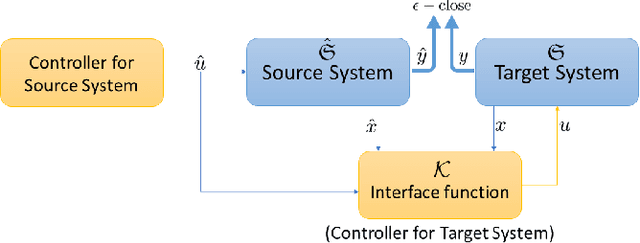
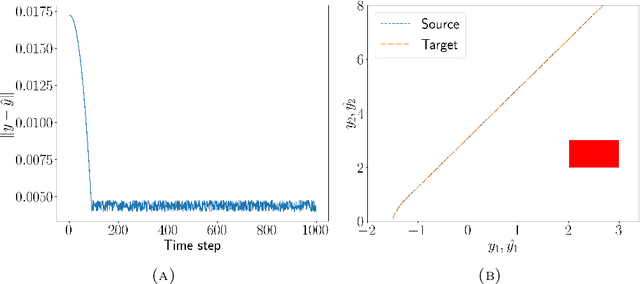
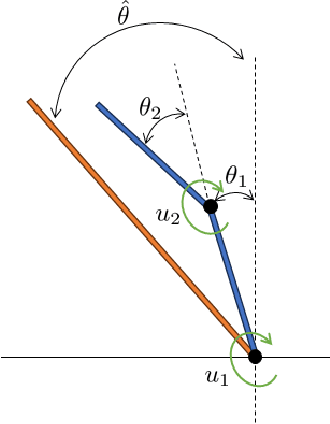
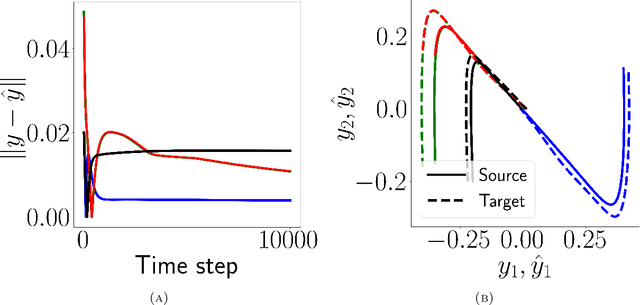
Transfer learning is an umbrella term for machine learning approaches that leverage knowledge gained from solving one problem (the source domain) to improve speed, efficiency, and data requirements in solving a different but related problem (the target domain). The performance of the transferred model in the target domain is typically measured via some notion of loss function in the target domain. This paper focuses on effectively transferring control logic from a source control system to a target control system while providing approximately similar behavioral guarantees in both domains. However, in the absence of a complete characterization of behavioral specifications, this problem cannot be captured in terms of loss functions. To overcome this challenge, we use (approximate) simulation relations to characterize observational equivalence between the behaviors of two systems. Simulation relations ensure that the outputs of both systems, equipped with their corresponding controllers, remain close to each other over time, and their closeness can be quantified {\it a priori}. By parameterizing simulation relations with neural networks, we introduce the notion of \emph{neural simulation relations}, which provides a data-driven approach to transfer any synthesized controller, regardless of the specification of interest, along with its proof of correctness. Compared with prior approaches, our method eliminates the need for a closed-loop mathematical model and specific requirements for both the source and target systems. We also introduce validity conditions that, when satisfied, guarantee the closeness of the outputs of two systems equipped with their corresponding controllers, thus eliminating the need for post-facto verification. We demonstrate the effectiveness of our approach through case studies involving a vehicle and a double inverted pendulum.