 Add to Chrome
 Add to Firefox
 Add to Edge
Search over the Visual World: Persistent Visual Memory, Layered Indexes, and Source-Grounded Evidence
Aug 08, 2026
Most video-retrieval systems assume a bounded corpus and return ranked files or timestamps. Agents operating over cameras, screens, streams, and archives face a different systems problem: observations arrive continuously; models interpret them at different temporal granularities; context must be selected without replaying the complete visual record; and results must stay connected to inspectable source evidence. We argue that search over such a corpus is an infrastructure problem that cannot be reduced to ranking video files. We develop a conceptual and formal model of search over the visual world built on analyzer-defined scenes, persistent understanding artifacts, visual memory as coexisting scene spaces over shared source time, and capability-declared indexes, distinguishing memory (everything retained), context (what is selected for a task), and evidence (the source intervals that ground it). The VideoDB data format (VDB) realizes this model in production, exposed through a typed search surface spanning planned retrieval, stateful investigation, direct access, and grounded synthesis. We contrast this model-agnostic infrastructure, where segmentation, sampling, model choice, embeddings, and ranking are system decisions and live streams are first-class sources, with video-native foundation models offered as fixed APIs. In a semantic-retrieval comparison against a commercial video-native engine spanning 9,800+ queries over four public datasets, a pipeline of general-purpose components achieves higher macro-averaged Recall@1/@3/@10 (73.09/83.39/91.20 versus 65.75/77.13/89.10), while the baseline is higher at Recall@50 (96.42 versus 96.07). Retrieval quality over the visual world is today governed more by system design than by video-specific pretraining, and visual-memory infrastructure can deliver it while keeping playable, source-grounded evidence first-class.

KV-Fold: One-Step KV-Cache Recurrence for Long-Context Inference
May 12, 2026We introduce KV-Fold, a simple, training-free long-context inference protocol that treats the key-value (KV) cache as the accumulator in a left fold over sequence chunks. At each step, the model processes the next chunk conditioned on the accumulated cache, appends the newly produced keys and values, and passes the enlarged cache forward; the same one-step update is applied repeatedly, analogous to foldl in functional programming. Building on the KV cache concatenation primitive introduced for latent multi-agent communication, we repurpose it as a chunk-to-chunk recurrence for long-context inference. When processing chunk t, the model attends to the KV cache carried from earlier chunks as a prefix, reusing its internal state across segments without modifying or retraining the model. Despite its simplicity, the induced recurrence is stable: per-step drift rises briefly and then saturates into a flat plateau that persists across deep chains. This plateau is insensitive to a 10,000x change in numerical precision, robust across chunk sizes, and consistent across model families. At the task level, KV-Fold preserves exact information over long distances. On a needle-in-a-haystack benchmark, it achieves 100% exact-match retrieval across 152 trials spanning contexts from 16K to 128K tokens and chain depths up to 511 on Llama-3.1-8B, while remaining within the memory limits of a single 40GB GPU. Compared to streaming methods, which trade fidelity for bounded memory, KV-Fold maintains long-range retrieval while operating as a sequence of tractable forward passes. Overall, our results show that frozen pretrained transformers already support a stable form of KV-cache recurrence, providing a practical route to long-context inference without architectural changes or training.
Do Thought Streams Matter? Evaluating Reasoning in Gemini Vision-Language Models for Video Scene Understanding
Apr 13, 2026We benchmark how internal reasoning traces, which we call thought streams, affect video scene understanding in vision-language models. Using four configurations of Google's Gemini 2.5 Flash and Flash Lite across scenes extracted from 100 hours of video, we ask three questions: does more thinking lead to better outputs, where do the gains stop, and what do these models actually think about? We introduce three evaluation metrics. Contentfulness measures how much of the thought stream is useful scene content versus meta-commentary. Thought-Final Coverage measures how faithfully the thought stream translates into the final output. Dominant Entity Analysis identifies which subjects, actions, and settings the model focuses on. GPT-5 serves as an independent judge. We find that quality gains from additional thinking plateau quickly, with most improvement occurring in the first few hundred tokens. Flash Lite offers the best balance between quality and token usage. Tight reasoning budgets cause the model to add content in the final output that it never reasoned about, a form of compression-step hallucination. Despite being different model tiers, Flash and Flash Lite produce similar thought streams, though they differ in style: Flash discusses its reasoning process, while Lite focuses on describing the scene.
Monotonicity as an Architectural Bias for Robust Language Models
Feb 02, 2026Large language models (LLMs) are known to exhibit brittle behavior under adversarial prompts and jailbreak attacks, even after extensive alignment and fine-tuning. This fragility reflects a broader challenge of modern neural language models: small, carefully structured perturbations in high-dimensional input spaces can induce large and unpredictable changes in internal semantic representations and output. We investigate monotonicity as an architectural inductive bias for improving the robustness of Transformer-based language models. Monotonicity constrains semantic transformations so that strengthening information, evidence, or constraints cannot lead to regressions in the corresponding internal representations. Such order-preserving behavior has long been exploited in control and safety-critical systems to simplify reasoning and improve robustness, but has traditionally been viewed as incompatible with the expressivity required by neural language models. We show that this trade-off is not inherent. By enforcing monotonicity selectively in the feed-forward sublayers of sequence-to-sequence Transformers -- while leaving attention mechanisms unconstrained -- we obtain monotone language models that preserve the performance of their pretrained counterparts. This architectural separation allows negation, contradiction, and contextual interactions to be introduced explicitly through attention, while ensuring that subsequent semantic refinement is order-preserving. Empirically, monotonicity substantially improves robustness: adversarial attack success rates drop from approximately 69% to 19%, while standard summarization performance degrades only marginally.
Uncovering Discrimination Clusters: Quantifying and Explaining Systematic Fairness Violations
Dec 29, 2025Fairness in algorithmic decision-making is often framed in terms of individual fairness, which requires that similar individuals receive similar outcomes. A system violates individual fairness if there exists a pair of inputs differing only in protected attributes (such as race or gender) that lead to significantly different outcomes-for example, one favorable and the other unfavorable. While this notion highlights isolated instances of unfairness, it fails to capture broader patterns of systematic or clustered discrimination that may affect entire subgroups. We introduce and motivate the concept of discrimination clustering, a generalization of individual fairness violations. Rather than detecting single counterfactual disparities, we seek to uncover regions of the input space where small perturbations in protected features lead to k-significantly distinct clusters of outcomes. That is, for a given input, we identify a local neighborhood-differing only in protected attributes-whose members' outputs separate into many distinct clusters. These clusters reveal significant arbitrariness in treatment solely based on protected attributes that help expose patterns of algorithmic bias that elude pairwise fairness checks. We present HyFair, a hybrid technique that combines formal symbolic analysis (via SMT and MILP solvers) to certify individual fairness with randomized search to discover discriminatory clusters. This combination enables both formal guarantees-when no counterexamples exist-and the detection of severe violations that are computationally challenging for symbolic methods alone. Given a set of inputs exhibiting high k-unfairness, we introduce a novel explanation method to generate interpretable, decision-tree-style artifacts. Our experiments demonstrate that HyFair outperforms state-of-the-art fairness verification and local explanation methods.
BarrierBench : Evaluating Large Language Models for Safety Verification in Dynamical Systems
Nov 12, 2025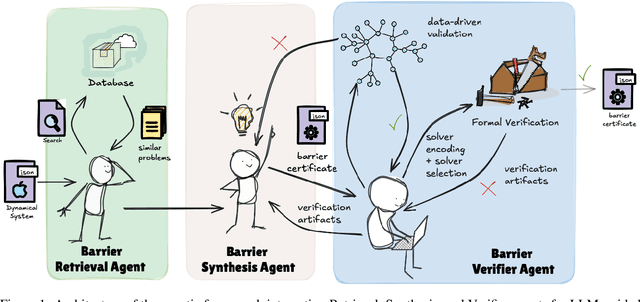
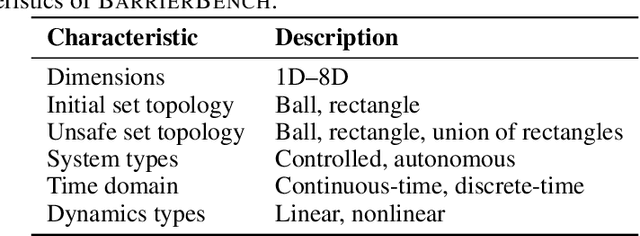
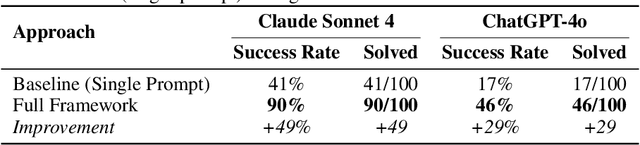
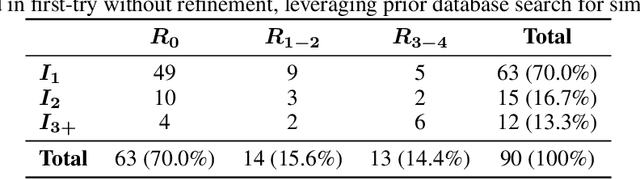
Safety verification of dynamical systems via barrier certificates is essential for ensuring correctness in autonomous applications. Synthesizing these certificates involves discovering mathematical functions with current methods suffering from poor scalability, dependence on carefully designed templates, and exhaustive or incremental function-space searches. They also demand substantial manual expertise--selecting templates, solvers, and hyperparameters, and designing sampling strategies--requiring both theoretical and practical knowledge traditionally shared through linguistic reasoning rather than formalized methods. This motivates a key question: can such expert reasoning be captured and operationalized by language models? We address this by introducing an LLM-based agentic framework for barrier certificate synthesis. The framework uses natural language reasoning to propose, refine, and validate candidate certificates, integrating LLM-driven template discovery with SMT-based verification, and supporting barrier-controller co-synthesis to ensure consistency between safety certificates and controllers. To evaluate this capability, we introduce BarrierBench, a benchmark of 100 dynamical systems spanning linear, nonlinear, discrete-time, and continuous-time settings. Our experiments assess not only the effectiveness of LLM-guided barrier synthesis but also the utility of retrieval-augmented generation and agentic coordination strategies in improving its reliability and performance. Across these tasks, the framework achieves more than 90% success in generating valid certificates. By releasing BarrierBench and the accompanying toolchain, we aim to establish a community testbed for advancing the integration of language-based reasoning with formal verification in dynamical systems. The benchmark is publicly available at https://hycodev.com/dataset/barrierbench
Explaining Hitori Puzzles: Neurosymbolic Proof Staging for Sequential Decisions
Aug 19, 2025We propose a neurosymbolic approach to the explanation of complex sequences of decisions that combines the strengths of decision procedures and Large Language Models (LLMs). We demonstrate this approach by producing explanations for the solutions of Hitori puzzles. The rules of Hitori include local constraints that are effectively explained by short resolution proofs. However, they also include a connectivity constraint that is more suitable for visual explanations. Hence, Hitori provides an excellent testing ground for a flexible combination of SAT solvers and LLMs. We have implemented a tool that assists humans in solving Hitori puzzles, and we present experimental evidence of its effectiveness.
Explaining Puzzle Solutions in Natural Language: An Exploratory Study on 6x6 Sudoku
May 21, 2025The success of Large Language Models (LLMs) in human-AI collaborative decision-making hinges on their ability to provide trustworthy, gradual, and tailored explanations. Solving complex puzzles, such as Sudoku, offers a canonical example of this collaboration, where clear and customized explanations often hold greater importance than the final solution. In this study, we evaluate the performance of five LLMs in solving and explaining \sixsix{} Sudoku puzzles. While one LLM demonstrates limited success in solving puzzles, none can explain the solution process in a manner that reflects strategic reasoning or intuitive problem-solving. These findings underscore significant challenges that must be addressed before LLMs can become effective partners in human-AI collaborative decision-making.
Technical Challenges in Maintaining Tax Prep Software with Large Language Models
Apr 25, 2025
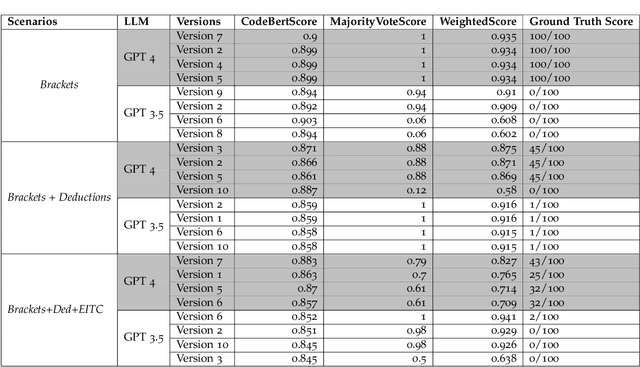
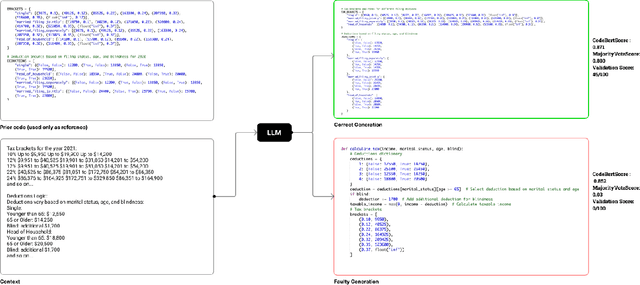
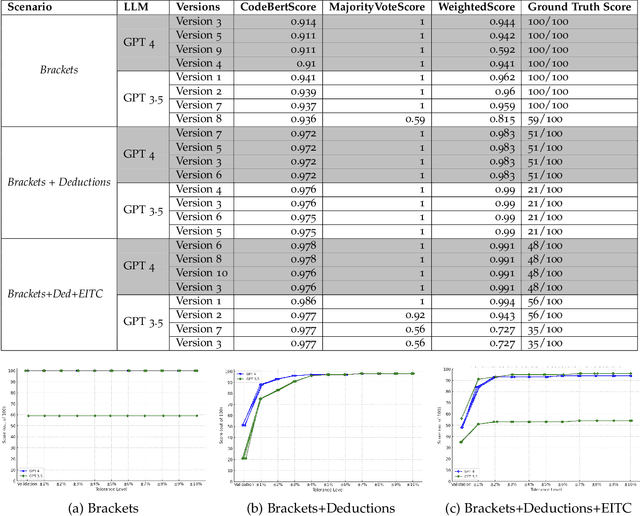
As the US tax law evolves to adapt to ever-changing politico-economic realities, tax preparation software plays a significant role in helping taxpayers navigate these complexities. The dynamic nature of tax regulations poses a significant challenge to accurately and timely maintaining tax software artifacts. The state-of-the-art in maintaining tax prep software is time-consuming and error-prone as it involves manual code analysis combined with an expert interpretation of tax law amendments. We posit that the rigor and formality of tax amendment language, as expressed in IRS publications, makes it amenable to automatic translation to executable specifications (code). Our research efforts focus on identifying, understanding, and tackling technical challenges in leveraging Large Language Models (LLMs), such as ChatGPT and Llama, to faithfully extract code differentials from IRS publications and automatically integrate them with the prior version of the code to automate tax prep software maintenance.
Benchmarking Vision-Language Models on Optical Character Recognition in Dynamic Video Environments
Feb 10, 2025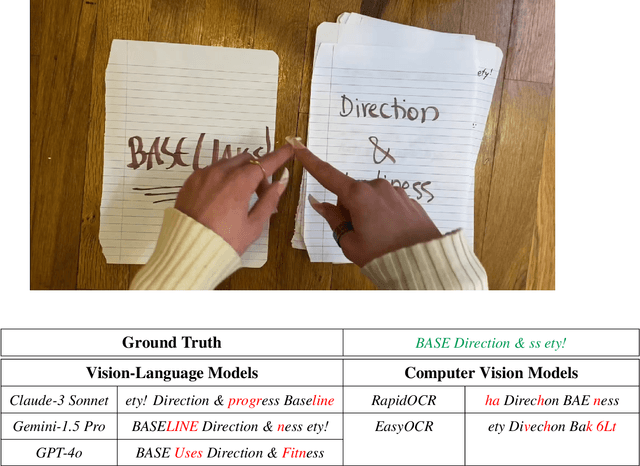
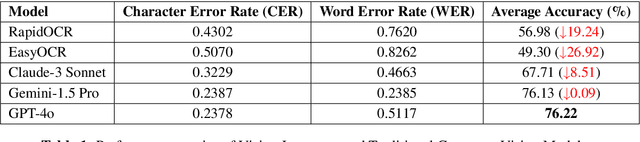
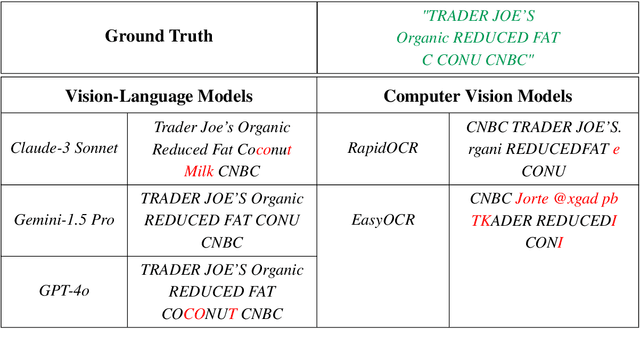
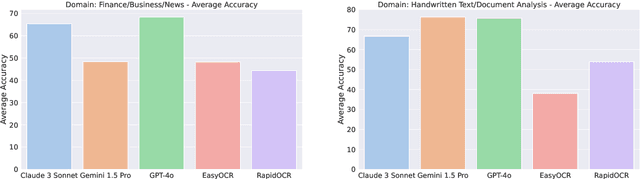
This paper introduces an open-source benchmark for evaluating Vision-Language Models (VLMs) on Optical Character Recognition (OCR) tasks in dynamic video environments. We present a curated dataset containing 1,477 manually annotated frames spanning diverse domains, including code editors, news broadcasts, YouTube videos, and advertisements. Three state of the art VLMs - Claude-3, Gemini-1.5, and GPT-4o are benchmarked against traditional OCR systems such as EasyOCR and RapidOCR. Evaluation metrics include Word Error Rate (WER), Character Error Rate (CER), and Accuracy. Our results highlight the strengths and limitations of VLMs in video-based OCR tasks, demonstrating their potential to outperform conventional OCR models in many scenarios. However, challenges such as hallucinations, content security policies, and sensitivity to occluded or stylized text remain. The dataset and benchmarking framework are publicly available to foster further research.