 Add to Chrome
 Add to Firefox
 Add to Edge
Group Alignment-Induced Sycophancy: A Two-Sided Evaluation of Steerable Pluralistic Alignment
Aug 12, 2026
Group alignment adapts a language model to a demographic group to produce responses that reflect the group's opinions, values, and preferences. Sycophancy, a well-documented by-product of alignment, causes the model to over-agree with the user regardless of factual and objective information. However, existing group alignment methods and evaluations focus only on how closely the model matches the group's opinions, overlooking the induced change in sycophantic behaviour. To bridge this gap, we introduce \textbf{G}roup \textbf{A}lignment-induced \textbf{S}ycophancy (GAS) and systematically evaluate alignment across 3 methods, 4 models and 13 demographic groups, on both the intended gain in opinion alignment and the unintended shift in sycophancy. We find that gain and shift are non-uniform across groups: under an identical budget, some groups receive larger gains in opinion alignment than others, and the induced sycophancy shift forms a group-specific profile rather than a single-dimensional change. These results suggest that group alignment should be reported as a two-sided, multi-dimensional profile rather than a single fit score that accounts for per-group differences when adapting LLMs to diverse populations.

Generating Natural and Expressive Robot Gestures through Iterative Reinforcement Learning with Human Feedback using LLMs
Jun 17, 2026Expressive gestures are essential for natural and effective communication, complementing speech when verbal cues alone are insufficient (e.g., pointing). For social robots such as the humanoid Pepper, producing natural and expressive movements is critical for improving human-robot interaction (HRI) and long-term acceptance. However, generating gestures remains challenging due to reliance on expert-authored animations, resulting in rigid behaviors that are impractical for dynamic and diverse environments. Alternatively, machine learning approaches often struggle to capture perceived naturalness, becoming increasingly challenging with more degrees of freedom. Consequently, producing expressive robot gestures requires a system that can adapt to the environment while adhering to social norms and physical constraints. Recent advances in large language models (LLMs) enable dynamic code generation, offering new opportunities for runtime gesture synthesis from natural language. In this paper, we integrate ChatGPT into the humanoid robot Pepper to generate co-speech gestures aligned with conversational output. While this baseline enables flexible gesture generation, the resulting motions are often perceived as stiff and unnatural. To address this limitation, we introduce an iterative reinforcement learning with human feedback (RLHF) system that finetunes gesture generation based on user evaluations, leveraging an iterative user study to compare Pepper's generated gestures. Our results show that RLHF improved the LLM's co-speech generative capabilities, producing more expressive, relevant and fluid movements.
AnyMo: Geometry-Aware Setup-Agnostic Modeling of Human Motion in the Wild
May 21, 2026As wearable and mobile devices become increasingly embedded in daily life, they offer a practical way to continuously sense human motion in the wild. But inertial signals are highly dependent on the sensing setup, including body location, mounting position, sensor orientation, device hardware, and sampling protocol. This setup dependence makes it difficult to learn motion representations that transfer across devices and datasets, and limits the broader use of wearable IMUs beyond closed-set recognition. We introduce AnyMo, a geometry-aware framework for setup-agnostic human motion modeling. AnyMo uses physics-grounded IMU simulation over dense body-surface placements to generate diverse and plausible synthetic signals, pre-trains a graph encoder from paired synthetic placement views and masked partial observations, tokenizes multi-position IMU into full-body motion tokens, and aligns these tokens with an LLM for motion-language understanding. We evaluate AnyMo on three complementary tasks: zero-shot activity recognition across 14 unseen downstream datasets, cross-modal retrieval, and wearable IMU motion captioning, where it improves average Accuracy/F1/R@2 by 11.7\%/11.6\%/22.6\% on HAR, increases zero-shot IMU-to-text and text-to-IMU retrieval MRR by 15.9\% and 28.6\%, respectively, and improves zero-shot captioning BERT-F1 by 18.8\%. These results support AnyMo as a generalist model for wearable motion understanding in the wild. Project page: https://baiyuchen.com/project/AnyMo.
AR-Facilitated Safety Inspection and Fall Hazard Detection on Construction Sites
Dec 02, 2024Together with industry experts, we are exploring the potential of head-mounted augmented reality to facilitate safety inspections on high-rise construction sites. A particular concern in the industry is inspecting perimeter safety screens on higher levels of construction sites, intended to prevent falls of people and objects. We aim to support workers performing this inspection task by tracking which parts of the safety screens have been inspected. We use machine learning to automatically detect gaps in the perimeter screens that require closer inspection and remediation and to automate reporting. This work-in-progress paper describes the problem, our early progress, concerns around worker privacy, and the possibilities to mitigate these.
DDoD: Dual Denial of Decision Attacks on Human-AI Teams
Dec 07, 2022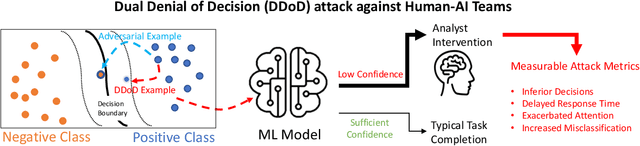
Artificial Intelligence (AI) systems have been increasingly used to make decision-making processes faster, more accurate, and more efficient. However, such systems are also at constant risk of being attacked. While the majority of attacks targeting AI-based applications aim to manipulate classifiers or training data and alter the output of an AI model, recently proposed Sponge Attacks against AI models aim to impede the classifier's execution by consuming substantial resources. In this work, we propose \textit{Dual Denial of Decision (DDoD) attacks against collaborative Human-AI teams}. We discuss how such attacks aim to deplete \textit{both computational and human} resources, and significantly impair decision-making capabilities. We describe DDoD on human and computational resources and present potential risk scenarios in a series of exemplary domains.