 Add to Chrome
 Add to Firefox
 Add to Edge
A Directed Graph Model and Experimental Framework for Design and Study of Time-Dependent Text Visualisation
Mar 02, 2026
Exponential growth in the quantity of digital news, social media, and other textual sources makes it difficult for humans to keep up with rapidly evolving narratives about world events. Various visualisation techniques have been touted to help people to understand such discourse by exposing relationships between texts (such as news articles) as topics and themes evolve over time. Arguably, the understandability of such visualisations hinges on the assumption that people will be able to easily interpret the relationships in such visual network structures. To test this assumption, we begin by defining an abstract model of time-dependent text visualisation based on directed graph structures. From this model we distill motifs that capture the set of possible ways that texts can be linked across changes in time. We also develop a controlled synthetic text generation methodology that leverages the power of modern LLMs to create fictional, yet structured sets of time-dependent texts that fit each of our patterns. Therefore, we create a clean user study environment (n=30) for participants to identify patterns that best represent a given set of synthetic articles. We find that it is a challenging task for the user to identify and recover the predefined motif. We analyse qualitative data to map an unexpectedly rich variety of user rationales when divergences from expected interpretation occur. A deeper analysis also points to unexpected complexities inherent in the formation of synthetic datasets with LLMs that undermine the study control in some cases. Furthermore, analysis of individual decision-making in our study hints at a future where text discourse visualisation may need to dispense with a one-size-fits-all approach and, instead, should be more adaptable to the specific user who is exploring the visualisation in front of them.

ACCESS : A Benchmark for Abstract Causal Event Discovery and Reasoning
Feb 12, 2025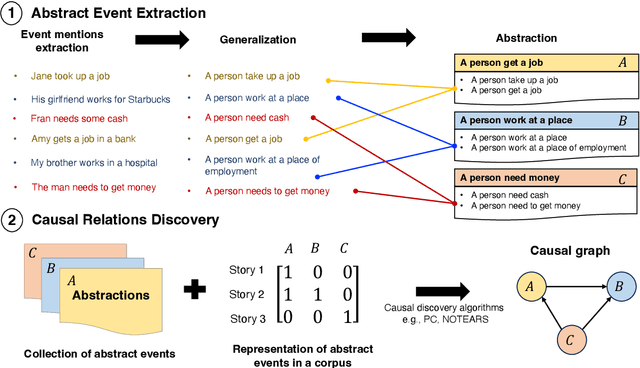
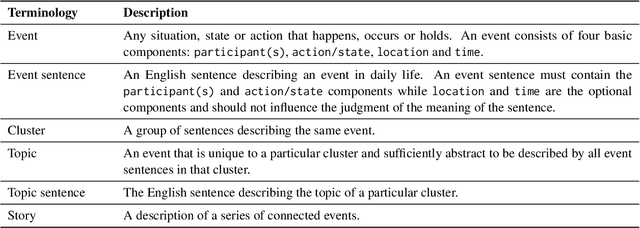
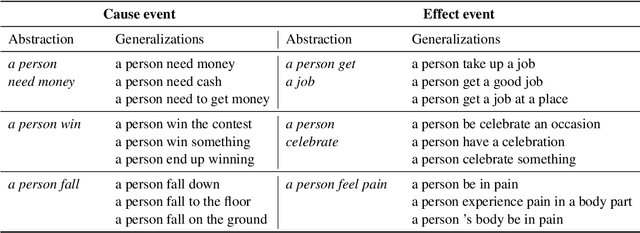
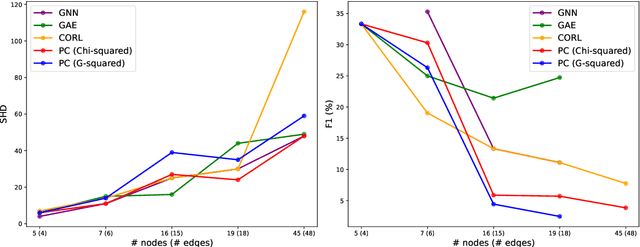
Identifying cause-and-effect relationships is critical to understanding real-world dynamics and ultimately causal reasoning. Existing methods for identifying event causality in NLP, including those based on Large Language Models (LLMs), exhibit difficulties in out-of-distribution settings due to the limited scale and heavy reliance on lexical cues within available benchmarks. Modern benchmarks, inspired by probabilistic causal inference, have attempted to construct causal graphs of events as a robust representation of causal knowledge, where \texttt{CRAB} \citep{romanou2023crab} is one such recent benchmark along this line. In this paper, we introduce \texttt{ACCESS}, a benchmark designed for discovery and reasoning over abstract causal events. Unlike existing resources, \texttt{ACCESS} focuses on causality of everyday life events on the abstraction level. We propose a pipeline for identifying abstractions for event generalizations from \texttt{GLUCOSE} \citep{mostafazadeh-etal-2020-glucose}, a large-scale dataset of implicit commonsense causal knowledge, from which we subsequently extract $1,4$K causal pairs. Our experiments highlight the ongoing challenges of using statistical methods and/or LLMs for automatic abstraction identification and causal discovery in NLP. Nonetheless, we demonstrate that the abstract causal knowledge provided in \texttt{ACCESS} can be leveraged for enhancing QA reasoning performance in LLMs.
AR-Facilitated Safety Inspection and Fall Hazard Detection on Construction Sites
Dec 02, 2024Together with industry experts, we are exploring the potential of head-mounted augmented reality to facilitate safety inspections on high-rise construction sites. A particular concern in the industry is inspecting perimeter safety screens on higher levels of construction sites, intended to prevent falls of people and objects. We aim to support workers performing this inspection task by tracking which parts of the safety screens have been inspected. We use machine learning to automatically detect gaps in the perimeter screens that require closer inspection and remediation and to automate reporting. This work-in-progress paper describes the problem, our early progress, concerns around worker privacy, and the possibilities to mitigate these.