 Add to Chrome
 Add to Firefox
 Add to Edge
Avatar V: Scaling Video-Reference Avatar Video Generation
Jun 11, 2026
Generating avatar videos that are not merely visually similar to a target individual but behaviorally recognizable, faithfully reproducing their talking rhythm, gestural tendencies, and expression dynamics, remains an open challenge. Existing methods predominantly condition on single static images, which provide insufficient identity information and cannot capture dynamic motion traits, while standard pixel-level objectives underserve the perceptually critical facial regions that determine avatar fidelity. We present Avatar V, a production-scale framework that addresses these limitations through video-reference-conditioned identity modeling. Rather than compressing identity into fixed-size embeddings, the model conditions directly on the full token sequence of a reference video, learning to reproduce both static identity attributes (facial geometry, skin texture) and dynamic behavioral patterns (talking rhythm, micro-expressions) through attention over the reference context. We introduce Sparse Reference Attention, an asymmetric mechanism achieving linear-complexity conditioning on arbitrarily long references; a motion representation stream enabling closed-loop talking style transfer; and an identity-aware super-resolution refiner inheriting the full reference conditioning. These are supported by a data engine curating 100M+ training clips from 50M raw videos, and a five-stage training pipeline with flow matching pre-training, personality fine-tuning, two-phase distillation (>10x acceleration), and RLHF alignment, deployed across thousands of GPUs. Avatar V generates 1080p videos of unlimited duration, achieving state-of-the-art identity preservation, lip synchronization, and generation quality on our cross-scene benchmark, consistently outperforming leading systems including Seedance 2.0, Kling O3 Pro, Veo 3.1, and OmniHuman 1.5 in both automated metrics and human evaluation.

Force-Aware Interface via Electromyography for Natural VR/AR Interaction
Oct 03, 2022


While tremendous advances in visual and auditory realism have been made for virtual and augmented reality (VR/AR), introducing a plausible sense of physicality into the virtual world remains challenging. Closing the gap between real-world physicality and immersive virtual experience requires a closed interaction loop: applying user-exerted physical forces to the virtual environment and generating haptic sensations back to the users. However, existing VR/AR solutions either completely ignore the force inputs from the users or rely on obtrusive sensing devices that compromise user experience. By identifying users' muscle activation patterns while engaging in VR/AR, we design a learning-based neural interface for natural and intuitive force inputs. Specifically, we show that lightweight electromyography sensors, resting non-invasively on users' forearm skin, inform and establish a robust understanding of their complex hand activities. Fuelled by a neural-network-based model, our interface can decode finger-wise forces in real-time with 3.3% mean error, and generalize to new users with little calibration. Through an interactive psychophysical study, we show that human perception of virtual objects' physical properties, such as stiffness, can be significantly enhanced by our interface. We further demonstrate that our interface enables ubiquitous control via finger tapping. Ultimately, we envision our findings to push forward research towards more realistic physicality in future VR/AR.
Egocentric Prediction of Action Target in 3D
Mar 24, 2022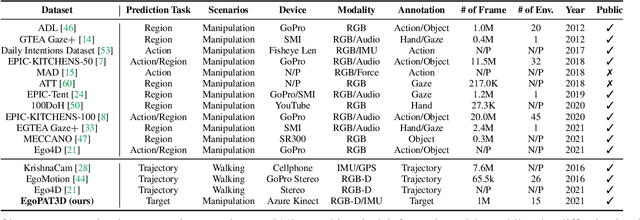
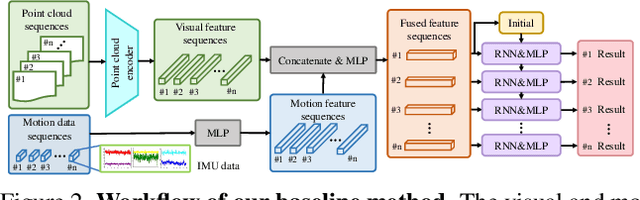
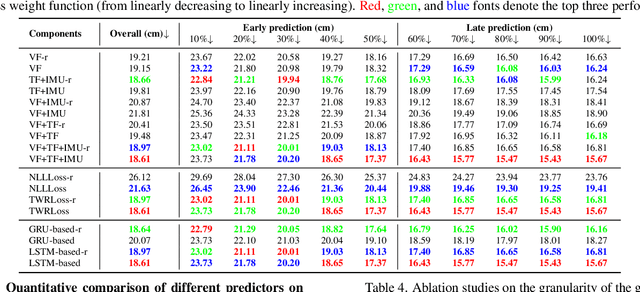
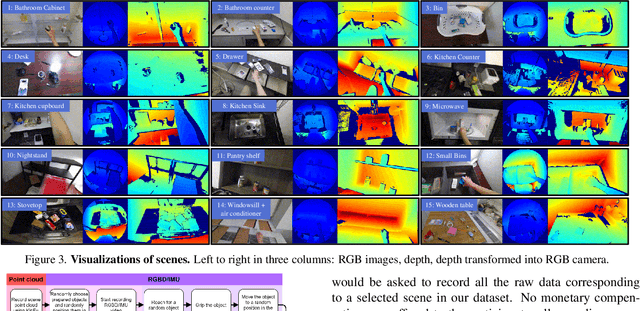
We are interested in anticipating as early as possible the target location of a person's object manipulation action in a 3D workspace from egocentric vision. It is important in fields like human-robot collaboration, but has not yet received enough attention from vision and learning communities. To stimulate more research on this challenging egocentric vision task, we propose a large multimodality dataset of more than 1 million frames of RGB-D and IMU streams, and provide evaluation metrics based on our high-quality 2D and 3D labels from semi-automatic annotation. Meanwhile, we design baseline methods using recurrent neural networks and conduct various ablation studies to validate their effectiveness. Our results demonstrate that this new task is worthy of further study by researchers in robotics, vision, and learning communities.