 Add to Chrome
 Add to Firefox
 Add to Edge
A Milestone in Formalization: The Sphere Packing Problem in Dimension 8
Apr 28, 2026
In 2016, Viazovska famously solved the sphere packing problem in dimension $8$, using modular forms to construct a 'magic' function satisfying optimality conditions determined by Cohn and Elkies in 2003. In March 2024, Hariharan and Viazovska launched a project to formalize this solution and related mathematical facts in the Lean Theorem Prover. A significant milestone was achieved in February 2026: the result was formally verified, with the final stages of the verification done by Math, Inc.'s autoformalization model 'Gauss'. We discuss the techniques used to achieve this milestone, reflect on the unique collaboration between humans and Gauss, and discuss project objectives that remain.

Do LLMs Game Formalization? Evaluating Faithfulness in Logical Reasoning
Apr 21, 2026Formal verification guarantees proof validity but not formalization faithfulness. For natural-language logical reasoning, where models construct axiom systems from scratch without library constraints, this gap between valid proofs and faithful translations is especially acute. We investigate whether frontier models exploit this gap when generating Lean 4 proofs, a behavior we term formalization gaming. We evaluate GPT-5 and DeepSeek-R1 on 303 first-order logic problems (203 from FOLIO, 100 from Multi-LogiEval), comparing unified generation against a two-stage pipeline that separates formalization from proving. Despite compilation rates of 87-99%, we find no evidence of systematic gaming in unified generation: models prefer reporting failure over forcing proofs, even under prompting designed to encourage it. However, unfaithfulness that evades our detection signals may still occur. The two-stage pipeline reveals two distinct modes of unfaithfulness: GPT-5 fabricates axioms during proof generation, a reactive fallback detectable via cross-stage comparison, while DeepSeek-R1 mistranslates premises during formalization, producing internally consistent outputs that evade detection entirely. These findings show that high compilation rates or accuracies should not be equated with faithful reasoning. Code and data are available at https://github.com/koreankiwi99/formalization-gaming.
SorryDB: Can AI Provers Complete Real-World Lean Theorems?
Mar 03, 2026We present SorryDB, a dynamically-updating benchmark of open Lean tasks drawn from 78 real world formalization projects on GitHub. Unlike existing static benchmarks, often composed of competition problems, hillclimbing the SorryDB benchmark will yield tools that are aligned to the community needs, more usable by mathematicians, and more capable of understanding complex dependencies. Moreover, by providing a continuously updated stream of tasks, SorryDB mitigates test-set contamination and offers a robust metric for an agent's ability to contribute to novel formal mathematics projects. We evaluate a collection of approaches, including generalist large language models, agentic approaches, and specialized symbolic provers, over a selected snapshot of 1000 tasks from SorryDB. We show that current approaches are complementary: even though an agentic approach based on Gemini Flash is the most performant, it is not strictly better than other off-the-shelf large-language models, specialized provers, or even a curated list of Lean tactics.
Apertus: Democratizing Open and Compliant LLMs for Global Language Environments
Sep 17, 2025
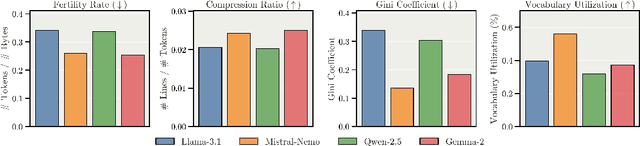

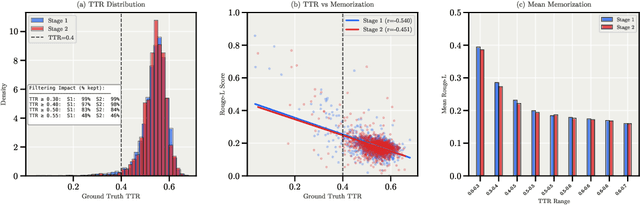
We present Apertus, a fully open suite of large language models (LLMs) designed to address two systemic shortcomings in today's open model ecosystem: data compliance and multilingual representation. Unlike many prior models that release weights without reproducible data pipelines or regard for content-owner rights, Apertus models are pretrained exclusively on openly available data, retroactively respecting robots.txt exclusions and filtering for non-permissive, toxic, and personally identifiable content. To mitigate risks of memorization, we adopt the Goldfish objective during pretraining, strongly suppressing verbatim recall of data while retaining downstream task performance. The Apertus models also expand multilingual coverage, training on 15T tokens from over 1800 languages, with ~40% of pretraining data allocated to non-English content. Released at 8B and 70B scales, Apertus approaches state-of-the-art results among fully open models on multilingual benchmarks, rivalling or surpassing open-weight counterparts. Beyond model weights, we release all scientific artifacts from our development cycle with a permissive license, including data preparation scripts, checkpoints, evaluation suites, and training code, enabling transparent audit and extension.
Improving Autoformalization using Type Checking
Jun 11, 2024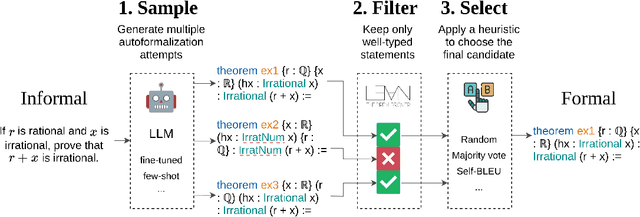

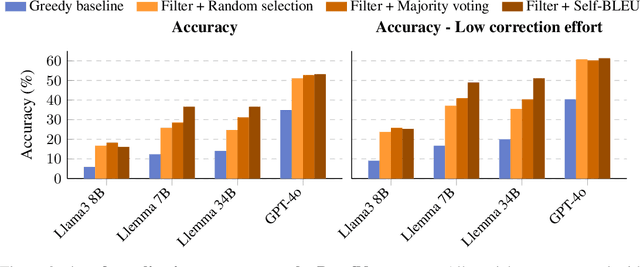

Large language models show promise for autoformalization, the task of automatically translating natural language into formal languages. However, current autoformalization methods remain limited. The last reported state-of-the-art performance on the ProofNet formalization benchmark for the Lean proof assistant, achieved using Codex for Lean 3, only showed successful formalization of 16.1% of informal statements. Similarly, our evaluation of GPT-4o for Lean 4 only produces successful translations 34.9% of the time. Our analysis shows that the performance of these models is largely limited by their inability to generate formal statements that successfully type-check (i.e., are syntactically correct and consistent with types) - with a whopping 86.6% of GPT-4o errors starting from a type-check failure. In this work, we propose a method to fix this issue through decoding with type-check filtering, where we initially sample a diverse set of candidate formalizations for an informal statement, then use the Lean proof assistant to filter out candidates that do not type-check. Using GPT-4o as a base model, and combining our method with self-consistency, we obtain a +18.3% absolute increase in formalization accuracy, and achieve a new state-of-the-art of 53.2% on ProofNet with Lean 4.