 Add to Chrome
 Add to Firefox
 Add to Edge
SorryDB: Can AI Provers Complete Real-World Lean Theorems?
Mar 03, 2026
We present SorryDB, a dynamically-updating benchmark of open Lean tasks drawn from 78 real world formalization projects on GitHub. Unlike existing static benchmarks, often composed of competition problems, hillclimbing the SorryDB benchmark will yield tools that are aligned to the community needs, more usable by mathematicians, and more capable of understanding complex dependencies. Moreover, by providing a continuously updated stream of tasks, SorryDB mitigates test-set contamination and offers a robust metric for an agent's ability to contribute to novel formal mathematics projects. We evaluate a collection of approaches, including generalist large language models, agentic approaches, and specialized symbolic provers, over a selected snapshot of 1000 tasks from SorryDB. We show that current approaches are complementary: even though an agentic approach based on Gemini Flash is the most performant, it is not strictly better than other off-the-shelf large-language models, specialized provers, or even a curated list of Lean tactics.

Generating Structured Outputs from Language Models: Benchmark and Studies
Jan 18, 2025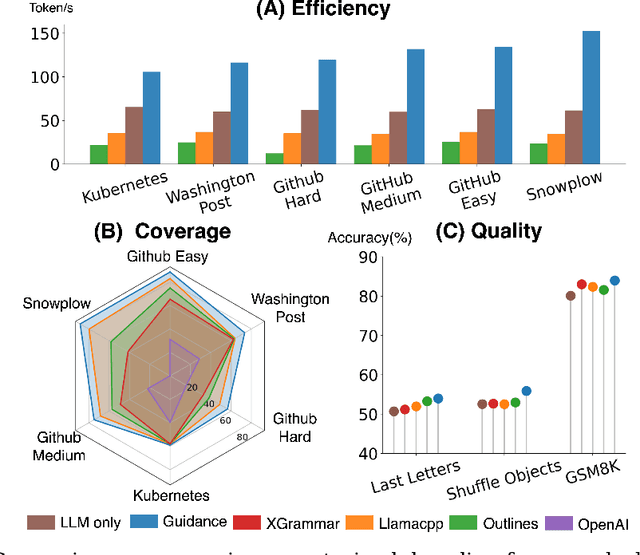
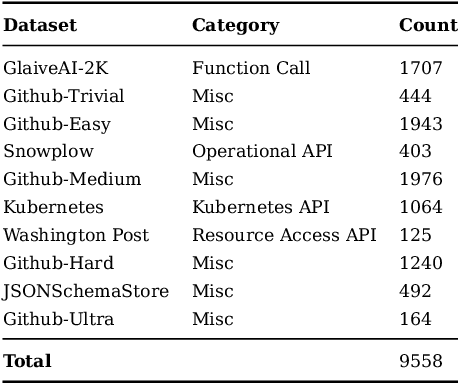
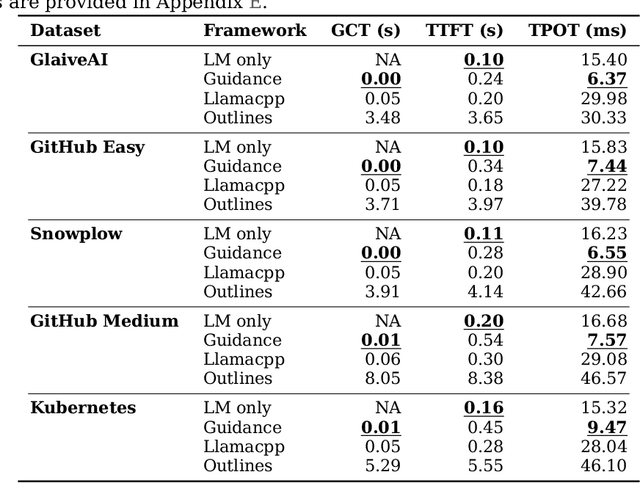
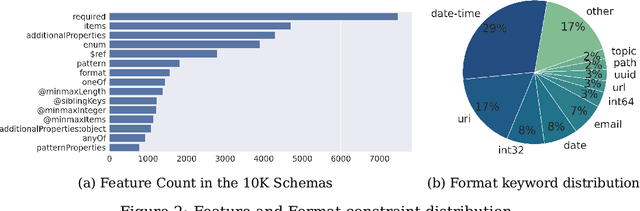
Reliably generating structured outputs has become a critical capability for modern language model (LM) applications. Constrained decoding has emerged as the dominant technology across sectors for enforcing structured outputs during generation. Despite its growing adoption, little has been done with the systematic evaluation of the behaviors and performance of constrained decoding. Constrained decoding frameworks have standardized around JSON Schema as a structured data format, with most uses guaranteeing constraint compliance given a schema. However, there is poor understanding of the effectiveness of the methods in practice. We present an evaluation framework to assess constrained decoding approaches across three critical dimensions: efficiency in generating constraint-compliant outputs, coverage of diverse constraint types, and quality of the generated outputs. To facilitate this evaluation, we introduce JSONSchemaBench, a benchmark for constrained decoding comprising 10K real-world JSON schemas that encompass a wide range of constraints with varying complexity. We pair the benchmark with the existing official JSON Schema Test Suite and evaluate six state-of-the-art constrained decoding frameworks, including Guidance, Outlines, Llamacpp, XGrammar, OpenAI, and Gemini. Through extensive experiments, we gain insights into the capabilities and limitations of constrained decoding on structured generation with real-world JSON schemas. Our work provides actionable insights for improving constrained decoding frameworks and structured generation tasks, setting a new standard for evaluating constrained decoding and structured generation. We release JSONSchemaBench at https://github.com/guidance-ai/jsonschemabench