 Add to Chrome
 Add to Firefox
 Add to Edge
ChainMark: Model-Free LLM Watermarking with Closed-Form Calibration
Jul 20, 2026
Regulatory regimes such as the EU AI Act mandate machine-readable marking of synthetic text, but existing watermark detectors rely on the generating LM and on heuristic thresholds with no closed-form calibration. We introduce ChainMark, an active watermark that partitions the vocabulary into S states via keyed SHA-256 and forces a hard Markov transition on a fraction rho of positions; the detector replays the partition from the same key in O(n) hash operations, with no LM access. We derive a closed-form S*(n, rho, alpha) mapping a target FPR, text length, and budget to the minimum state count (Theorem 1), prove a universal robustness threshold delta* = 1 - 1/sqrt(2) approximately 29.3% that is invariant in (S, rho, n) (Theorem 2), and generalise both to any k-regular transition topology (Theorem 3). Across three instruction-tuned LLMs and four domains, ChainMark strictly dominates KGW and SWEET under translation and random-substitution attacks at matched budget; a one-corpus empirical recalibration restores the 1% target FPR on natural-language text.

Do LLMs Game Formalization? Evaluating Faithfulness in Logical Reasoning
Apr 21, 2026Formal verification guarantees proof validity but not formalization faithfulness. For natural-language logical reasoning, where models construct axiom systems from scratch without library constraints, this gap between valid proofs and faithful translations is especially acute. We investigate whether frontier models exploit this gap when generating Lean 4 proofs, a behavior we term formalization gaming. We evaluate GPT-5 and DeepSeek-R1 on 303 first-order logic problems (203 from FOLIO, 100 from Multi-LogiEval), comparing unified generation against a two-stage pipeline that separates formalization from proving. Despite compilation rates of 87-99%, we find no evidence of systematic gaming in unified generation: models prefer reporting failure over forcing proofs, even under prompting designed to encourage it. However, unfaithfulness that evades our detection signals may still occur. The two-stage pipeline reveals two distinct modes of unfaithfulness: GPT-5 fabricates axioms during proof generation, a reactive fallback detectable via cross-stage comparison, while DeepSeek-R1 mistranslates premises during formalization, producing internally consistent outputs that evade detection entirely. These findings show that high compilation rates or accuracies should not be equated with faithful reasoning. Code and data are available at https://github.com/koreankiwi99/formalization-gaming.
KoCoNovel: Annotated Dataset of Character Coreference in Korean Novels
Apr 11, 2024

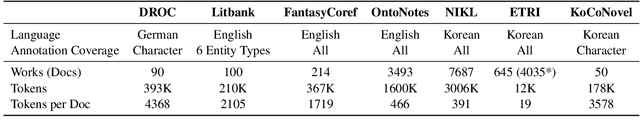
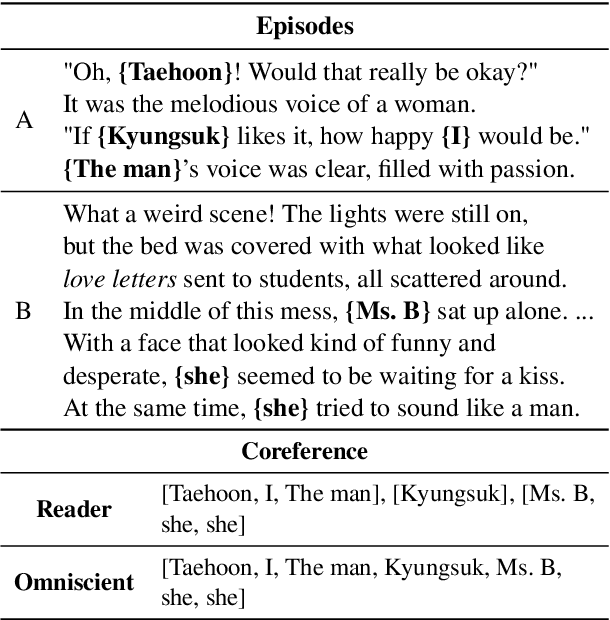
In this paper, we present KoCoNovel, a novel character coreference dataset derived from Korean literary texts, complete with detailed annotation guidelines. Comprising 178K tokens from 50 modern and contemporary novels, KoCoNovel stands as one of the largest public coreference resolution corpora in Korean, and the first to be based on literary texts. KoCoNovel offers four distinct versions to accommodate a wide range of literary coreference analysis needs. These versions are designed to support perspectives of the omniscient author or readers, and to manage multiple entities as either separate or overlapping, thereby broadening its applicability. One of KoCoNovel's distinctive features is that 24% of all character mentions are single common nouns, lacking possessive markers or articles. This feature is particularly influenced by the nuances of Korean address term culture, which favors the use of terms denoting social relationships and kinship over personal names. In experiments with a BERT-based coreference model, we observe notable performance enhancements with KoCoNovel in character coreference tasks within literary texts, compared to a larger non-literary coreference dataset. Such findings underscore KoCoNovel's potential to significantly enhance coreference resolution models through the integration of Korean cultural and linguistic dynamics.
K-Act2Emo: Korean Commonsense Knowledge Graph for Indirect Emotional Expression
Mar 23, 2024In many literary texts, emotions are indirectly conveyed through descriptions of actions, facial expressions, and appearances, necessitating emotion inference for narrative understanding. In this paper, we introduce K-Act2Emo, a Korean commonsense knowledge graph (CSKG) comprising 1,900 indirect emotional expressions and the emotions inferable from them. We categorize reasoning types into inferences in positive situations, inferences in negative situations, and inferences when expressions do not serve as emotional cues. Unlike existing CSKGs, K-Act2Emo specializes in emotional contexts, and experimental results validate its effectiveness for training emotion inference models. Significantly, the BART-based knowledge model fine-tuned with K-Act2Emo outperforms various existing Korean large language models, achieving performance levels comparable to GPT-4 Turbo.