 Add to Chrome
 Add to Firefox
 Add to Edge
Managing Procedural Memory in LLM Agents: Control, Adaptation, and Evaluation
Jun 22, 2026
Procedural memory is increasingly used to improve LLM agents on recurring workplace tasks, yet its ability to produce reusable skills remains poorly understood. We introduce AFTER, a benchmark of 382 realistic enterprise tasks spanning six professional roles and 22 procedural skills, designed to evaluate how skills transfer across tasks, roles, and model backbones. The benchmark includes controlled evaluation settings for local improvement, cross-task transfer, cross-role transfer, and cross-model generalization. Experiments show that procedural memory delivers consistent gains in industrial workflows: a single refinement round improves aggregate performance by 3.7-6.7 points, while skills evolved from diverse multi-model execution traces achieve 73.1% cross-model test accuracy, outperforming all single-model trace sources. We further find that some skills generalize broadly across tasks and models, whereas others become specialized to role-specific workflows and lose effectiveness under transfer. These results provide practical guidance for building, evaluating, and deploying procedural memory systems in production agent platforms.

Detecting Overflow in Compressed Token Representations for Retrieval-Augmented Generation
Feb 13, 2026Efficient long-context processing remains a crucial challenge for contemporary large language models (LLMs), especially in resource-constrained environments. Soft compression architectures promise to extend effective context length by replacing long token sequences with smaller sets of learned compressed tokens. Yet, the limits of compressibility -- and when compression begins to erase task-relevant content -- remain underexplored. In this paper, we define token overflow as a regime in which compressed representations no longer contain sufficient information to answer a given query, and propose a methodology to characterize and detect it. In the xRAG soft-compression setting, we find that query-agnostic saturation statistics reliably separate compressed from uncompressed token representations, providing a practical tool for identifying compressed tokens but showing limited overflow detection capability. Lightweight probing classifiers over both query and context xRAG representations detect overflow with 0.72 AUC-ROC on average on HotpotQA, SQuADv2, and TriviaQA datasets, demonstrating that incorporating query information improves detection performance. These results advance from query-independent diagnostics to query-aware detectors, enabling low-cost pre-LLM gating to mitigate compression-induced errors.
When Models Lie, We Learn: Multilingual Span-Level Hallucination Detection with PsiloQA
Oct 06, 2025Hallucination detection remains a fundamental challenge for the safe and reliable deployment of large language models (LLMs), especially in applications requiring factual accuracy. Existing hallucination benchmarks often operate at the sequence level and are limited to English, lacking the fine-grained, multilingual supervision needed for a comprehensive evaluation. In this work, we introduce PsiloQA, a large-scale, multilingual dataset annotated with span-level hallucinations across 14 languages. PsiloQA is constructed through an automated three-stage pipeline: generating question-answer pairs from Wikipedia using GPT-4o, eliciting potentially hallucinated answers from diverse LLMs in a no-context setting, and automatically annotating hallucinated spans using GPT-4o by comparing against golden answers and retrieved context. We evaluate a wide range of hallucination detection methods -- including uncertainty quantification, LLM-based tagging, and fine-tuned encoder models -- and show that encoder-based models achieve the strongest performance across languages. Furthermore, PsiloQA demonstrates effective cross-lingual generalization and supports robust knowledge transfer to other benchmarks, all while being significantly more cost-efficient than human-annotated datasets. Our dataset and results advance the development of scalable, fine-grained hallucination detection in multilingual settings.
Data-efficient Meta-models for Evaluation of Context-based Questions and Answers in LLMs
May 29, 2025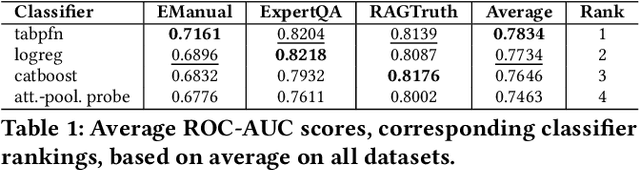
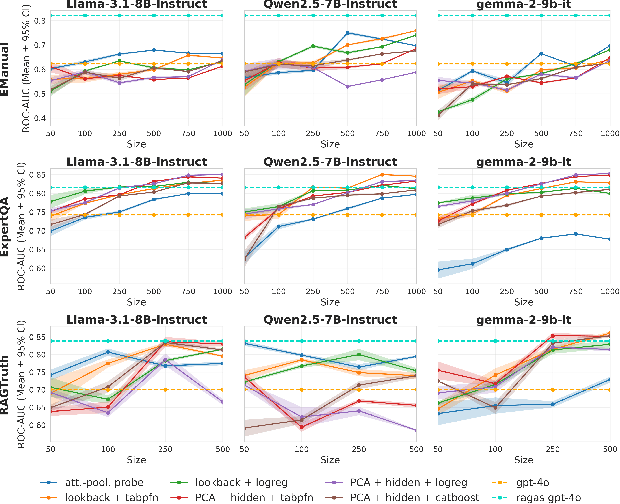
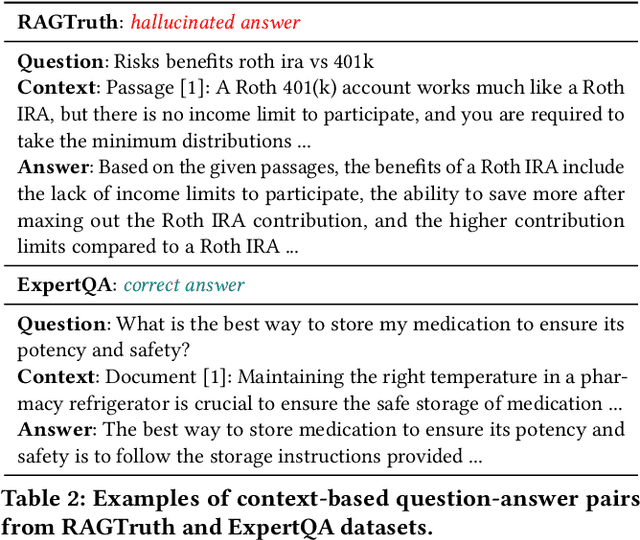
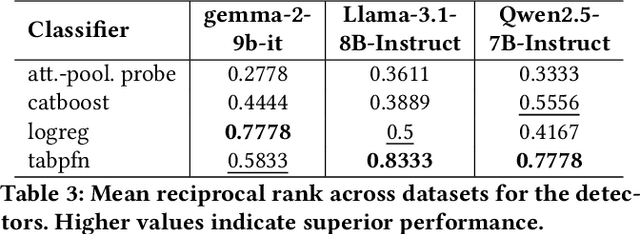
Large Language Models (LLMs) and Retrieval-Augmented Generation (RAG) systems are increasingly deployed in industry applications, yet their reliability remains hampered by challenges in detecting hallucinations. While supervised state-of-the-art (SOTA) methods that leverage LLM hidden states -- such as activation tracing and representation analysis -- show promise, their dependence on extensively annotated datasets limits scalability in real-world applications. This paper addresses the critical bottleneck of data annotation by investigating the feasibility of reducing training data requirements for two SOTA hallucination detection frameworks: Lookback Lens, which analyzes attention head dynamics, and probing-based approaches, which decode internal model representations. We propose a methodology combining efficient classification algorithms with dimensionality reduction techniques to minimize sample size demands while maintaining competitive performance. Evaluations on standardized question-answering RAG benchmarks show that our approach achieves performance comparable to strong proprietary LLM-based baselines with only 250 training samples. These results highlight the potential of lightweight, data-efficient paradigms for industrial deployment, particularly in annotation-constrained scenarios.
Hallucination Detection in LLMs via Topological Divergence on Attention Graphs
Apr 14, 2025Hallucination, i.e., generating factually incorrect content, remains a critical challenge for large language models (LLMs). We introduce TOHA, a TOpology-based HAllucination detector in the RAG setting, which leverages a topological divergence metric to quantify the structural properties of graphs induced by attention matrices. Examining the topological divergence between prompt and response subgraphs reveals consistent patterns: higher divergence values in specific attention heads correlate with hallucinated outputs, independent of the dataset. Extensive experiments, including evaluation on question answering and data-to-text tasks, show that our approach achieves state-of-the-art or competitive results on several benchmarks, two of which were annotated by us and are being publicly released to facilitate further research. Beyond its strong in-domain performance, TOHA maintains remarkable domain transferability across multiple open-source LLMs. Our findings suggest that analyzing the topological structure of attention matrices can serve as an efficient and robust indicator of factual reliability in LLMs.