 Add to Chrome
 Add to Firefox
 Add to Edge
Mixture of Probes: Learning from Privileged Modalities in Multimodal LLMs Through Probing
Jul 09, 2026
Multimodal Large Language Models (MLLMs) are typically designed under the assumption that all modalities available during training will also be accessible at inference. However, many real-world settings violate this assumption, requiring models to operate under a privileged modality setting, where auxiliary modalities are available only during training. While these modalities contain valuable information, existing MLLMs largely fail to leverage them effectively, as they treat modalities as interchangeable inputs rather than sources of complementary supervision. We propose Mixture of Probes (MoP), a novel framework that disentangles modality-specific and modality-general signals within the MLLM, allowing the model to preserve modality-dependent structure while learning transferable representations across modalities. At its core, MoP achieves this through a structured probing mechanism that extracts and organizes information from intermediate representations of a shared modality encoder, rather than relying only on final-layer alignment as done in existing MLLMs. To support this disentanglement, we further introduce MoP Cross-modal Training (MoP-X), a training strategy for MoP centered around a probe disentanglement loss that prevents probe collapse and encourages cross-modal learning. We evaluate MoP across two domains spanning eight tasks and four modalities under a comprehensive evaluation protocol tailored to the privileged modality setting, where each modality is independently treated as the sole input at inference time. MoP consistently outperforms strong MLLM baselines, achieving up to 65% relative improvement, demonstrating that auxiliary modalities, even when unavailable at inference, can provide substantial gains when effectively leveraged during training. Code, model checkpoints, and evaluation protocols will be made available at https://github.com/Sony/MoP.

World Action Models Enable Continual Imitation Learning with Recurrent Generative Replays
Jun 25, 2026Going beyond predicting robot actions, World Action Models (WAMs) can also generate future visual observations. We build on this generative capability to propose Recurrent Generative Replay (REGEN), a continual imitation learning framework that synthesizes pseudo-replay trajectories, enabling a robot policy to rehearse previously learned tasks without storing their original human demonstrations. During continual adaptation, REGEN recursively queries the WAM to synthesize pseudo-replay trajectories conditioned only on prior task instructions and current-task observations. Experiments in both simulation and real-world manipulation settings show that REGEN reduces catastrophic forgetting by up to $50\%$ relative to sequential fine-tuning, while approaching the performance of privileged experience replay methods that require access to real replay data. Finally, we analyze the factors limiting generated replay, identifying long-horizon visual degradation and action-observation inconsistency as the primary bottlenecks. Our results establish WAMs as a promising foundation for continual robot learning without stored demonstrations.
TimeProVe: Propose, then Verify for Efficient Long Video Temporal Reasoning in Activities of Daily Living
Jun 18, 2026Long Video Question Answering (LVQA) requires identifying sparse, query-relevant evidence within hours-long untrimmed videos. Existing approaches either process videos densely with large vision-language models (VLMs), incurring prohibitive computational cost, or rely on sparse caption-based reasoning, which often misses temporally localized and motion-centric evidence. We introduce TimeProVe, a cost-efficient hybrid framework for temporally grounded reasoning in long videos. TimeProVe first employs lightweight modules to generate action-grounded answer--evidence hypotheses and subsequently invokes an expensive VLM only for targeted verification. The core of our framework lies in the Action-based Candidate Evidence (ACE) module, which converts temporally localized actions into query-conditioned candidate answers and supporting evidence windows through lightweight LLM reasoning. We further introduce OpenTSUBench (OTB), an open-ended benchmark designed to evaluate temporally grounded reasoning in real-world Activities of Daily Living (ADL) scenarios. Experiments show that TimeProVe outperforms the strongest baseline on OTB by 7.3%, while reducing VLM calls by 75% and inference cost by 93%. Furthermore, without explicit temporal grounding training, TimeProVe achieves competitive performance on Charades-STA, and reaches state-of-the-art results when enhanced with grounding VLMs.
UNIEGO: Proxies as Mediators for Unified Egocentric Video Representation Learning
Jun 18, 2026Egocentric video understanding is inherently limited by the narrow perspective of wearable cameras: a single viewpoint, a single modality, a single model cannot capture the full richness of human action. We argue that a truly expressive egocentric representation must subsume complementary knowledge across viewpoints, modalities, and foundation model representations, yet remain deployable from egocentric video alone. To this end, we introduce a hierarchical multi-teacher distillation framework that produces UNIEGO, a unified egocentric encoder trained with nine teachers spanning ego-exo viewpoints, RGB, depth, and skeleton modalities, and four foundation models. Rather than distilling directly from heterogeneous teachers whose incompatible architectures and feature geometries induce conflicting gradients, our framework interposes a layer of representation-specific Proxy models that translate diverse teacher knowledge into a homogeneous egocentric space. A second distillation stage, Selective Proxy Distillation (SPD), then adaptively selects, for each training sample, the subset of proxies that are both correct and confident, distilling exclusively from reliable supervision and suppressing erroneous signals. SPD is further stabilized by initializing UNIEGO as a learned convex combination of proxy parameters, placing the unified model in a well-conditioned region of the loss landscape before distillation begins. UNIEGO achieves state-of-the-art performance across three egocentric video understanding tasks - action recognition, video retrieval, and action segmentation on three challenging ego-exo benchmarks, outperforming naive multi-teacher distillation baselines and demonstrating that structured, proxy-mediated knowledge transfer yields richer and more discriminative egocentric representations.
UniLACT: Depth-Aware RGB Latent Action Learning for Vision-Language-Action Models
Feb 23, 2026Latent action representations learned from unlabeled videos have recently emerged as a promising paradigm for pretraining vision-language-action (VLA) models without explicit robot action supervision. However, latent actions derived solely from RGB observations primarily encode appearance-driven dynamics and lack explicit 3D geometric structure, which is essential for precise and contact-rich manipulation. To address this limitation, we introduce UniLACT, a transformer-based VLA model that incorporates geometric structure through depth-aware latent pretraining, enabling downstream policies to inherit stronger spatial priors. To facilitate this process, we propose UniLARN, a unified latent action learning framework based on inverse and forward dynamics objectives that learns a shared embedding space for RGB and depth while explicitly modeling their cross-modal interactions. This formulation produces modality-specific and unified latent action representations that serve as pseudo-labels for the depth-aware pretraining of UniLACT. Extensive experiments in both simulation and real-world settings demonstrate the effectiveness of depth-aware unified latent action representations. UniLACT consistently outperforms RGB-based latent action baselines under in-domain and out-of-domain pretraining regimes, as well as on both seen and unseen manipulation tasks.
SKI Models: Skeleton Induced Vision-Language Embeddings for Understanding Activities of Daily Living
Feb 05, 2025


The introduction of vision-language models like CLIP has enabled the development of foundational video models capable of generalizing to unseen videos and human actions. However, these models are typically trained on web videos, which often fail to capture the challenges present in Activities of Daily Living (ADL) videos. Existing works address ADL-specific challenges, such as similar appearances, subtle motion patterns, and multiple viewpoints, by combining 3D skeletons and RGB videos. However, these approaches are not integrated with language, limiting their ability to generalize to unseen action classes. In this paper, we introduce SKI models, which integrate 3D skeletons into the vision-language embedding space. SKI models leverage a skeleton-language model, SkeletonCLIP, to infuse skeleton information into Vision Language Models (VLMs) and Large Vision Language Models (LVLMs) through collaborative training. Notably, SKI models do not require skeleton data during inference, enhancing their robustness for real-world applications. The effectiveness of SKI models is validated on three popular ADL datasets for zero-shot action recognition and video caption generation tasks.
From My View to Yours: Ego-Augmented Learning in Large Vision Language Models for Understanding Exocentric Daily Living Activities
Jan 10, 2025


Large Vision Language Models (LVLMs) have demonstrated impressive capabilities in video understanding, yet their adoption for Activities of Daily Living (ADL) remains limited by their inability to capture fine-grained interactions and spatial relationships. This limitation is particularly evident in ADL tasks, where understanding detailed human-object interaction and human-centric motion is crucial for applications such as elderly monitoring and cognitive assessment. To address this, we aim to leverage the complementary nature of egocentric views to enhance LVLM's understanding of exocentric ADL videos. Consequently, we propose an online ego2exo distillation approach to learn ego-augmented exo representations in LVLMs. While effective, this approach requires paired ego-exo training data, which is impractical to collect for real-world ADL scenarios. Consequently, we develop EgoMimic, a skeleton-guided method that can generate mimicked ego views from exocentric videos. We find that the exo representations of our ego-augmented LVLMs successfully learn to extract ego-perspective cues, demonstrated through comprehensive evaluation on six ADL benchmarks and our proposed EgoPerceptionMCQ benchmark designed specifically to assess egocentric understanding from exocentric videos. Code, models, and data will be open-sourced at https://github.com/dominickrei/EgoExo4ADL.
Introducing Gating and Context into Temporal Action Detection
Sep 06, 2024Temporal Action Detection (TAD), the task of localizing and classifying actions in untrimmed video, remains challenging due to action overlaps and variable action durations. Recent findings suggest that TAD performance is dependent on the structural design of transformers rather than on the self-attention mechanism. Building on this insight, we propose a refined feature extraction process through lightweight, yet effective operations. First, we employ a local branch that employs parallel convolutions with varying window sizes to capture both fine-grained and coarse-grained temporal features. This branch incorporates a gating mechanism to select the most relevant features. Second, we introduce a context branch that uses boundary frames as key-value pairs to analyze their relationship with the central frame through cross-attention. The proposed method captures temporal dependencies and improves contextual understanding. Evaluations of the gating mechanism and context branch on challenging datasets (THUMOS14 and EPIC-KITCHEN 100) show a consistent improvement over the baseline and existing methods.
Fibottention: Inceptive Visual Representation Learning with Diverse Attention Across Heads
Jun 27, 2024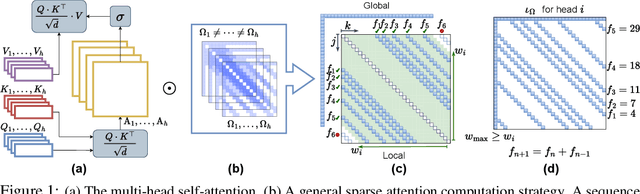
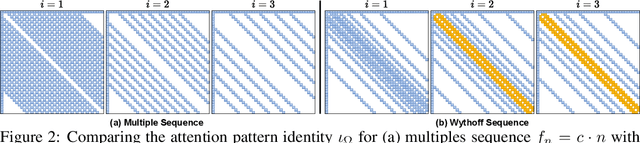

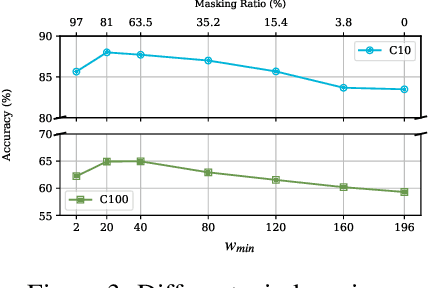
Visual perception tasks are predominantly solved by Vision Transformer (ViT) architectures, which, despite their effectiveness, encounter a computational bottleneck due to the quadratic complexity of computing self-attention. This inefficiency is largely due to the self-attention heads capturing redundant token interactions, reflecting inherent redundancy within visual data. Many works have aimed to reduce the computational complexity of self-attention in ViTs, leading to the development of efficient and sparse transformer architectures. In this paper, viewing through the efficiency lens, we realized that introducing any sparse self-attention strategy in ViTs can keep the computational overhead low. However, these strategies are sub-optimal as they often fail to capture fine-grained visual details. This observation leads us to propose a general, efficient, sparse architecture, named Fibottention, for approximating self-attention with superlinear complexity that is built upon Fibonacci sequences. The key strategies in Fibottention include: it excludes proximate tokens to reduce redundancy, employs structured sparsity by design to decrease computational demands, and incorporates inception-like diversity across attention heads. This diversity ensures the capture of complementary information through non-overlapping token interactions, optimizing both performance and resource utilization in ViTs for visual representation learning. We embed our Fibottention mechanism into multiple state-of-the-art transformer architectures dedicated to visual tasks. Leveraging only 2-6% of the elements in the self-attention heads, Fibottention in conjunction with ViT and its variants, consistently achieves significant performance boosts compared to standard ViTs in nine datasets across three domains $\unicode{x2013}$ image classification, video understanding, and robot learning tasks.
LLAVIDAL: Benchmarking Large Language Vision Models for Daily Activities of Living
Jun 13, 2024Large Language Vision Models (LLVMs) have demonstrated effectiveness in processing internet videos, yet they struggle with the visually perplexing dynamics present in Activities of Daily Living (ADL) due to limited pertinent datasets and models tailored to relevant cues. To this end, we propose a framework for curating ADL multiview datasets to fine-tune LLVMs, resulting in the creation of ADL-X, comprising 100K RGB video-instruction pairs, language descriptions, 3D skeletons, and action-conditioned object trajectories. We introduce LLAVIDAL, an LLVM capable of incorporating 3D poses and relevant object trajectories to understand the intricate spatiotemporal relationships within ADLs. Furthermore, we present a novel benchmark, ADLMCQ, for quantifying LLVM effectiveness in ADL scenarios. When trained on ADL-X, LLAVIDAL consistently achieves state-of-the-art performance across all ADL evaluation metrics. Qualitative analysis reveals LLAVIDAL's temporal reasoning capabilities in understanding ADL. The link to the dataset is provided at: https://adl-x.github.io/