 Add to Chrome
 Add to Firefox
 Add to Edge
DnA: Denoising Attention for Visual Tasks
Jun 25, 2026
The softmax activation in multihead attention (MHA) is the de facto standard for attention-based models in visual perception tasks. However, standard softmax can produce noisy attention patterns that dilute relevant features and degrade its performance. In this paper, we propose Denoising Attention or DnA, in which, first, a positive query identifies which image features belong to the correct class, and a negative query identifies closely associated but irrelevant image features. DnA then projects these interactions into two distinct subspaces with larger principal angles, promoting subspace separation and improved discriminability. Using a ViT-B backbone, our proposed DnA achieves an absolute gain of 0.8% on ImageNet-1K compared to the baseline. We further show improvements across multiple visual understanding tasks, including video understanding with video transformers (1.8%) and video LLMs (0.5%). Our extensive empirical analyses justify the design choices involving two interacting subspaces and the denoising effect of DnA.

GAEA: A Geolocation Aware Conversational Model
Mar 20, 2025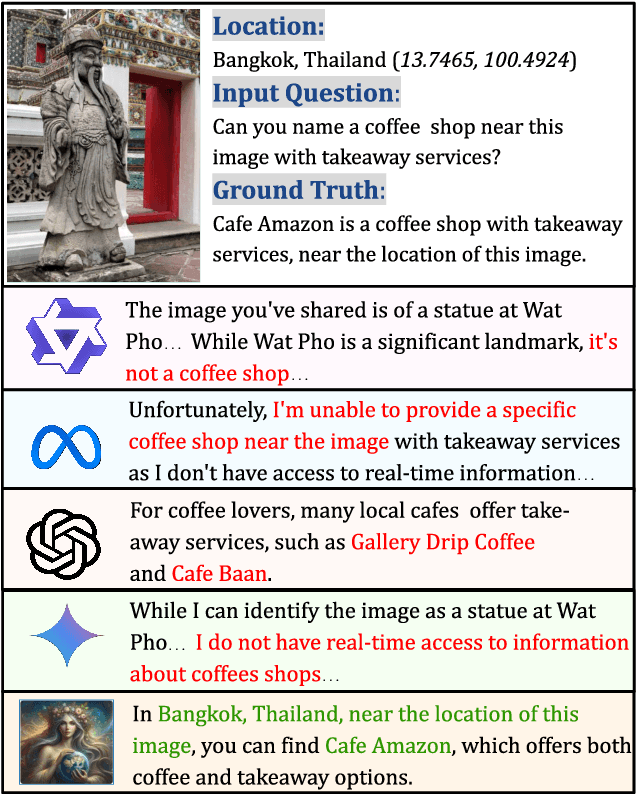
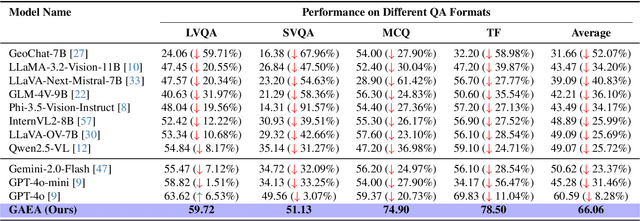
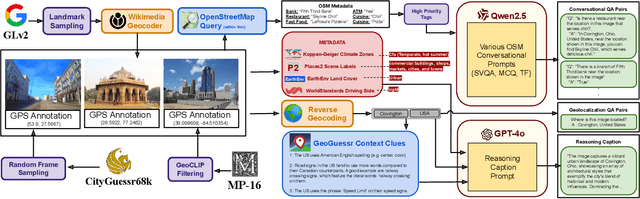
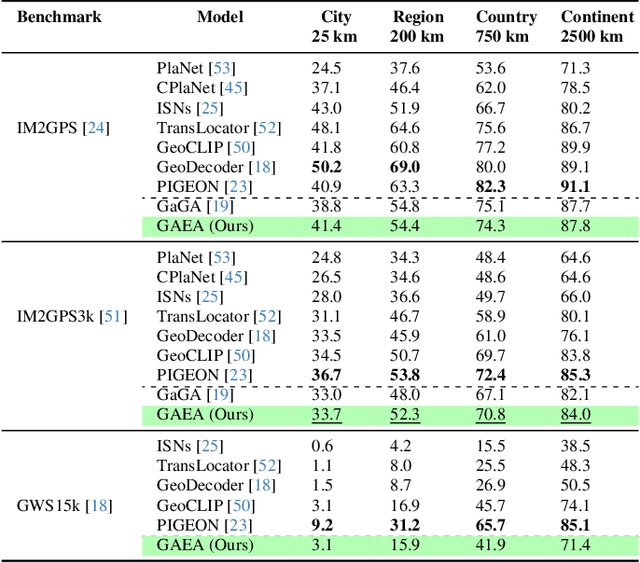
Image geolocalization, in which, traditionally, an AI model predicts the precise GPS coordinates of an image is a challenging task with many downstream applications. However, the user cannot utilize the model to further their knowledge other than the GPS coordinate; the model lacks an understanding of the location and the conversational ability to communicate with the user. In recent days, with tremendous progress of large multimodal models (LMMs) proprietary and open-source researchers have attempted to geolocalize images via LMMs. However, the issues remain unaddressed; beyond general tasks, for more specialized downstream tasks, one of which is geolocalization, LMMs struggle. In this work, we propose to solve this problem by introducing a conversational model GAEA that can provide information regarding the location of an image, as required by a user. No large-scale dataset enabling the training of such a model exists. Thus we propose a comprehensive dataset GAEA with 800K images and around 1.6M question answer pairs constructed by leveraging OpenStreetMap (OSM) attributes and geographical context clues. For quantitative evaluation, we propose a diverse benchmark comprising 4K image-text pairs to evaluate conversational capabilities equipped with diverse question types. We consider 11 state-of-the-art open-source and proprietary LMMs and demonstrate that GAEA significantly outperforms the best open-source model, LLaVA-OneVision by 25.69% and the best proprietary model, GPT-4o by 8.28%. Our dataset, model and codes are available