 Add to Chrome
 Add to Firefox
 Add to Edge
The Prosocial Ranking Challenge: Reducing Polarization on Social Media without Sacrificing Engagement
Mar 20, 2026
We report the first direct comparisons of multiple alternative social media algorithms on multiple platforms on outcomes of societal interest. We used a browser extension to modify which posts were shown to desktop social media users, randomly assigning 9,386 users to a control group or one of five alternative ranking algorithms which simultaneously altered content across three platforms for six months during the US 2024 presidential election. This reduced our preregistered index of affective polarization by an average of 0.03 standard deviations (p < 0.05), including a 1.5 degree decrease in differences between the 100 point inparty and outparty feeling thermometers. We saw reductions in active use time for Facebook (-0.37 min/day) and Reddit (-0.2 min/day), but an increase of 0.32 min/day (p < 0.01) for X/Twitter. We saw an increase in reports of negative social media experiences but found no effects on well-being, news knowledge, outgroup empathy, perceptions of and support for partisan violence. This implies that bridging content can improve some societal outcomes without necessarily conflicting with the engagement-driven business model of social media.

AI Chat Assistants can Improve Conversations about Divisive Topics
Feb 21, 2023


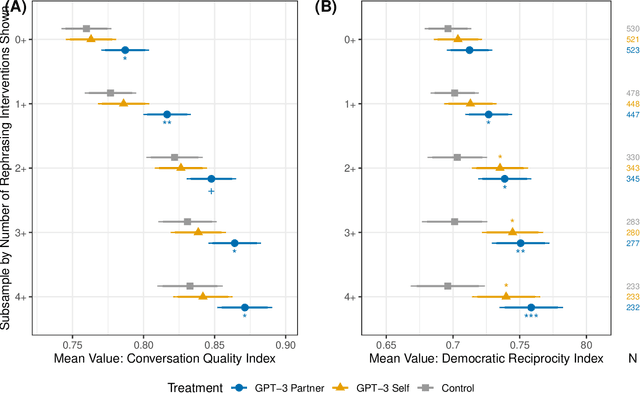
A rapidly increasing amount of human conversation occurs online. But divisiveness and conflict can fester in text-based interactions on social media platforms, in messaging apps, and on other digital forums. Such toxicity increases polarization and, importantly, corrodes the capacity of diverse societies to develop efficient solutions to complex social problems that impact everyone. Scholars and civil society groups promote interventions that can make interpersonal conversations less divisive or more productive in offline settings, but scaling these efforts to the amount of discourse that occurs online is extremely challenging. We present results of a large-scale experiment that demonstrates how online conversations about divisive topics can be improved with artificial intelligence tools. Specifically, we employ a large language model to make real-time, evidence-based recommendations intended to improve participants' perception of feeling understood in conversations. We find that these interventions improve the reported quality of the conversation, reduce political divisiveness, and improve the tone, without systematically changing the content of the conversation or moving people's policy attitudes. These findings have important implications for future research on social media, political deliberation, and the growing community of scholars interested in the place of artificial intelligence within computational social science.