 Add to Chrome
 Add to Firefox
 Add to Edge
LoRA-based Adaptation Alone Is Not Enough: Understanding the Limits of Foundation Models for Face Presentation Attack Detection
Aug 10, 2026
Face presentation attack detection (PAD) aims to reliably detect a wide range of presentation attacks. While PAD methods achieve strong performance within individual datasets, their performance degrades under cross-dataset evaluation. Variations in sensors or lighting conditions can reduce the effectiveness of detectors from near-perfect to nearly random. Foundation models (FMs) have emerged as a promising alternative because typical PAD datasets, such as the MCIO benchmarks (MSU-MFSD, CASIA-FASD, Replay-Attack, and OULU-NPU), are small relative to the scale used for web-based pretraining. However, existing PAD systems primarily focus on CLIP-based foundation models, while overlooking other FMs with different architectures and training procedures. This study addresses this question by systematically evaluating 32 FMs. Zero-shot prompting achieves performance near chance across model families and scales. The vision encoders, when low-rankadapted (LoRA) with fewer than 1% trainable weights, achieve below 2% intra-dataset ACER in most cases, while cross-dataset ACER is substantially higher. LoRA primarily refines the decision boundary within a dataset, suggesting that pretrained representations and the adaptation dataset play a larger role in cross-dataset generalization than the evaluated lightweight adaptation strategy.

Improving Low-Resolution Face Recognition under Limited Data: How Synthetic Data Generation Can Close the Domain Gap
Aug 06, 2026Face Recognition (FR) systems in surveillance settings often encounter Low Resolution (LR) faces, those whose face region falls below the standard 112 $\times$ 112 input size. While labelled High Resolution (HR) training data is abundant, labelled native-LR data, and above all paired native LR/HR data, is scarce. One workaround is to synthesize LR data from the available HR faces, but how much synthesis effort is repaid in recognition accuracy remains unclear. We present a study of simple synthetic generation strategies for a compact, edge device-oriented face recognition system, spanning interpolation-based degradation, knowledge distillation, a Prepended Domain Transformer (PDT), Real ESRGAN-style degradation, and a learned Super Resolution (SR) front-end with an identity-aware loss. We evaluate these strategies on synthetic cross-resolution face benchmarks (LFW, CFP-FP, AgeDB-30) and on TinyFace, a real-world native LR dataset, and expose a synthetic-real gap: the degradation setting that is optimal on synthetic benchmarks is not the one that is optimal on real LR. We find that more synthesis effort does not help monotonically: the learned SR front-end does not surpass a direct feed of the aligned LR image into a strong backbone, while simple interpolation augmentation of a compact backbone is the only synthesis that improves over its own baseline. We conclude that generative methods for LR face recognition must be validated on real LR and against a direct-feed baseline, and release our pipeline at https://idiap.ch/paper/synth-lrfr
Foundation Models for Face Presentation Attack Detection: A Unified Linear-Probing Benchmark
Jul 29, 2026Face presentation attack detection (PAD) remains challenging under cross-dataset evaluation, where domain shift degrades models trained on a single dataset. The scarcity of large-scale labeled data motivates adapting pretrained vision models rather than training task-specific architectures from scratch, raising a fundamental question: do general-purpose vision foundation models encode PAD-relevant information accessible with minimal task-specific training? To investigate, we systematically evaluate 24 frozen encoders, including self-supervised vision transformers, vision-language encoders, and supervised CNNs, using a unified linear-probing protocol on the MCIO benchmark (MSU-MFSD, CASIA-FASD, Replay-Attack, OULU-NPU). The backbone remains fixed, and only a lightweight linear head is trained to isolate the PAD information already present in the pretrained representation. %We report intra- and cross-dataset performance, along with accuracy-compute trade-offs, relative to two specialist PAD baselines. Results show that frozen foundation-model representations can support strong intra-dataset PAD performance with only a linear classifier, but this performance does not reliably transfer across datasets. Model scale is beneficial within several families, although the effect is not monotonic and is strongly mediated by architecture and pretraining. InternViT-6B achieves the lowest mean intra-dataset error, whereas CLIP ViT-B/32 offers the most favorable cross-dataset transfer-compute trade-off among the evaluated probes. These findings suggest that while pretrained representations contain PAD-relevant information, explicit adaptation remains necessary to address domain shift.
GaitFace: A Multimodal Dataset for Long-Range Person Identification
Jul 26, 2026Efficient border control is becoming a significant global challenge, mainly due to severe congestion and extended passenger waiting times. To mitigate these bottlenecks and facilitate passenger flow, biometric technologies are increasingly deployed to streamline identity verification and enhance crossing efficiency. Technical limitations frequently impede biometric identification, particularly in long-range surveillance, where systems must deal with adverse atmospheric conditions and degraded image quality. While high-quality frameworks like BRIAR exist, they are frequently restricted to specific government agencies. This paper introduces GaitFace, a new public dataset that contains face and gait data captured at long distances. To ensure that the research reflects authentic border scenarios, we use Pre-Enrollment data, where a traveler registers via a mobile device, and "In-the-Wild" captures, which records individuals at a distance across multiple viewing angles and different cameras. Benchmarking SOTA face and gait models reveals that current architectures fail under low-resolution and elevated viewpoints despite success with optical assistance. GaitFace exposes these critical vulnerabilities, providing a rigorous public benchmark to drive more robust, unconstrained biometric research.
DriveFace: A Cross-Spectral Through-Glass Face Dataset for On-the-Move Vehicular Border Control
Jul 15, 2026The continuous growth in cross-border mobility places increasing pressure on existing border control infrastructures, motivating on-the-move biometric authentication, in which travellers are identified directly inside their vehicles at checkpoints. Face recognition is well-suited to this setting, as it can be acquired passively and at a distance. Its development, however, is hindered by the lack of representative datasets: existing benchmarks are collected in controlled environments and do not capture the challenges inherent to vehicular acquisition, including motion blur, variable illumination, occlusions, and cross-spectral enrollment. To address this gap, we introduce a dataset for on-the-move face recognition in border-control scenarios, comprising NIR vehicle-crossing videos paired with smartphone-based pre-enrollment data. Baseline evaluations with state-of-the-art models show clear performance limitations under these realistic conditions, highlighting the need for dedicated methods to advance the field.
Lightweight Cross-Spectral Face Recognition via Contrastive Alignment and Distillation
May 06, 2026Heterogeneous Face Recognition (HFR) aims at matching face images captured across different sensing modalities, such as thermal-to-visible or near-infrared-to-visible, enhancing the usability of face recognition systems in challenging real-world conditions. Although recent HFR methods have achieved significant improvements in performance, many rely on computationally expensive models, making them impractical for deployment on resource-limited edge devices. In this work, we introduce a lightweight yet effective HFR framework by adapting a hybrid CNN-Transformer model originally developed for RGB homogeneous face recognition. Our approach enables efficient end-to-end training with only a small amount of paired heterogeneous data, while still maintaining strong performance on standard RGB face recognition benchmarks. This makes it suitable for both homogeneous and heterogeneous settings. Comprehensive experiments on several challenging HFR and face recognition benchmarks show that our method achieves state-of-the-art or competitive performance while keeping computational requirements low.
Enhancing Domain Diversity in Synthetic Data Face Recognition with Dataset Fusion
Jul 22, 2025While the accuracy of face recognition systems has improved significantly in recent years, the datasets used to train these models are often collected through web crawling without the explicit consent of users, raising ethical and privacy concerns. To address this, many recent approaches have explored the use of synthetic data for training face recognition models. However, these models typically underperform compared to those trained on real-world data. A common limitation is that a single generator model is often used to create the entire synthetic dataset, leading to model-specific artifacts that may cause overfitting to the generator's inherent biases and artifacts. In this work, we propose a solution by combining two state-of-the-art synthetic face datasets generated using architecturally distinct backbones. This fusion reduces model-specific artifacts, enhances diversity in pose, lighting, and demographics, and implicitly regularizes the face recognition model by emphasizing identity-relevant features. We evaluate the performance of models trained on this combined dataset using standard face recognition benchmarks and demonstrate that our approach achieves superior performance across many of these benchmarks.
The Invisible Threat: Evaluating the Vulnerability of Cross-Spectral Face Recognition to Presentation Attacks
May 01, 2025Cross-spectral face recognition systems are designed to enhance the performance of facial recognition systems by enabling cross-modal matching under challenging operational conditions. A particularly relevant application is the matching of near-infrared (NIR) images to visible-spectrum (VIS) images, enabling the verification of individuals by comparing NIR facial captures acquired with VIS reference images. The use of NIR imaging offers several advantages, including greater robustness to illumination variations, better visibility through glasses and glare, and greater resistance to presentation attacks. Despite these claimed benefits, the robustness of NIR-based systems against presentation attacks has not been systematically studied in the literature. In this work, we conduct a comprehensive evaluation into the vulnerability of NIR-VIS cross-spectral face recognition systems to presentation attacks. Our empirical findings indicate that, although these systems exhibit a certain degree of reliability, they remain vulnerable to specific attacks, emphasizing the need for further research in this area.
xEdgeFace: Efficient Cross-Spectral Face Recognition for Edge Devices
Apr 28, 2025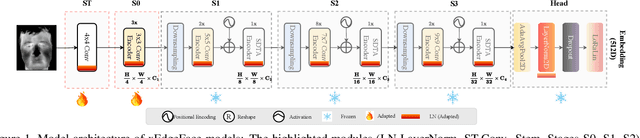
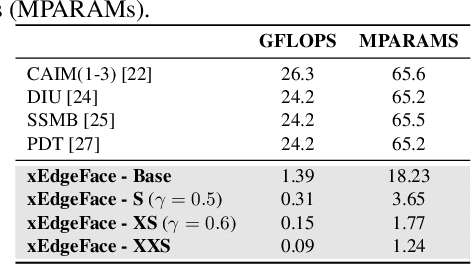
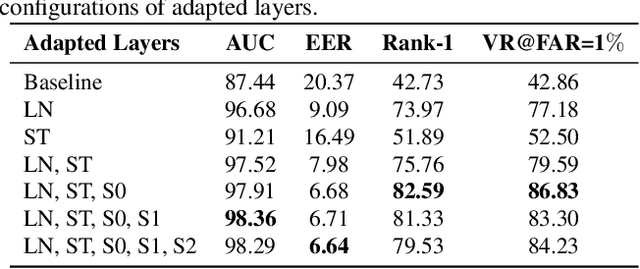
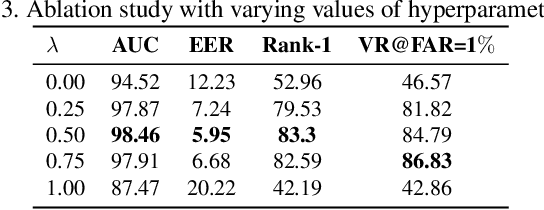
Heterogeneous Face Recognition (HFR) addresses the challenge of matching face images across different sensing modalities, such as thermal to visible or near-infrared to visible, expanding the applicability of face recognition systems in real-world, unconstrained environments. While recent HFR methods have shown promising results, many rely on computation-intensive architectures, limiting their practicality for deployment on resource-constrained edge devices. In this work, we present a lightweight yet effective HFR framework by adapting a hybrid CNN-Transformer architecture originally designed for face recognition. Our approach enables efficient end-to-end training with minimal paired heterogeneous data while preserving strong performance on standard RGB face recognition tasks. This makes it a compelling solution for both homogeneous and heterogeneous scenarios. Extensive experiments across multiple challenging HFR and face recognition benchmarks demonstrate that our method consistently outperforms state-of-the-art approaches while maintaining a low computational overhead.
Exploring ChatGPT for Face Presentation Attack Detection in Zero and Few-Shot in-Context Learning
Jan 15, 2025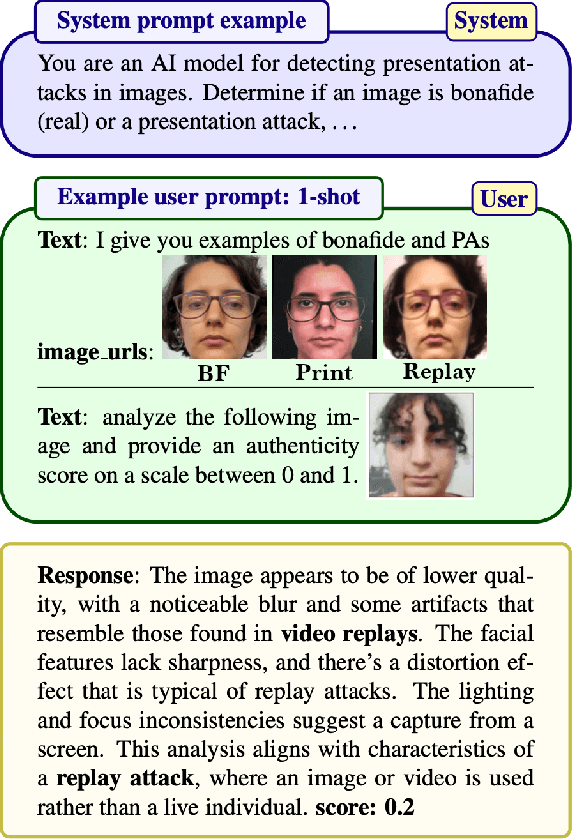
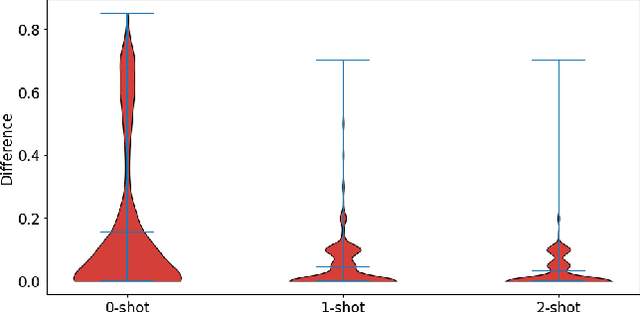

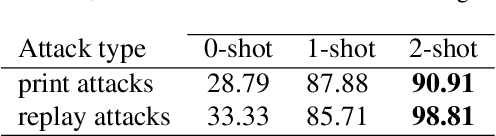
This study highlights the potential of ChatGPT (specifically GPT-4o) as a competitive alternative for Face Presentation Attack Detection (PAD), outperforming several PAD models, including commercial solutions, in specific scenarios. Our results show that GPT-4o demonstrates high consistency, particularly in few-shot in-context learning, where its performance improves as more examples are provided (reference data). We also observe that detailed prompts enable the model to provide scores reliably, a behavior not observed with concise prompts. Additionally, explanation-seeking prompts slightly enhance the model's performance by improving its interpretability. Remarkably, the model exhibits emergent reasoning capabilities, correctly predicting the attack type (print or replay) with high accuracy in few-shot scenarios, despite not being explicitly instructed to classify attack types. Despite these strengths, GPT-4o faces challenges in zero-shot tasks, where its performance is limited compared to specialized PAD systems. Experiments were conducted on a subset of the SOTERIA dataset, ensuring compliance with data privacy regulations by using only data from consenting individuals. These findings underscore GPT-4o's promise in PAD applications, laying the groundwork for future research to address broader data privacy concerns and improve cross-dataset generalization. Code available here: https://gitlab.idiap.ch/bob/bob.paper.wacv2025_chatgpt_face_pad