 Add to Chrome
 Add to Firefox
 Add to Edge
Frequency-Aware Continual Learning for Smart Contract Vulnerability Detection with Large Language Models
Aug 20, 2026
Smart contract vulnerability detection with Large Language Models (LLMs) faces three causally linked challenges. First, new vulnerability categories demand parameter-efficient adaptation, since full retraining is prohibitive for sequentially arriving tasks. Second, training per-task adapters on a shared backbone causes catastrophic forgetting of previously learned vulnerabilities. Third, the resulting multiplicity of adapters must be consolidated into a single model, since task identity is unknown at inference time. Each challenge arises directly from the solution to its predecessor, making an integrated framework essential. We propose a three-stage pipeline in which each stage addresses one challenge and feeds into the next. The adaptation stage uses Frequency-Aware Low-Rank Adaptation (FA-LoRA), which performs adaptation in the Fourier domain with per-frequency importance gates, requiring only 0.4% trainable parameters while outperforming standard LoRA and QLoRA. The continual learning stage applies Forget-Aware Replay (FAR), which uses these frequency gates to estimate per-sample forgetting risk via loss dynamics and prioritizes vulnerable knowledge for rehearsal, achieving an average Micro-F1 of 0.8022 across sequential tasks. The deployment stage employs Anchor-Protected Progressive Merging (APPM), which exploits the asymmetric generalization produced by FAR training to identify the strongest-generalizing adapter as an anchor and consolidates all adapters into a single model via anchor-protected weighted merging with frequency-domain gate competition. APPM achieves a Micro-F1 of 0.8085, within 2.7% of the independent per-task upper bound, at a merge cost of 156 ms and no additional runtime memory. Experiments on DIVE confirm the framework effectively addresses all three challenges for evolving blockchain ecosystems.

pvCNN: Privacy-Preserving and Verifiable Convolutional Neural Network Testing
Jan 23, 2022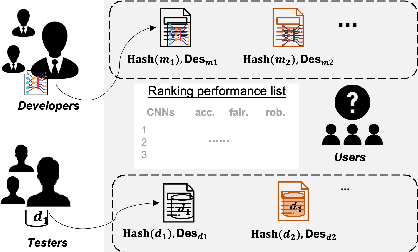
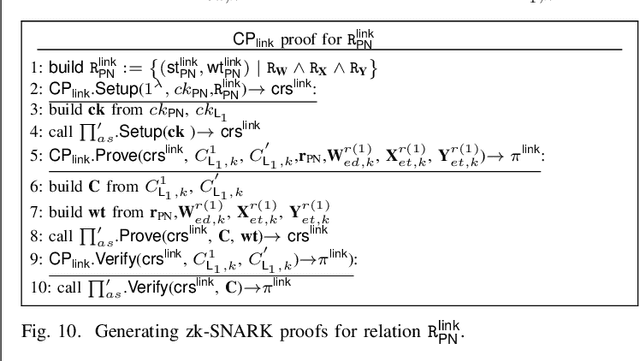
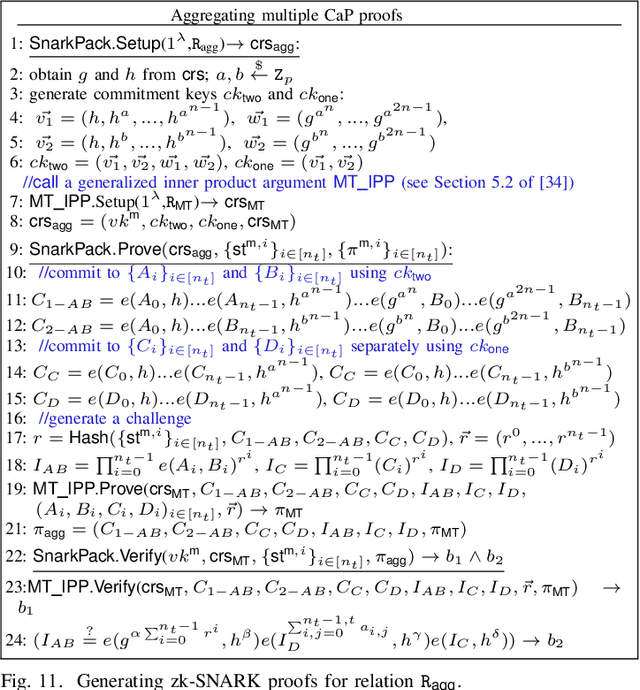
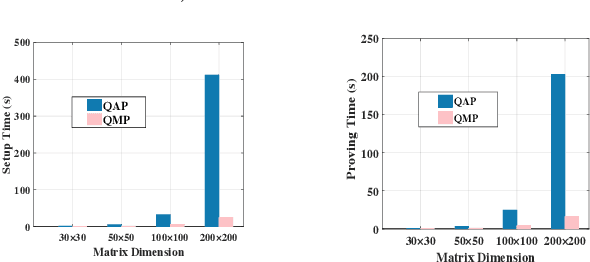
This paper proposes a new approach for privacy-preserving and verifiable convolutional neural network (CNN) testing, enabling a CNN model developer to convince a user of the truthful CNN performance over non-public data from multiple testers, while respecting model privacy. To balance the security and efficiency issues, three new efforts are done by appropriately integrating homomorphic encryption (HE) and zero-knowledge succinct non-interactive argument of knowledge (zk-SNARK) primitives with the CNN testing. First, a CNN model to be tested is strategically partitioned into a private part kept locally by the model developer, and a public part outsourced to an outside server. Then, the private part runs over HE-protected test data sent by a tester and transmits its outputs to the public part for accomplishing subsequent computations of the CNN testing. Second, the correctness of the above CNN testing is enforced by generating zk-SNARK based proofs, with an emphasis on optimizing proving overhead for two-dimensional (2-D) convolution operations, since the operations dominate the performance bottleneck during generating proofs. We specifically present a new quadratic matrix programs (QMPs)-based arithmetic circuit with a single multiplication gate for expressing 2-D convolution operations between multiple filters and inputs in a batch manner. Third, we aggregate multiple proofs with respect to a same CNN model but different testers' test data (i.e., different statements) into one proof, and ensure that the validity of the aggregated proof implies the validity of the original multiple proofs. Lastly, our experimental results demonstrate that our QMPs-based zk-SNARK performs nearly 13.9$\times$faster than the existing QAPs-based zk-SNARK in proving time, and 17.6$\times$faster in Setup time, for high-dimension matrix multiplication.
DAMIA: Leveraging Domain Adaptation as a Defense against Membership Inference Attacks
May 16, 2020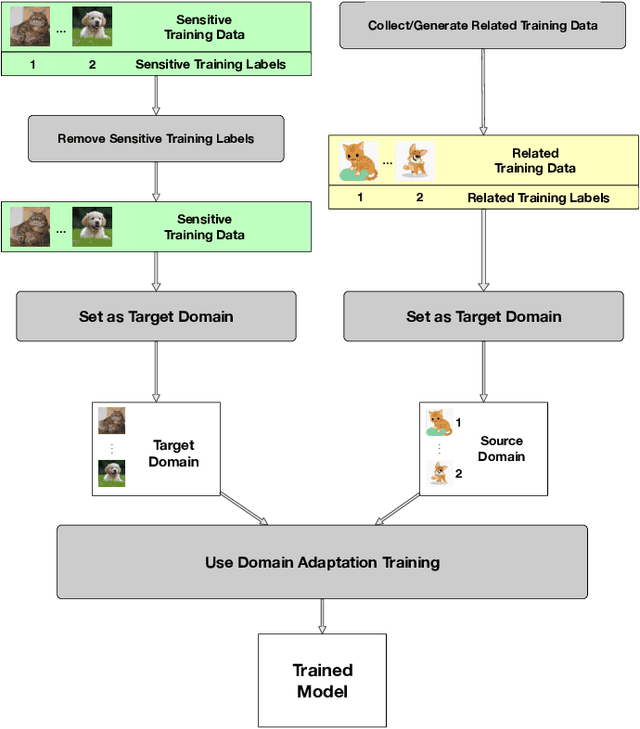
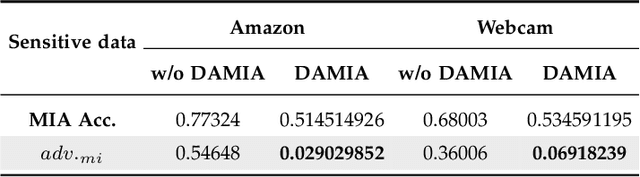
Deep Learning (DL) techniques allow ones to train models from a dataset to solve tasks. DL has attracted much interest given its fancy performance and potential market value, while security issues are amongst the most colossal concerns. However, the DL models may be prone to the membership inference attack, where an attacker determines whether a given sample is from the training dataset. Efforts have been made to hinder the attack but unfortunately, they may lead to a major overhead or impaired usability. In this paper, we propose and implement DAMIA, leveraging Domain Adaptation (DA) as a defense aginist membership inference attacks. Our observation is that during the training process, DA obfuscates the dataset to be protected using another related dataset, and derives a model that underlyingly extracts the features from both datasets. Seeing that the model is obfuscated, membership inference fails, while the extracted features provide supports for usability. Extensive experiments have been conducted to validates our intuition. The model trained by DAMIA has a negligible footprint to the usability. Our experiment also excludes factors that may hinder the performance of DAMIA, providing a potential guideline to vendors and researchers to benefit from our solution in a timely manner.