 Add to Chrome
 Add to Firefox
 Add to Edge
BarcodeMamba+: Advancing State-Space Models for Fungal Biodiversity Research
Dec 17, 2025
Accurate taxonomic classification from DNA barcodes is a cornerstone of global biodiversity monitoring, yet fungi present extreme challenges due to sparse labelling and long-tailed taxa distributions. Conventional supervised learning methods often falter in this domain, struggling to generalize to unseen species and to capture the hierarchical nature of the data. To address these limitations, we introduce BarcodeMamba+, a foundation model for fungal barcode classification built on a powerful and efficient state-space model architecture. We employ a pretrain and fine-tune paradigm, which utilizes partially labelled data and we demonstrate this is substantially more effective than traditional fully-supervised methods in this data-sparse environment. During fine-tuning, we systematically integrate and evaluate a suite of enhancements--including hierarchical label smoothing, a weighted loss function, and a multi-head output layer from MycoAI--to specifically tackle the challenges of fungal taxonomy. Our experiments show that each of these components yields significant performance gains. On a challenging fungal classification benchmark with distinct taxonomic distribution shifts from the broad training set, our final model outperforms a range of existing methods across all taxonomic levels. Our work provides a powerful new tool for genomics-based biodiversity research and establishes an effective and scalable training paradigm for this challenging domain. Our code is publicly available at https://github.com/bioscan-ml/BarcodeMamba.

BarcodeMamba: State Space Models for Biodiversity Analysis
Dec 15, 2024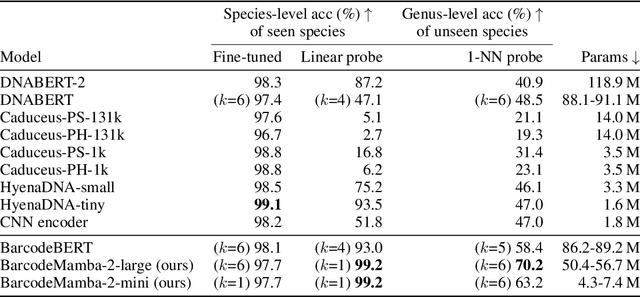
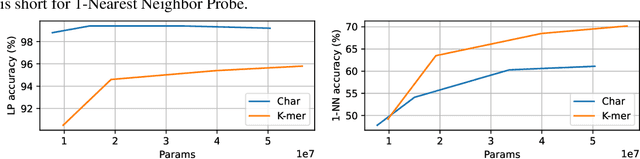
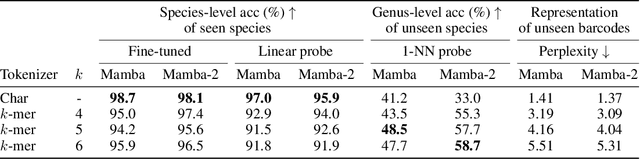
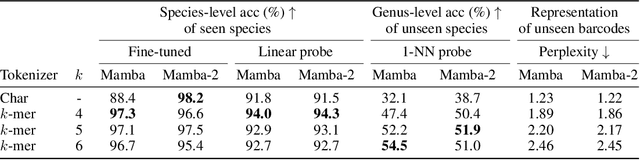
DNA barcodes are crucial in biodiversity analysis for building automatic identification systems that recognize known species and discover unseen species. Unlike human genome modeling, barcode-based invertebrate identification poses challenges in the vast diversity of species and taxonomic complexity. Among Transformer-based foundation models, BarcodeBERT excelled in species-level identification of invertebrates, highlighting the effectiveness of self-supervised pretraining on barcode-specific datasets. Recently, structured state space models (SSMs) have emerged, with a time complexity that scales sub-quadratically with the context length. SSMs provide an efficient parameterization of sequence modeling relative to attention-based architectures. Given the success of Mamba and Mamba-2 in natural language, we designed BarcodeMamba, a performant and efficient foundation model for DNA barcodes in biodiversity analysis. We conducted a comprehensive ablation study on the impacts of self-supervised training and tokenization methods, and compared both versions of Mamba layers in terms of expressiveness and their capacity to identify "unseen" species held back from training. Our study shows that BarcodeMamba has better performance than BarcodeBERT even when using only 8.3% as many parameters, and improves accuracy to 99.2% on species-level accuracy in linear probing without fine-tuning for "seen" species. In our scaling study, BarcodeMamba with 63.6% of BarcodeBERT's parameters achieved 70.2% genus-level accuracy in 1-nearest neighbor (1-NN) probing for unseen species. The code repository to reproduce our experiments is available at https://github.com/bioscan-ml/BarcodeMamba.