 Add to Chrome
 Add to Firefox
 Add to Edge
WARP-RM: A Warp-Augmented Relative Progress Reward Model for Data Curation
Jun 26, 2026
Scaling imitation learning requires large datasets, yet human teleoperation inevitably produces mixed-quality demonstrations containing hesitations and recoveries. Prior frame-level progress reward models supervise on absolute temporal progress proxies that suffer from label noise, or require costly human annotations to define subtask boundaries. We present WARP (Warp-Augmented Relative Progress), a novel fully self-supervised algorithm for learning dense, signed relative progress magnitudes directly from successful demonstrations. WARP generates per-frame progress targets via time-warp augmentations of demonstrations (variable playback speeds and reversals) and we train WARP-RM to predict the normalized elapsed time between input frames. Aggregating these predictions across overlapping windows yields a dense frame-level progress signal. We then introduce WARP-BC, which leverages these scalar reward estimates to upweight high-advantage action chunks during behavior cloning, where chunk-level advantage is obtained by aggregating per-frame rewards. We evaluate our approach on a physical bimanual robot system performing a long-horizon deformable object manipulation task: folding T-shirts from a random crumpled start. To evaluate policy robustness against suboptimal data, we construct training datasets of varying quality using episode length as a proxy for teleoperation sub-optimality. As the dataset is widened to admit more inefficiencies, WARP-BC maintains a 19/20 success rate compared to vanilla BC's collapse to 2/20, improving throughput by up to 18x.

Blox-Net: Generative Design-for-Robot-Assembly Using VLM Supervision, Physics Simulation, and a Robot with Reset
Sep 25, 2024


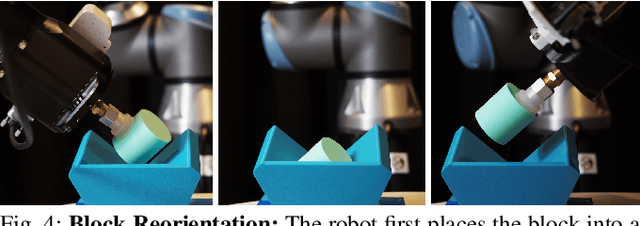
Generative AI systems have shown impressive capabilities in creating text, code, and images. Inspired by the rich history of research in industrial ''Design for Assembly'', we introduce a novel problem: Generative Design-for-Robot-Assembly (GDfRA). The task is to generate an assembly based on a natural language prompt (e.g., ''giraffe'') and an image of available physical components, such as 3D-printed blocks. The output is an assembly, a spatial arrangement of these components, and instructions for a robot to build this assembly. The output must 1) resemble the requested object and 2) be reliably assembled by a 6 DoF robot arm with a suction gripper. We then present Blox-Net, a GDfRA system that combines generative vision language models with well-established methods in computer vision, simulation, perturbation analysis, motion planning, and physical robot experimentation to solve a class of GDfRA problems with minimal human supervision. Blox-Net achieved a Top-1 accuracy of 63.5% in the ''recognizability'' of its designed assemblies (eg, resembling giraffe as judged by a VLM). These designs, after automated perturbation redesign, were reliably assembled by a robot, achieving near-perfect success across 10 consecutive assembly iterations with human intervention only during reset prior to assembly. Surprisingly, this entire design process from textual word (''giraffe'') to reliable physical assembly is performed with zero human intervention.