 Add to Chrome
 Add to Firefox
 Add to Edge
Breaking Lock-In: Preserving Steerability under Low-Data VLA Post-Training
Apr 25, 2026
Have you ever post-trained a generalist vision-language-action (VLA) policy on a small demonstration dataset, only to find that it stops responding to new instructions and is limited to behaviors observed during post-training? We identify this phenomenon as lock-in: after low-data, supervised fine-tuning (SFT), the policy becomes overly specialized to the post-training data and fails to generalize to novel instructions, manifesting as concept lock-in (fixation on training objects/attributes) and spatial lock-in (fixation on training spatial targets). Many existing remedies introduce additional supervision signals, such as those derived from foundation models or auxiliary objectives, or rely on augmented datasets to recover generalization. In this paper, we show that the policy's internal pre-trained knowledge is sufficient: DeLock mitigates lock-in by preserving visual grounding during post-training and applying test-time contrastive prompt guidance to steer the policy's denoising dynamics according to novel instructions. Across eight simulation and real-world evaluations, DeLock consistently outperforms strong baselines and matches or exceeds the performance of a state-of-the-art generalist policy post-trained with substantially more curated demonstrations.

GRaD-Nav: Efficiently Learning Visual Drone Navigation with Gaussian Radiance Fields and Differentiable Dynamics
Mar 06, 2025Autonomous visual navigation is an essential element in robot autonomy. Reinforcement learning (RL) offers a promising policy training paradigm. However existing RL methods suffer from high sample complexity, poor sim-to-real transfer, and limited runtime adaptability to navigation scenarios not seen during training. These problems are particularly challenging for drones, with complex nonlinear and unstable dynamics, and strong dynamic coupling between control and perception. In this paper, we propose a novel framework that integrates 3D Gaussian Splatting (3DGS) with differentiable deep reinforcement learning (DDRL) to train vision-based drone navigation policies. By leveraging high-fidelity 3D scene representations and differentiable simulation, our method improves sample efficiency and sim-to-real transfer. Additionally, we incorporate a Context-aided Estimator Network (CENet) to adapt to environmental variations at runtime. Moreover, by curriculum training in a mixture of different surrounding environments, we achieve in-task generalization, the ability to solve new instances of a task not seen during training. Drone hardware experiments demonstrate our method's high training efficiency compared to state-of-the-art RL methods, zero shot sim-to-real transfer for real robot deployment without fine tuning, and ability to adapt to new instances within the same task class (e.g. to fly through a gate at different locations with different distractors in the environment).
Simultaneous Spatial and Temporal Assignment for Fast UAV Trajectory Optimization using Bilevel Optimization
Dec 01, 2022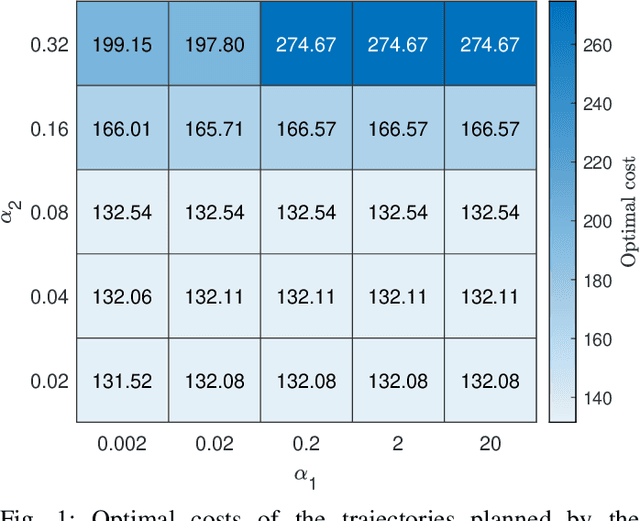
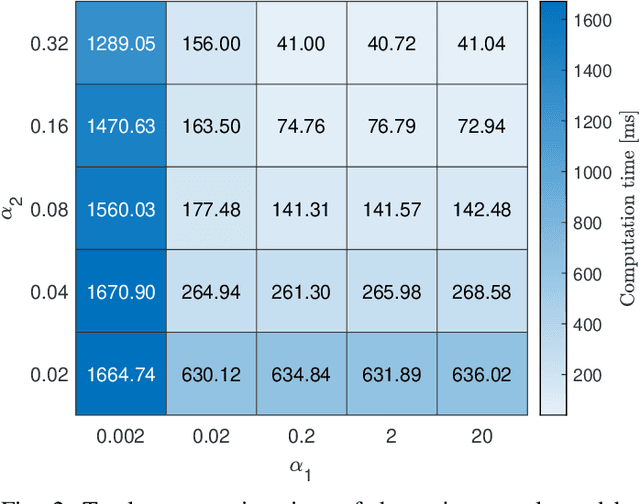
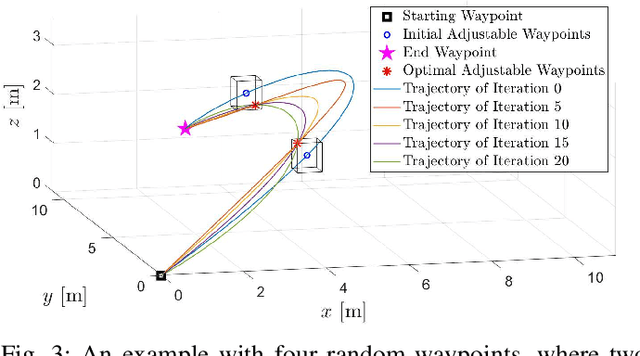
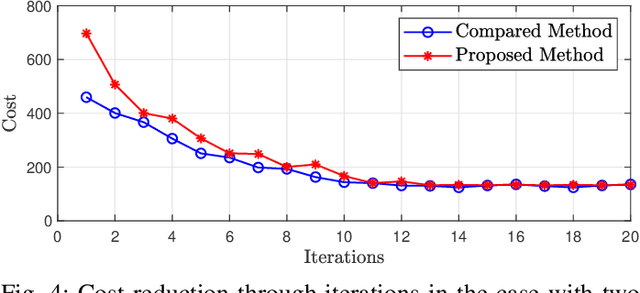
In this paper, we propose a framework for fast trajectory planning for unmanned aerial vehicles (UAVs). Our framework is reformulated from an existing bilevel optimization, in which the lower-level problem solves for the optimal trajectory with a fixed time allocation, whereas the upper-level problem updates the time allocation using analytical gradients. The lower-level problem incorporates the safety-set constraints (in the form of inequality constraints) and is cast as a convex quadratic program (QP). Our formulation modifies the lower-level QP by excluding the inequality constraints for the safety sets, which significantly reduces the computation time. The safety-set constraints are moved to the upper-level problem, where the feasible waypoints are updated together with the time allocation using analytical gradients enabled by the OptNet. We validate our approach in simulations, where our method's computation time scales linearly with respect to the number of safety sets, in contrast to the state-of-the-art that scales exponentially.