 Add to Chrome
 Add to Firefox
 Add to Edge
Stochastic Bilevel Optimization with Lower-Level Contextual Markov Decision Processes
Jun 03, 2024
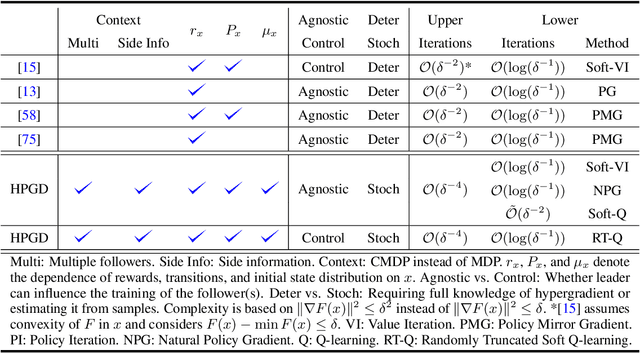

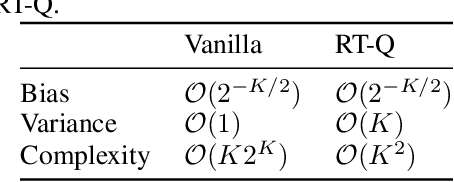
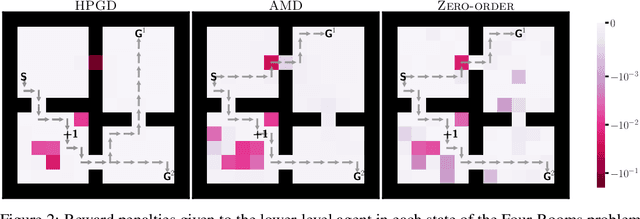
In various applications, the optimal policy in a strategic decision-making problem depends both on the environmental configuration and exogenous events. For these settings, we introduce Bilevel Optimization with Contextual Markov Decision Processes (BO-CMDP), a stochastic bilevel decision-making model, where the lower level consists of solving a contextual Markov Decision Process (CMDP). BO-CMDP can be viewed as a Stackelberg Game where the leader and a random context beyond the leader's control together decide the setup of (many) MDPs that (potentially multiple) followers best respond to. This framework extends beyond traditional bilevel optimization and finds relevance in diverse fields such as model design for MDPs, tax design, reward shaping and dynamic mechanism design. We propose a stochastic Hyper Policy Gradient Descent (HPGD) algorithm to solve BO-CMDP, and demonstrate its convergence. Notably, HPGD only utilizes observations of the followers' trajectories. Therefore, it allows followers to use any training procedure and the leader to be agnostic of the specific algorithm used, which aligns with various real-world scenarios. We further consider the setting when the leader can influence the training of followers and propose an accelerated algorithm. We empirically demonstrate the performance of our algorithm.

Safe Exploration Using Bayesian World Models and Log-Barrier Optimization
May 09, 2024A major challenge in deploying reinforcement learning in online tasks is ensuring that safety is maintained throughout the learning process. In this work, we propose CERL, a new method for solving constrained Markov decision processes while keeping the policy safe during learning. Our method leverages Bayesian world models and suggests policies that are pessimistic w.r.t. the model's epistemic uncertainty. This makes CERL robust towards model inaccuracies and leads to safe exploration during learning. In our experiments, we demonstrate that CERL outperforms the current state-of-the-art in terms of safety and optimality in solving CMDPs from image observations.
Bridging the Sim-to-Real Gap with Bayesian Inference
Mar 25, 2024We present SIM-FSVGD for learning robot dynamics from data. As opposed to traditional methods, SIM-FSVGD leverages low-fidelity physical priors, e.g., in the form of simulators, to regularize the training of neural network models. While learning accurate dynamics already in the low data regime, SIM-FSVGD scales and excels also when more data is available. We empirically show that learning with implicit physical priors results in accurate mean model estimation as well as precise uncertainty quantification. We demonstrate the effectiveness of SIM-FSVGD in bridging the sim-to-real gap on a high-performance RC racecar system. Using model-based RL, we demonstrate a highly dynamic parking maneuver with drifting, using less than half the data compared to the state of the art.
Transition Constrained Bayesian Optimization via Markov Decision Processes
Feb 13, 2024
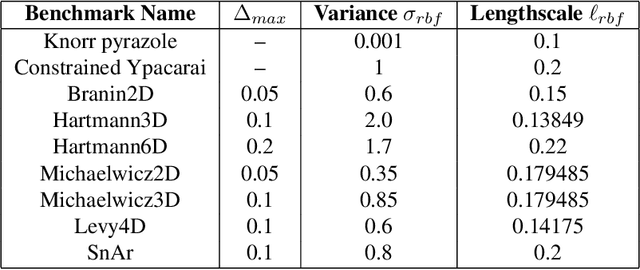


Bayesian optimization is a methodology to optimize black-box functions. Traditionally, it focuses on the setting where you can arbitrarily query the search space. However, many real-life problems do not offer this flexibility; in particular, the search space of the next query may depend on previous ones. Example challenges arise in the physical sciences in the form of local movement constraints, required monotonicity in certain variables, and transitions influencing the accuracy of measurements. Altogether, such transition constraints necessitate a form of planning. This work extends Bayesian optimization via the framework of Markov Decision Processes, iteratively solving a tractable linearization of our objective using reinforcement learning to obtain a policy that plans ahead over long horizons. The resulting policy is potentially history-dependent and non-Markovian. We showcase applications in chemical reactor optimization, informative path planning, machine calibration, and other synthetic examples.
Information-based Transductive Active Learning
Feb 13, 2024


We generalize active learning to address real-world settings where sampling is restricted to an accessible region of the domain, while prediction targets may lie outside this region. To this end, we propose ITL, short for information-based transductive learning, an approach which samples adaptively to maximize the information gained about specified prediction targets. We show, under general regularity assumptions, that ITL converges uniformly to the smallest possible uncertainty obtainable from the accessible data. We demonstrate ITL in two key applications: Few-shot fine-tuning of large neural networks and safe Bayesian optimization, and in both cases, ITL significantly outperforms the state-of-the-art.
Active Few-Shot Fine-Tuning
Feb 13, 2024We study the active few-shot fine-tuning of large neural networks to downstream tasks. We show that few-shot fine-tuning is an instance of a generalization of classical active learning, transductive active learning, and we propose ITL, short for information-based transductive learning, an approach which samples adaptively to maximize the information gained about specified downstream tasks. Under general regularity assumptions, we prove that ITL converges uniformly to the smallest possible uncertainty obtainable from the accessible data. To the best of our knowledge, we are the first to derive generalization bounds of this kind, and they may be of independent interest for active learning. We apply ITL to the few-shot fine-tuning of large neural networks and show that ITL substantially improves upon the state-of-the-art.
Safe Guaranteed Exploration for Non-linear Systems
Feb 09, 2024Safely exploring environments with a-priori unknown constraints is a fundamental challenge that restricts the autonomy of robots. While safety is paramount, guarantees on sufficient exploration are also crucial for ensuring autonomous task completion. To address these challenges, we propose a novel safe guaranteed exploration framework using optimal control, which achieves first-of-its-kind results: guaranteed exploration for non-linear systems with finite time sample complexity bounds, while being provably safe with arbitrarily high probability. The framework is general and applicable to many real-world scenarios with complex non-linear dynamics and unknown domains. Based on this framework we propose an efficient algorithm, SageMPC, SAfe Guaranteed Exploration using Model Predictive Control. SageMPC improves efficiency by incorporating three techniques: i) exploiting a Lipschitz bound, ii) goal-directed exploration, and iii) receding horizon style re-planning, all while maintaining the desired sample complexity, safety and exploration guarantees of the framework. Lastly, we demonstrate safe efficient exploration in challenging unknown environments using SageMPC with a car model.
Model-Based RL for Mean-Field Games is not Statistically Harder than Single-Agent RL
Feb 08, 2024We study the sample complexity of reinforcement learning (RL) in Mean-Field Games (MFGs) with model-based function approximation that requires strategic exploration to find a Nash Equilibrium policy. We introduce the Partial Model-Based Eluder Dimension (P-MBED), a more effective notion to characterize the model class complexity. Notably, P-MBED measures the complexity of the single-agent model class converted from the given mean-field model class, and potentially, can be exponentially lower than the MBED proposed by \citet{huang2023statistical}. We contribute a model elimination algorithm featuring a novel exploration strategy and establish sample complexity results polynomial w.r.t.~P-MBED. Crucially, our results reveal that, under the basic realizability and Lipschitz continuity assumptions, \emph{learning Nash Equilibrium in MFGs is no more statistically challenging than solving a logarithmic number of single-agent RL problems}. We further extend our results to Multi-Type MFGs, generalizing from conventional MFGs and involving multiple types of agents. This extension implies statistical tractability of a broader class of Markov Games through the efficacy of mean-field approximation. Finally, inspired by our theoretical algorithm, we present a heuristic approach with improved computational efficiency and empirically demonstrate its effectiveness.
Personalized Federated Learning of Probabilistic Models: A PAC-Bayesian Approach
Jan 16, 2024Federated learning aims to infer a shared model from private and decentralized data stored locally by multiple clients. Personalized federated learning (PFL) goes one step further by adapting the global model to each client, enhancing the model's fit for different clients. A significant level of personalization is required for highly heterogeneous clients, but can be challenging to achieve especially when they have small datasets. To address this problem, we propose a PFL algorithm named PAC-PFL for learning probabilistic models within a PAC-Bayesian framework that utilizes differential privacy to handle data-dependent priors. Our algorithm collaboratively learns a shared hyper-posterior and regards each client's posterior inference as the personalization step. By establishing and minimizing a generalization bound on the average true risk of clients, PAC-PFL effectively combats over-fitting. PACPFL achieves accurate and well-calibrated predictions, supported by experiments on a dataset of photovoltaic panel power generation, FEMNIST dataset (Caldas et al., 2019), and Dirichlet-partitioned EMNIST dataset (Cohen et al., 2017).
EquiReact: An equivariant neural network for chemical reactions
Dec 13, 2023Equivariant neural networks have considerably improved the accuracy and data-efficiency of predictions of molecular properties. Building on this success, we introduce EquiReact, an equivariant neural network to infer properties of chemical reactions, built from three-dimensional structures of reactants and products. We illustrate its competitive performance on the prediction of activation barriers on the GDB7-22-TS, Cyclo-23-TS and Proparg-21-TS datasets with different regimes according to the inclusion of atom-mapping information. We show that, compared to state-of-the-art models for reaction property prediction, EquiReact offers: (i) a flexible model with reduced sensitivity between atom-mapping regimes, (ii) better extrapolation capabilities to unseen chemistries, (iii) impressive prediction errors for datasets exhibiting subtle variations in three-dimensional geometries of reactants/products, (iv) reduced sensitivity to geometry quality and (iv) excellent data efficiency.