 Add to Chrome
 Add to Firefox
 Add to Edge
What preferences can - and cannot - predict in multi-agent online learning
Aug 13, 2026
We examine the interplay between ordinal, preference-based solution concepts in games and the long-run behavior of game dynamics, asking in particular to what extent the combinatorial data of a game -- its preference graph -- determine the outcomes of no-regret learning dynamics -- such as follow-the-regularized-leader (FTRL). In one direction, we show that the skeleton of every dynamically stable set (i.e. the set of pure profiles it contains) must also be preferentially stable, that is, it must be closed under profitable deviations. We then ask the converse question: when do preferences determine the long-run behavior of the players' learning dynamics? We begin by showing that preferences characterize asymptotic stability in the case of subgames -- i.e. subsets of pure profiles obtained by restricting players' action sets. Beyond this case however, the equivalence between dynamic and preferential stability collapses: concretely, we construct a three-player game with a preferentially stable set whose span is dynamically unstable, showing in this way that preferences do not suffice as a criterion of dynamic stability. We then bridge this gap via the notion of resilience under aggregate deviations, an easy-to-check payoff-based condition that guarantees asymptotic stability of arbitrary spans of pure strategies.

Regret, equilibrium, and learning in games: A guided tour
Aug 10, 2026This note aims to serve as an entry point to the literature on learning in games, a topic with significant theoretical appeal and a wide range of applications -- from machine learning and data science to economics and beyond. Our presentation is structured around two complementary viewpoints: We first consider a single agent -- the learner -- engaged in a sequential decision process in an unknown, non-stationary, and possibly adversarial environment. We then examine what happens when the environment is shaped by the decisions of several interacting agents, not necessarily aware of each other's actions or goals, and all seeking to improve their individual rewards. In this general context, we examine a family of regularized learning policies based on best-responding to the past history of play, up to a regularization penalty intended to encourage exploration and prevent over-commitment to suboptimal choices. In the single-agent setting, we present some basic regret bounds for regularized learning in adversarial multi-armed bandits; in the multi-agent setting, we describe an ergodic equilibrium convergence result for zero-sum games in the spirit of classical results on fictitious play, as well as a "folk theorem" linking strategic and dynamic notions of stability -- Nash equilibria and attracting points of regularized learning, respectively. We pay special attention to the information available to the players and, through a unified analysis framework, we study both oracle- and payoff-based (bandit) methods. Our goal is to provide a coherent and comprehensible -- albeit, by necessity, not comprehensive -- account of some recent ideas in the field, and to discuss their implications for the study of rationality.
Leveraging Similarities in Multi-Armed Bandits
Jun 22, 2026In many online learning and bandit problems, the actions we consider possess inherent similarities--for instance because they share latent traits, tags, or hierarchical structure. We study online learning with a similarity-structured action set, encoded by a rooted tree whose leaves are the actions and whose levels quantify how closely two actions are related. The loss sequence is assumed tree-compatible: losses of similar actions are constrained to be close. We establish an impossibility result showing that usual one-point bandit feedback cannot, in general, leverage range or tree-induced similarity, even under very strong similarity constraints. We then provide a unified set of algorithms which adapt to a wide range of richer feedback models, from semi-bandit feedback down to multi-point bandit protocols, including the minimal two-point feedback setting. We show these algorithms exhibit best-of-both-worlds guarantees and provably exploit action similarities by replacing the number of actions $K$ by a similarity-aware effective number of actions $K_{\mathrm{eff}}$ in the regret bounds. As an application, we show that under two-point feedback, it is possible to achieve $\sqrt{T}$ regret in Lipschitz bandits when $d \leq 2$.
Bregman meets Lévy: Stochastic mirror descent with heavy-tailed noise in continuous and discrete time
Jun 02, 2026We study the robustness of stochastic mirror descent (SMD) under heavy-tailed noise, focusing on whether the method retains its convergence guarantees when run with infinite-variance stochastic gradient input. To address this question in a principled manner, we begin by introducing a continuous-time model of SMD as a stochastic differential equation (SDE) driven by a centered Lévy noise process with finite $p$-th order moments, $1 < p \leq 2$. This scheme -- which we call the Lévy mirror flow (LMF) -- arises naturally as the scaling limit of SMD in the presence of heavy-tailed noise. In particular, when $p < 2$ -- the heavy noise regime -- the trajectories of LMF generically exhibit jump discontinuities of arbitrary magnitude which, if frequent enough, lead to infinite variance. Nonetheless, despite this highly singular behavior, we show that LMF attains $ε$-optimality within $\mathcal{O}(ε^{-p/(p-1)})$ time in the convex case, and within $\mathcal{\tilde O}(ε^{-1/(p-1)})$ time for (relatively) strongly convex objectives. These guarantees provide a transparent characterization of the impact of frequent long jumps on the convergence of the process, and percolate to a series of matching discrete-time guarantees for several variants of SMD under heavy-tailed noise.
Efficient Swap Regret Minimization in Combinatorial Bandits
Feb 02, 2026This paper addresses the problem of designing efficient no-swap regret algorithms for combinatorial bandits, where the number of actions $N$ is exponentially large in the dimensionality of the problem. In this setting, designing efficient no-swap regret translates to sublinear -- in horizon $T$ -- swap regret with polylogarithmic dependence on $N$. In contrast to the weaker notion of external regret minimization - a problem which is fairly well understood in the literature - achieving no-swap regret with a polylogarithmic dependence on $N$ has remained elusive in combinatorial bandits. Our paper resolves this challenge, by introducing a no-swap-regret learning algorithm with regret that scales polylogarithmically in $N$ and is tight for the class of combinatorial bandits. To ground our results, we also demonstrate how to implement the proposed algorithm efficiently -- that is, with a per-iteration complexity that also scales polylogarithmically in $N$ -- across a wide range of well-studied applications.
Robust equilibria in continuous games: From strategic to dynamic robustness
Dec 09, 2025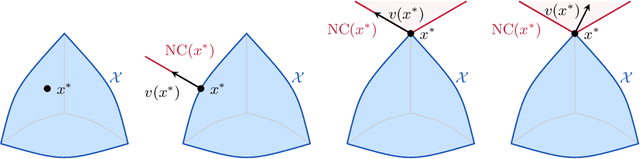
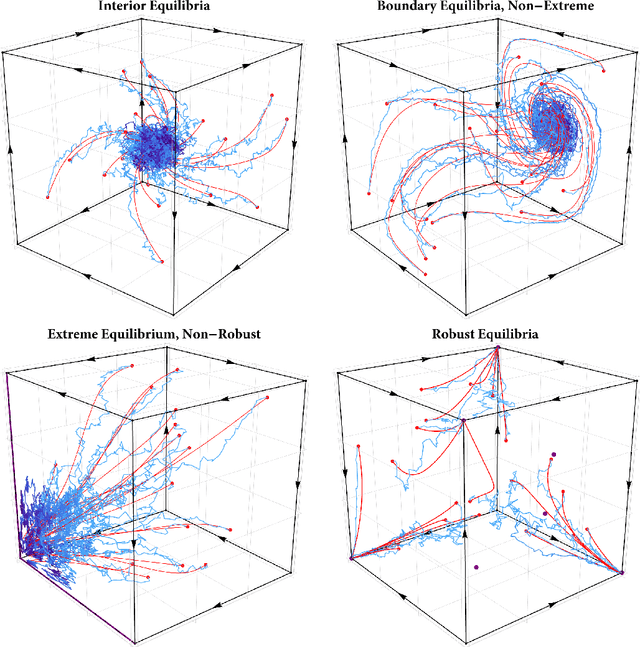
In this paper, we examine the robustness of Nash equilibria in continuous games, under both strategic and dynamic uncertainty. Starting with the former, we introduce the notion of a robust equilibrium as those equilibria that remain invariant to small -- but otherwise arbitrary -- perturbations to the game's payoff structure, and we provide a crisp geometric characterization thereof. Subsequently, we turn to the question of dynamic robustness, and we examine which equilibria may arise as stable limit points of the dynamics of "follow the regularized leader" (FTRL) in the presence of randomness and uncertainty. Despite their very distinct origins, we establish a structural correspondence between these two notions of robustness: strategic robustness implies dynamic robustness, and, conversely, the requirement of strategic robustness cannot be relaxed if dynamic robustness is to be maintained. Finally, we examine the rate of convergence to robust equilibria as a function of the underlying regularizer, and we show that entropically regularized learning converges at a geometric rate in games with affinely constrained action spaces.
Multi-agent learning under uncertainty: Recurrence vs. concentration
Dec 09, 2025In this paper, we examine the convergence landscape of multi-agent learning under uncertainty. Specifically, we analyze two stochastic models of regularized learning in continuous games -- one in continuous and one in discrete time with the aim of characterizing the long-run behavior of the induced sequence of play. In stark contrast to deterministic, full-information models of learning (or models with a vanishing learning rate), we show that the resulting dynamics do not converge in general. In lieu of this, we ask instead which actions are played more often in the long run, and by how much. We show that, in strongly monotone games, the dynamics of regularized learning may wander away from equilibrium infinitely often, but they always return to its vicinity in finite time (which we estimate), and their long-run distribution is sharply concentrated around a neighborhood thereof. We quantify the degree of this concentration, and we show that these favorable properties may all break down if the underlying game is not strongly monotone -- underscoring in this way the limits of regularized learning in the presence of persistent randomness and uncertainty.
The impact of uncertainty on regularized learning in games
Jun 16, 2025In this paper, we investigate how randomness and uncertainty influence learning in games. Specifically, we examine a perturbed variant of the dynamics of "follow-the-regularized-leader" (FTRL), where the players' payoff observations and strategy updates are continually impacted by random shocks. Our findings reveal that, in a fairly precise sense, "uncertainty favors extremes": in any game, regardless of the noise level, every player's trajectory of play reaches an arbitrarily small neighborhood of a pure strategy in finite time (which we estimate). Moreover, even if the player does not ultimately settle at this strategy, they return arbitrarily close to some (possibly different) pure strategy infinitely often. This prompts the question of which sets of pure strategies emerge as robust predictions of learning under uncertainty. We show that (a) the only possible limits of the FTRL dynamics under uncertainty are pure Nash equilibria; and (b) a span of pure strategies is stable and attracting if and only if it is closed under better replies. Finally, we turn to games where the deterministic dynamics are recurrent - such as zero-sum games with interior equilibria - and we show that randomness disrupts this behavior, causing the stochastic dynamics to drift toward the boundary on average.
The global convergence time of stochastic gradient descent in non-convex landscapes: Sharp estimates via large deviations
Mar 20, 2025In this paper, we examine the time it takes for stochastic gradient descent (SGD) to reach the global minimum of a general, non-convex loss function. We approach this question through the lens of randomly perturbed dynamical systems and large deviations theory, and we provide a tight characterization of the global convergence time of SGD via matching upper and lower bounds. These bounds are dominated by the most "costly" set of obstacles that the algorithm may need to overcome to reach a global minimizer from a given initialization, coupling in this way the global geometry of the underlying loss landscape with the statistics of the noise entering the process. Finally, motivated by applications to the training of deep neural networks, we also provide a series of refinements and extensions of our analysis for loss functions with shallow local minima.
Accelerated regularized learning in finite N-person games
Dec 29, 2024Motivated by the success of Nesterov's accelerated gradient algorithm for convex minimization problems, we examine whether it is possible to achieve similar performance gains in the context of online learning in games. To that end, we introduce a family of accelerated learning methods, which we call "follow the accelerated leader" (FTXL), and which incorporates the use of momentum within the general framework of regularized learning - and, in particular, the exponential/multiplicative weights algorithm and its variants. Drawing inspiration and techniques from the continuous-time analysis of Nesterov's algorithm, we show that FTXL converges locally to strict Nash equilibria at a superlinear rate, achieving in this way an exponential speed-up over vanilla regularized learning methods (which, by comparison, converge to strict equilibria at a geometric, linear rate). Importantly, FTXL maintains its superlinear convergence rate in a broad range of feedback structures, from deterministic, full information models to stochastic, realization-based ones, and even when run with bandit, payoff-based information, where players are only able to observe their individual realized payoffs.