 Add to Chrome
 Add to Firefox
 Add to Edge
VLM-Based Advanced Rider Assistance System for Motorcycle Safety
May 27, 2026
Motorcycles face disproportionately high crash risks compared to cars due to limited protection and heightened sensitivity to surface hazards, yet Advanced Rider Assistance Systems (ARAS) remain underdeveloped relative to Advanced Driver Assistance Systems (ADAS). We propose a novel ARAS that enhances motorcycle safety through semantic perception and risk-aware planning. Our approach leverages Vision-Language Models (VLMs) for contextual hazard reasoning and integrates them with segmentation-based detection to construct dense risk maps. These maps encode both semantic characteristics (e.g., pothole severity, puddle slipperiness) and physical attributes (e.g., size, depth), which produce per-pixel hazard costs that capture motorcycle-specific risks. These maps are used by a sampling-based planner tailored to motorcycle dynamics to recommend throttle and steering actions that minimize hazard exposure while advancing toward the destination. We evaluate our system in different scenarios in the CARLA simulator. Compared to the baseline method, our method achieves higher success rates and lower hazard exposure, while qualitative results demonstrate interpretable risk maps and safe trajectory recommendations.

Adaptive Time Step Flow Matching for Autonomous Driving Motion Planning
Feb 14, 2026Autonomous driving requires reasoning about interactions with surrounding traffic. A prevailing approach is large-scale imitation learning on expert driving datasets, aimed at generalizing across diverse real-world scenarios. For online trajectory generation, such methods must operate at real-time rates. Diffusion models require hundreds of denoising steps at inference, resulting in high latency. Consistency models mitigate this issue but rely on carefully tuned noise schedules to capture the multimodal action distributions common in autonomous driving. Adapting the schedule, typically requires expensive retraining. To address these limitations, we propose a framework based on conditional flow matching that jointly predicts future motions of surrounding agents and plans the ego trajectory in real time. We train a lightweight variance estimator that selects the number of inference steps online, removing the need for retraining to balance runtime and imitation learning performance. To further enhance ride quality, we introduce a trajectory post-processing step cast as a convex quadratic program, with negligible computational overhead. Trained on the Waymo Open Motion Dataset, the framework performs maneuvers such as lane changes, cruise control, and navigating unprotected left turns without requiring scenario-specific tuning. Our method maintains a 20 Hz update rate on an NVIDIA RTX 3070 GPU, making it suitable for online deployment. Compared to transformer, diffusion, and consistency model baselines, we achieve improved trajectory smoothness and better adherence to dynamic constraints. Experiment videos and code implementations can be found at https://flow-matching-self-driving.github.io/.
Chance-Constrained Convex MPC for Robust Quadruped Locomotion Under Parametric and Additive Uncertainties
Nov 05, 2024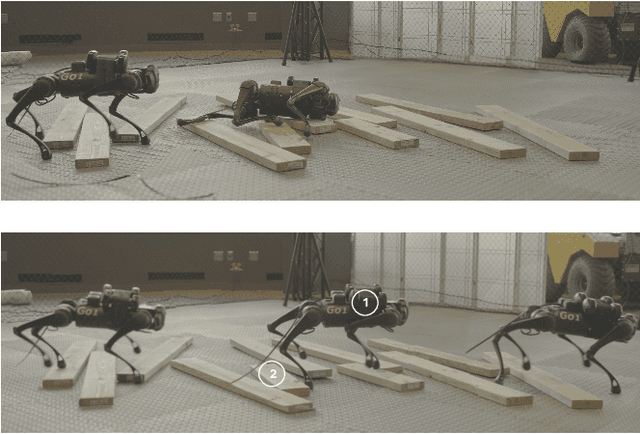
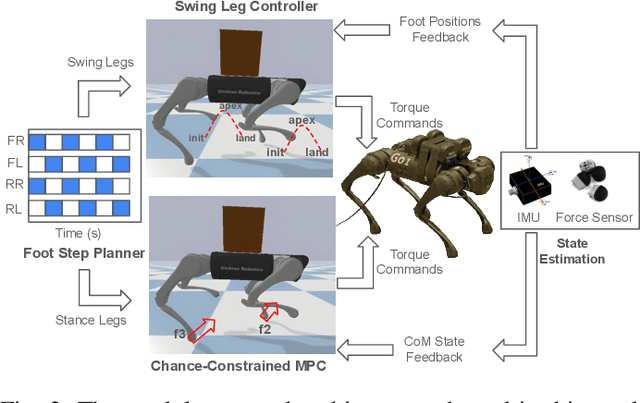
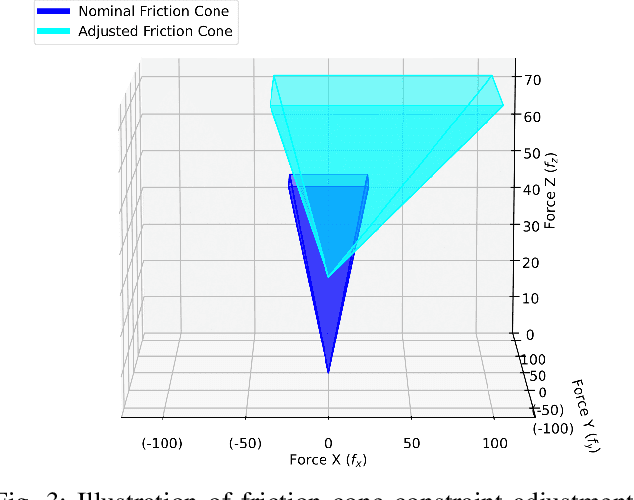
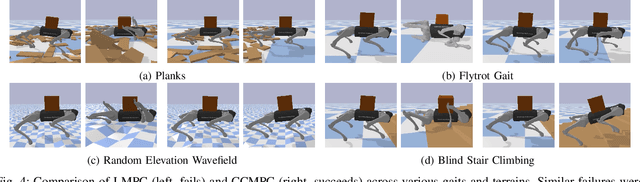
Recent advances in quadrupedal locomotion have focused on improving stability and performance across diverse environments. However, existing methods often lack adequate safety analysis and struggle to adapt to varying payloads and complex terrains, typically requiring extensive tuning. To overcome these challenges, we propose a Chance-Constrained Model Predictive Control (CCMPC) framework that explicitly models payload and terrain variability as distributions of parametric and additive disturbances within the single rigid body dynamics (SRBD) model. Our approach ensures safe and consistent performance under uncertain dynamics by expressing the model friction cone constraints, which define the feasible set of ground reaction forces, as chance constraints. Moreover, we solve the resulting stochastic control problem using a computationally efficient quadratic programming formulation. Extensive Monte Carlo simulations of quadrupedal locomotion across varying payloads and complex terrains demonstrate that CCMPC significantly outperforms two competitive benchmarks: Linear MPC (LMPC) and MPC with hand-tuned safety margins to maintain stability, reduce foot slippage, and track the center of mass. Hardware experiments on the Unitree Go1 robot show successful locomotion across various indoor and outdoor terrains with unknown loads exceeding 50% of the robot body weight, despite no additional parameter tuning. A video of the results and accompanying code can be found at: https://cc-mpc.github.io/.
Data-Driven Sampling Based Stochastic MPC for Skid-Steer Mobile Robot Navigation
Nov 05, 2024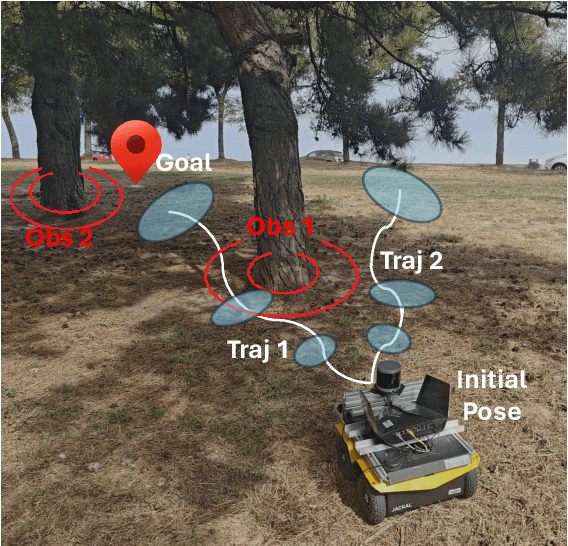

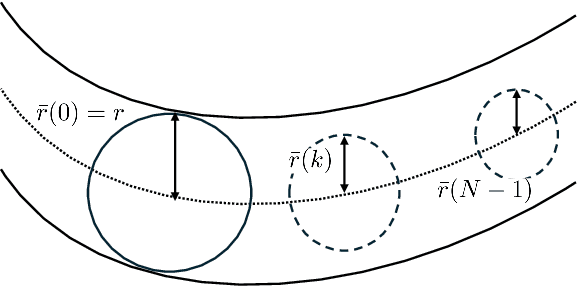
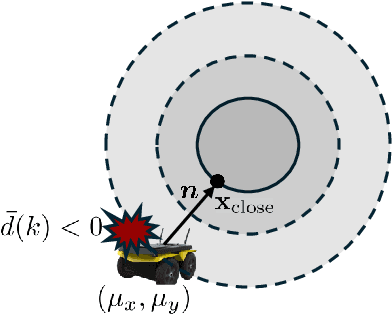
Traditional approaches to motion modeling for skid-steer robots struggle with capturing nonlinear tire-terrain dynamics, especially during high-speed maneuvers. In this paper, we tackle such nonlinearities by enhancing a dynamic unicycle model with Gaussian Process (GP) regression outputs. This enables us to develop an adaptive, uncertainty-informed navigation formulation. We solve the resultant stochastic optimal control problem using a chance-constrained Model Predictive Path Integral (MPPI) control method. This approach formulates both obstacle avoidance and path-following as chance constraints, accounting for residual uncertainties from the GP to ensure safety and reliability in control. Leveraging GPU acceleration, we efficiently manage the non-convex nature of the problem, ensuring real-time performance. Our approach unifies path-following and obstacle avoidance across different terrains, unlike prior works which typically focus on one or the other. We compare our GP-MPPI method against unicycle and data-driven kinematic models within the MPPI framework. In simulations, our approach shows superior tracking accuracy and obstacle avoidance. We further validate our approach through hardware experiments on a skid-steer robot platform, demonstrating its effectiveness in high-speed navigation. The GPU implementation of the proposed method and supplementary video footage are available at https: //stochasticmppi.github.io.
Predictive Mapping of Spectral Signatures from RGB Imagery for Off-Road Terrain Analysis
May 08, 2024Accurate identification of complex terrain characteristics, such as soil composition and coefficient of friction, is essential for model-based planning and control of mobile robots in off-road environments. Spectral signatures leverage distinct patterns of light absorption and reflection to identify various materials, enabling precise characterization of their inherent properties. Recent research in robotics has explored the adoption of spectroscopy to enhance perception and interaction with environments. However, the significant cost and elaborate setup required for mounting these sensors present formidable barriers to widespread adoption. In this study, we introduce RS-Net (RGB to Spectral Network), a deep neural network architecture designed to map RGB images to corresponding spectral signatures. We illustrate how RS-Net can be synergistically combined with Co-Learning techniques for terrain property estimation. Initial results demonstrate the effectiveness of this approach in characterizing spectral signatures across an extensive off-road real-world dataset. These findings highlight the feasibility of terrain property estimation using only RGB cameras.
A Probabilistic Motion Model for Skid-Steer Wheeled Mobile Robot Navigation on Off-Road Terrains
Feb 29, 2024Skid-Steer Wheeled Mobile Robots (SSWMRs) are increasingly being used for off-road autonomy applications. When turning at high speeds, these robots tend to undergo significant skidding and slipping. In this work, using Gaussian Process Regression (GPR) and Sigma-Point Transforms, we estimate the non-linear effects of tire-terrain interaction on robot velocities in a probabilistic fashion. Using the mean estimates from GPR, we propose a data-driven dynamic motion model that is more accurate at predicting future robot poses than conventional kinematic motion models. By efficiently solving a convex optimization problem based on the history of past robot motion, the GPR augmented motion model generalizes to previously unseen terrain conditions. The output distribution from the proposed motion model can be used for local motion planning approaches, such as stochastic model predictive control, leveraging model uncertainty to make safe decisions. We validate our work on a benchmark real-world multi-terrain SSWMR dataset. Our results show that the model generalizes to three different terrains while significantly reducing errors in linear and angular motion predictions. As shown in the attached video, we perform a separate set of experiments on a physical robot to demonstrate the robustness of the proposed algorithm.