 Add to Chrome
 Add to Firefox
 Add to Edge
Accelerating Mixed Discrete-Continuous Motion Planning via Neural Graphs of Convex Sets
Aug 15, 2026
Motion planning problems such as collision-free navigation and contact-rich manipulation can be naturally formulated as optimization problems that couple discrete decisions with continuous trajectories. The Graphs of Convex Sets (GCS) framework offers a practical solution to these problems. It represents discrete decisions as nodes of a graph and encodes continuous trajectories in the edges connecting them. However, the resulting optimization subproblems can become computationally prohibitive for online replanning. In this work, we propose a learning-based strategy to mitigate this limitation. Specifically, we replace the costly convex relaxation step required by nominal GCS with a single forward pass through a Graph Attention Network that predicts a set of highly probable candidate paths through the graph. A lightweight ranking network then orders these candidates by their estimated trajectory cost. Evaluating them in this order, we terminate our search early while still recovering a near-optimal motion plan. We validate the resulting pipeline across diverse robotic tasks, including collision-free motion planning for a 3D quadrotor and a 7-DoF manipulator, and planning through contact for planar pushing. Across both convex and non-convex cost and constraint settings, our approach yields up to two orders of magnitude speedup over nominal GCS while maintaining a 100% success rate, at the cost of some suboptimality in the recovered solutions. Code implementations and video demonstrations can be found at https://neural-gcs.github.io/.

Layered Risk Mapping for Autonomous Patient Transport in Expeditionary Medical Facilities
Jul 15, 2026In expeditionary medical facilities, routine patient transport imposes a compounding burden of personal protective equipment consumption, staff diversion, and elevated infection risk that becomes unsustainable under surge conditions. While autonomous wheelchairs could absorb this operational load, the safety-critical nature of patient transit within these highly unstructured and dynamic environments poses complex navigational challenges. To address this, we present a layered risk mapping framework that fuses four heterogeneous environmental hazards (terrain slope, static and dynamic obstacles, and semantic traversability) into a unified probabilistic cost surface via a Noisy-OR fusion model. In a paired Monte-Carlo evaluation, risk-informed fusion reduces collision rates from over 73% to under 32% and more than doubles obstacle clearance relative to a risk-unaware baseline. Additionaly, Noisy-OR achieves the highest clearance to obstacles and the lowest conditional peak risk across all tested hazard densities. We further validate the framework on a commercial powered wheelchair across three representative mission profiles in indoor and outdoor deployments, demonstrating that this architecture successfully meets the planning requirements of this previously unaddressed operational regime.
Socially-Aware Autonomous Doorway Traversal and Payload Delivery for Emergency Assistance
Jul 06, 2026In this work, we focus on the scenario of a robot-assisted emergency evacuation. We consider two capabilities relevant to such a setting. The first is opening doors ahead of the people being evacuated, so that their path toward an exit stays clear. The second is retrieving rescue equipment and delivering it to the emergency responders carrying out the evacuation. From a systems perspective, this involves several tasks at once. The robot must locate ADA-compliant door buttons and the rescue equipment it needs to retrieve. Additionally, it must remain aware of the people around it and adapt its behavior to them, so that it supports the evacuation rather than getting in the way. We address these demands with a behavior tree at the core of our framework. This structure is chosen for its ability to select high-level tasks based on environmental triggers, and to extend to new situations as they arise. We evaluate the system in 105 trials on the Toyota Human Support Robot, across five hardware and three simulation scenarios. These trials capture the decisions the robot must make in this setting: whether to press a door button, yield to a nearby person, walk through a door someone else is holding, or first retrieve rescue equipment before traversing the door. Overall, the system completes 97 of the 105 trials successfully. These results suggest our framework provides a practical basis for robotic assistance in broader emergency response tasks. Code and video demonstrations are available at https://github.com/AndrewSnowdy/hsr_mm_control.
Re4MPC: Reactive Nonlinear MPC for Multi-model Motion Planning via Deep Reinforcement Learning
Jun 10, 2025Traditional motion planning methods for robots with many degrees-of-freedom, such as mobile manipulators, are often computationally prohibitive for real-world settings. In this paper, we propose a novel multi-model motion planning pipeline, termed Re4MPC, which computes trajectories using Nonlinear Model Predictive Control (NMPC). Re4MPC generates trajectories in a computationally efficient manner by reactively selecting the model, cost, and constraints of the NMPC problem depending on the complexity of the task and robot state. The policy for this reactive decision-making is learned via a Deep Reinforcement Learning (DRL) framework. We introduce a mathematical formulation to integrate NMPC into this DRL framework. To validate our methodology and design choices, we evaluate DRL training and test outcomes in a physics-based simulation involving a mobile manipulator. Experimental results demonstrate that Re4MPC is more computationally efficient and achieves higher success rates in reaching end-effector goals than the NMPC baseline, which computes whole-body trajectories without our learning mechanism.
Forest Biomass Mapping with Terrestrial Hyperspectral Imaging for Wildfire Risk Monitoring
Nov 25, 2024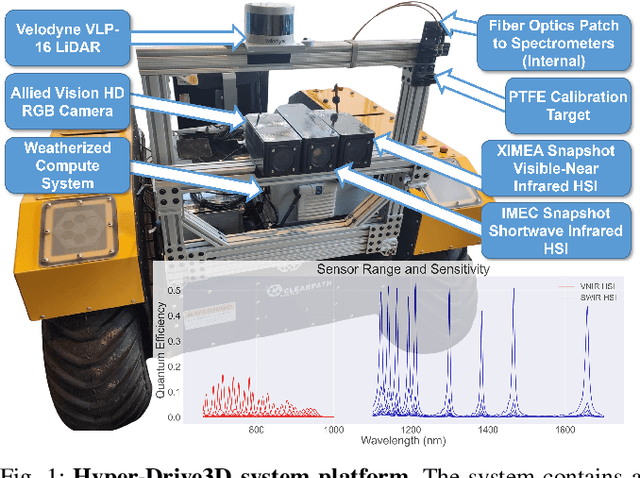
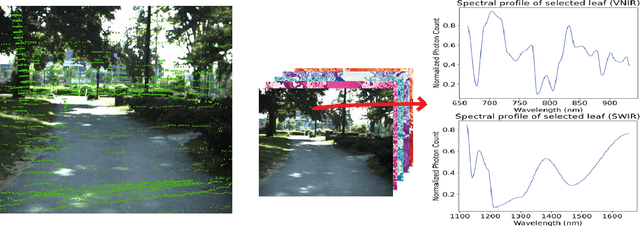

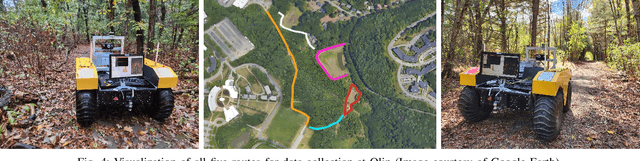
With the rapid increase in wildfires in the past decade, it has become necessary to detect and predict these disasters to mitigate losses to ecosystems and human lives. In this paper, we present a novel solution -- Hyper-Drive3D -- consisting of snapshot hyperspectral imaging and LiDAR, mounted on an Unmanned Ground Vehicle (UGV) that identifies areas inside forests at risk of becoming fuel for a forest fire. This system enables more accurate classification by analyzing the spectral signatures of forest vegetation. We conducted field trials in a controlled environment simulating forest conditions, yielding valuable insights into the system's effectiveness. Extensive data collection was also performed in a dense forest across varying environmental conditions and topographies to enhance the system's predictive capabilities for fire hazards and support a risk-informed, proactive forest management strategy. Additionally, we propose a framework for extracting moisture data from hyperspectral imagery and projecting it into 3D space.
Chance-Constrained Convex MPC for Robust Quadruped Locomotion Under Parametric and Additive Uncertainties
Nov 05, 2024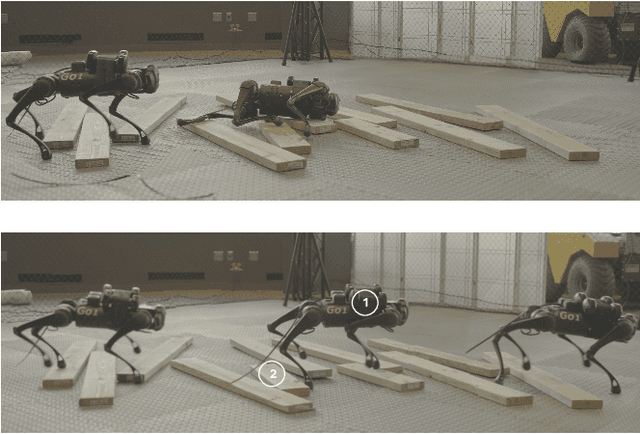
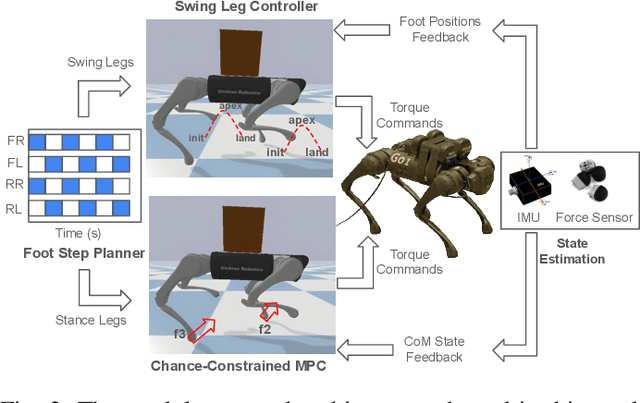
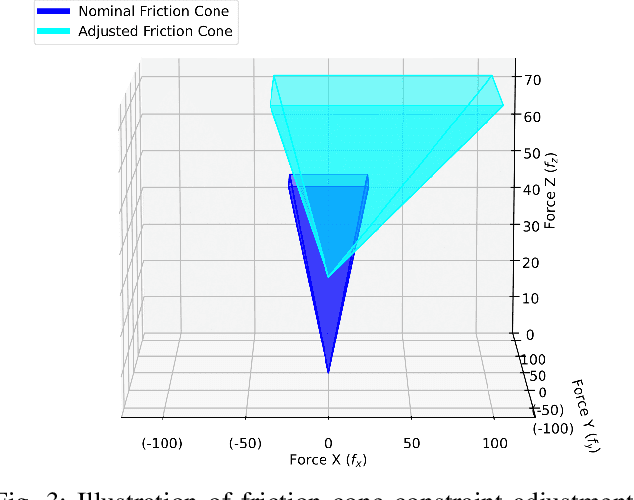
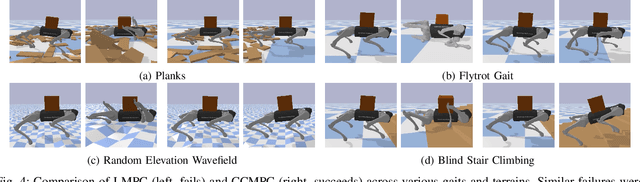
Recent advances in quadrupedal locomotion have focused on improving stability and performance across diverse environments. However, existing methods often lack adequate safety analysis and struggle to adapt to varying payloads and complex terrains, typically requiring extensive tuning. To overcome these challenges, we propose a Chance-Constrained Model Predictive Control (CCMPC) framework that explicitly models payload and terrain variability as distributions of parametric and additive disturbances within the single rigid body dynamics (SRBD) model. Our approach ensures safe and consistent performance under uncertain dynamics by expressing the model friction cone constraints, which define the feasible set of ground reaction forces, as chance constraints. Moreover, we solve the resulting stochastic control problem using a computationally efficient quadratic programming formulation. Extensive Monte Carlo simulations of quadrupedal locomotion across varying payloads and complex terrains demonstrate that CCMPC significantly outperforms two competitive benchmarks: Linear MPC (LMPC) and MPC with hand-tuned safety margins to maintain stability, reduce foot slippage, and track the center of mass. Hardware experiments on the Unitree Go1 robot show successful locomotion across various indoor and outdoor terrains with unknown loads exceeding 50% of the robot body weight, despite no additional parameter tuning. A video of the results and accompanying code can be found at: https://cc-mpc.github.io/.
Data-Driven Sampling Based Stochastic MPC for Skid-Steer Mobile Robot Navigation
Nov 05, 2024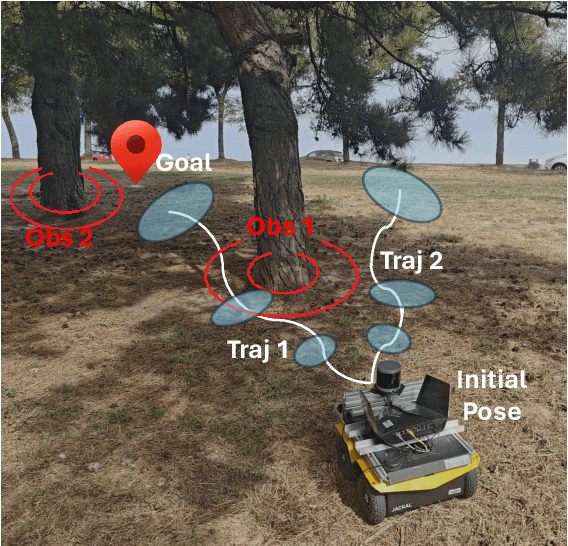

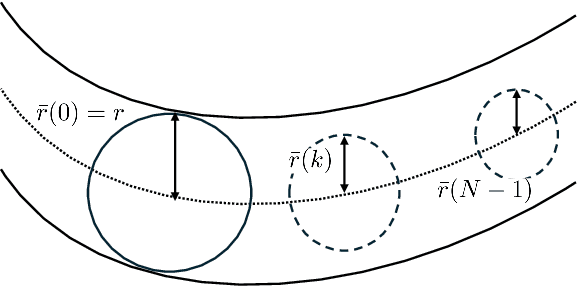
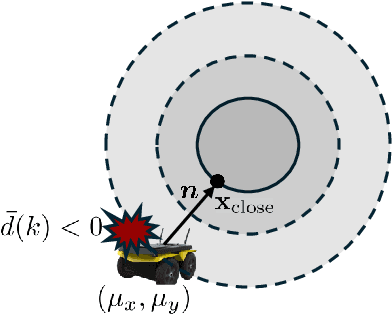
Traditional approaches to motion modeling for skid-steer robots struggle with capturing nonlinear tire-terrain dynamics, especially during high-speed maneuvers. In this paper, we tackle such nonlinearities by enhancing a dynamic unicycle model with Gaussian Process (GP) regression outputs. This enables us to develop an adaptive, uncertainty-informed navigation formulation. We solve the resultant stochastic optimal control problem using a chance-constrained Model Predictive Path Integral (MPPI) control method. This approach formulates both obstacle avoidance and path-following as chance constraints, accounting for residual uncertainties from the GP to ensure safety and reliability in control. Leveraging GPU acceleration, we efficiently manage the non-convex nature of the problem, ensuring real-time performance. Our approach unifies path-following and obstacle avoidance across different terrains, unlike prior works which typically focus on one or the other. We compare our GP-MPPI method against unicycle and data-driven kinematic models within the MPPI framework. In simulations, our approach shows superior tracking accuracy and obstacle avoidance. We further validate our approach through hardware experiments on a skid-steer robot platform, demonstrating its effectiveness in high-speed navigation. The GPU implementation of the proposed method and supplementary video footage are available at https: //stochasticmppi.github.io.
Predictive Mapping of Spectral Signatures from RGB Imagery for Off-Road Terrain Analysis
May 08, 2024Accurate identification of complex terrain characteristics, such as soil composition and coefficient of friction, is essential for model-based planning and control of mobile robots in off-road environments. Spectral signatures leverage distinct patterns of light absorption and reflection to identify various materials, enabling precise characterization of their inherent properties. Recent research in robotics has explored the adoption of spectroscopy to enhance perception and interaction with environments. However, the significant cost and elaborate setup required for mounting these sensors present formidable barriers to widespread adoption. In this study, we introduce RS-Net (RGB to Spectral Network), a deep neural network architecture designed to map RGB images to corresponding spectral signatures. We illustrate how RS-Net can be synergistically combined with Co-Learning techniques for terrain property estimation. Initial results demonstrate the effectiveness of this approach in characterizing spectral signatures across an extensive off-road real-world dataset. These findings highlight the feasibility of terrain property estimation using only RGB cameras.
A Probabilistic Motion Model for Skid-Steer Wheeled Mobile Robot Navigation on Off-Road Terrains
Feb 29, 2024Skid-Steer Wheeled Mobile Robots (SSWMRs) are increasingly being used for off-road autonomy applications. When turning at high speeds, these robots tend to undergo significant skidding and slipping. In this work, using Gaussian Process Regression (GPR) and Sigma-Point Transforms, we estimate the non-linear effects of tire-terrain interaction on robot velocities in a probabilistic fashion. Using the mean estimates from GPR, we propose a data-driven dynamic motion model that is more accurate at predicting future robot poses than conventional kinematic motion models. By efficiently solving a convex optimization problem based on the history of past robot motion, the GPR augmented motion model generalizes to previously unseen terrain conditions. The output distribution from the proposed motion model can be used for local motion planning approaches, such as stochastic model predictive control, leveraging model uncertainty to make safe decisions. We validate our work on a benchmark real-world multi-terrain SSWMR dataset. Our results show that the model generalizes to three different terrains while significantly reducing errors in linear and angular motion predictions. As shown in the attached video, we perform a separate set of experiments on a physical robot to demonstrate the robustness of the proposed algorithm.