 Add to Chrome
 Add to Firefox
 Add to Edge
VLM-Based Advanced Rider Assistance System for Motorcycle Safety
May 27, 2026
Motorcycles face disproportionately high crash risks compared to cars due to limited protection and heightened sensitivity to surface hazards, yet Advanced Rider Assistance Systems (ARAS) remain underdeveloped relative to Advanced Driver Assistance Systems (ADAS). We propose a novel ARAS that enhances motorcycle safety through semantic perception and risk-aware planning. Our approach leverages Vision-Language Models (VLMs) for contextual hazard reasoning and integrates them with segmentation-based detection to construct dense risk maps. These maps encode both semantic characteristics (e.g., pothole severity, puddle slipperiness) and physical attributes (e.g., size, depth), which produce per-pixel hazard costs that capture motorcycle-specific risks. These maps are used by a sampling-based planner tailored to motorcycle dynamics to recommend throttle and steering actions that minimize hazard exposure while advancing toward the destination. We evaluate our system in different scenarios in the CARLA simulator. Compared to the baseline method, our method achieves higher success rates and lower hazard exposure, while qualitative results demonstrate interpretable risk maps and safe trajectory recommendations.

N3P: Accelerated Automated Parking via a Learning-Based Naturalistic Three-Stage Scheme
May 21, 2026Autonomous parking requires efficient path planning that ensures kinematic feasibility and collision avoidance in constrained environments. Hybrid A* is widely used but computationally expensive, while reinforcement learning (RL) methods lack reliability and often struggle with long-horizon geometric constraints, leading to suboptimal trajectories. We present N3P, a fast learning-based three-stage framework for automated parking. By introducing an intermediate preparatory pose and using a learning module to predict it, N3P decomposes the maneuver into simpler subproblems, thereby reducing computational complexity and accelerating path generation. We validate the framework by integrating it with Hybrid A* algorithms. Experiments in perpendicular and parallel parking scenarios show that N3P-enhanced Hybrid A* speeds up planning by more than 80%. It also outperforms RL baselines in success rate and trajectory quality, producing shorter trajectories with fewer gear changes, while achieving comparable or lower planning time in most cases.
ONRAP: Occupancy-driven Noise-Resilient Autonomous Path Planning
Feb 14, 2026Dynamic path planning must remain reliable in the presence of sensing noise, uncertain localization, and incomplete semantic perception. We propose a practical, implementation-friendly planner that operates on occupancy grids and optionally incorporates occupancy-flow predictions to generate ego-centric, kinematically feasible paths that safely navigate through static and dynamic obstacles. The core is a nonlinear program in the spatial domain built on a modified bicycle model with explicit feasibility and collision-avoidance penalties. The formulation naturally handles unknown obstacle classes and heterogeneous agent motion by operating purely in occupancy space. The pipeline runs in real-time (faster than 10 Hz on average), requires minimal tuning, and interfaces cleanly with standard control stacks. We validate our approach in simulation with severe localization and perception noises, and on an F1TENTH platform, demonstrating smooth and safe maneuvering through narrow passages and rough routes. The approach provides a robust foundation for noise-resilient, prediction-aware planning, eliminating the need for handcrafted heuristics. The project website can be accessed at https://honda-research-institute.github.io/onrap/
Optimization of Velocity Ramps with Survival Analysis for Intersection Merge-Ins
Mar 13, 2023
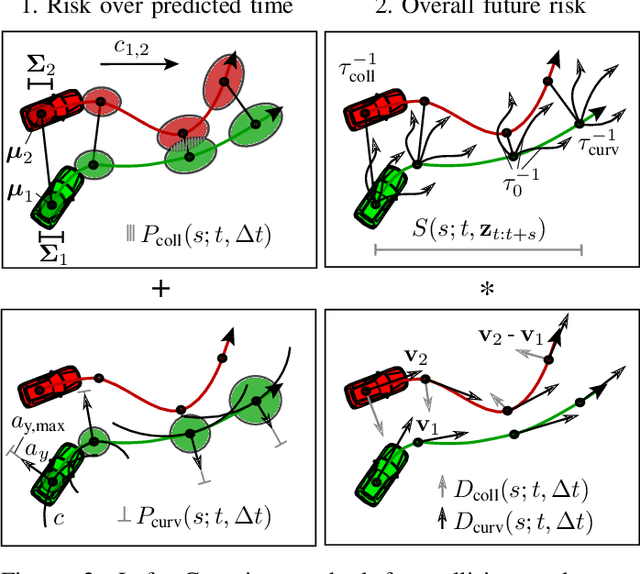

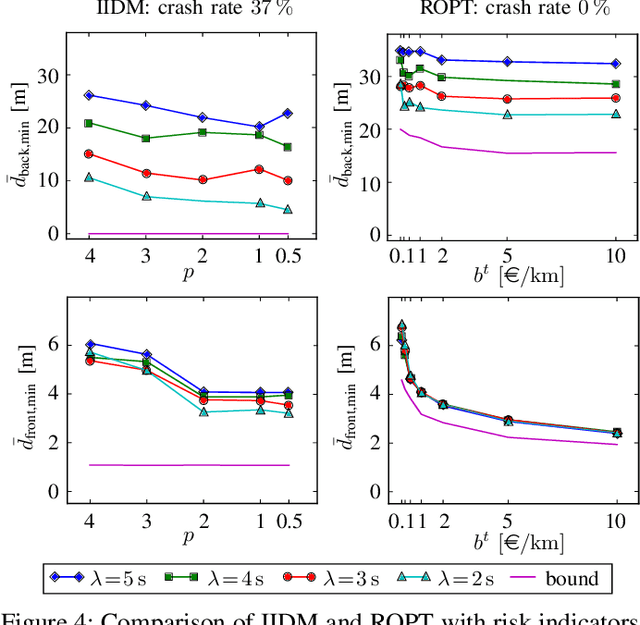
We consider the problem of correct motion planning for T-intersection merge-ins of arbitrary geometry and vehicle density. A merge-in support system has to estimate the chances that a gap between two consecutive vehicles can be taken successfully. In contrast to previous models based on heuristic gap size rules, we present an approach which optimizes the integral risk of the situation using parametrized velocity ramps. It accounts for the risks from curves and all involved vehicles (front and rear on all paths) with a so-called survival analysis. For comparison, we also introduce a specially designed extension of the Intelligent Driver Model (IDM) for entering intersections. We show in a quantitative statistical evaluation that the survival method provides advantages in terms of lower absolute risk (i.e., no crash happens) and better risk-utility tradeoff (i.e., making better use of appearing gaps). Furthermore, our approach generalizes to more complex situations with additional risk sources.