 Add to Chrome
 Add to Firefox
 Add to Edge
Modeling Aggregate Downwash Forces for Dense Multirotor Flight
Dec 06, 2023
Dense formation flight with multirotor swarms is a powerful, nature-inspired flight regime with numerous applications in the realworld. However, when multirotors fly in close vertical proximity to each other, the propeller downwash from the vehicles can have a destabilising effect on each other. Unfortunately, even in a homogeneous team, an accurate model of downwash forces from one vehicle is unlikely to be sufficient for predicting aggregate forces from multiple vehicles in formation. In this work, we model the interaction patterns produced by one or more vehicles flying in close proximity to an ego-vehicle. We first present an experimental test rig designed to capture 6-DOF exogenic forces acting on a multirotor frame. We then study and characterize these measured forces as a function of the relative states of two multirotors flying various patterns in its vicinity. Our analysis captures strong non-linearities present in the aggregation of these interactions. Then, by modeling the formation as a graph, we present a novel approach for learning the force aggregation function, and contrast it against simpler linear models. Finally, we explore how our proposed models generalize when a fourth vehicle is added to the formation.

On the Trade-Off between Stability and Representational Capacity in Graph Neural Networks
Dec 04, 2023Analyzing the stability of graph neural networks (GNNs) under topological perturbations is key to understanding their transferability and the role of each architecture component. However, stability has been investigated only for particular architectures, questioning whether it holds for a broader spectrum of GNNs or only for a few instances. To answer this question, we study the stability of EdgeNet: a general GNN framework that unifies more than twenty solutions including the convolutional and attention-based classes, as well as graph isomorphism networks and hybrid architectures. We prove that all GNNs within the EdgeNet framework are stable to topological perturbations. By studying the effect of different EdgeNet categories on the stability, we show that GNNs with fewer degrees of freedom in their parameter space, linked to a lower representational capacity, are more stable. The key factor yielding this trade-off is the eigenvector misalignment between the EdgeNet parameter matrices and the graph shift operator. For example, graph convolutional neural networks that assign a single scalar per signal shift (hence, with a perfect alignment) are more stable than the more involved node or edge-varying counterparts. Extensive numerical results corroborate our theoretical findings and highlight the role of different architecture components in the trade-off.
BenchMARL: Benchmarking Multi-Agent Reinforcement Learning
Dec 03, 2023The field of Multi-Agent Reinforcement Learning (MARL) is currently facing a reproducibility crisis. While solutions for standardized reporting have been proposed to address the issue, we still lack a benchmarking tool that enables standardization and reproducibility, while leveraging cutting-edge Reinforcement Learning (RL) implementations. In this paper, we introduce BenchMARL, the first MARL training library created to enable standardized benchmarking across different algorithms, models, and environments. BenchMARL uses TorchRL as its backend, granting it high performance and maintained state-of-the-art implementations while addressing the broad community of MARL PyTorch users. Its design enables systematic configuration and reporting, thus allowing users to create and run complex benchmarks from simple one-line inputs. BenchMARL is open-sourced on GitHub: https://github.com/facebookresearch/BenchMARL
Docking Multirotors in Close Proximity using Learnt Downwash Models
Nov 23, 2023Unmodeled aerodynamic disturbances pose a key challenge for multirotor flight when multiple vehicles are in close proximity to each other. However, certain missions \textit{require} two multirotors to approach each other within 1-2 body-lengths of each other and hold formation -- we consider one such practical instance: vertically docking two multirotors in the air. In this leader-follower setting, the follower experiences significant downwash interference from the leader in its final docking stages. To compensate for this, we employ a learnt downwash model online within an optimal feedback controller to accurately track a docking maneuver and then hold formation. Through real-world flights with different maneuvers, we demonstrate that this compensation is crucial for reducing the large vertical separation otherwise required by conventional/naive approaches. Our evaluations show a tracking error of less than 0.06m for the follower (a 3-4x reduction) when approaching vertically within two body-lengths of the leader. Finally, we deploy the complete system to effect a successful physical docking between two airborne multirotors in a single smooth planned trajectory.
Reinforcement Learning with Fast and Forgetful Memory
Oct 06, 2023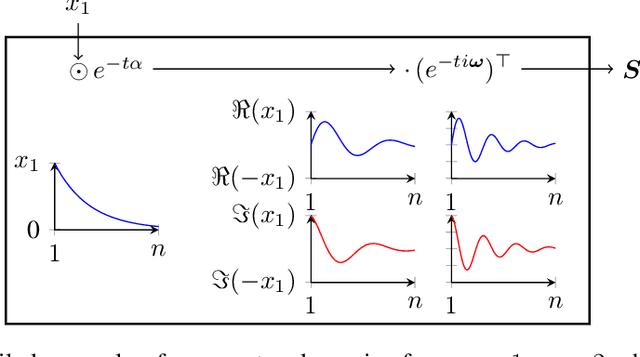
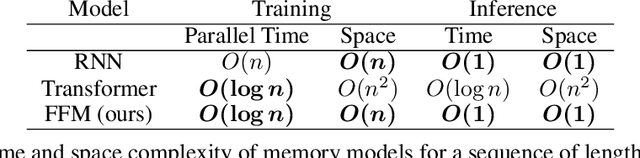
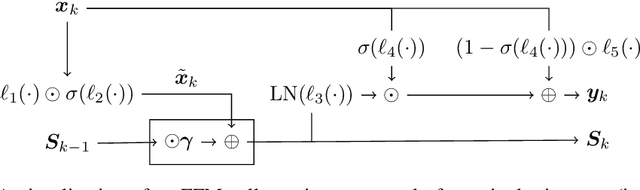
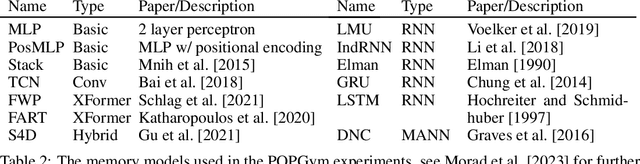
Nearly all real world tasks are inherently partially observable, necessitating the use of memory in Reinforcement Learning (RL). Most model-free approaches summarize the trajectory into a latent Markov state using memory models borrowed from Supervised Learning (SL), even though RL tends to exhibit different training and efficiency characteristics. Addressing this discrepancy, we introduce Fast and Forgetful Memory, an algorithm-agnostic memory model designed specifically for RL. Our approach constrains the model search space via strong structural priors inspired by computational psychology. It is a drop-in replacement for recurrent neural networks (RNNs) in recurrent RL algorithms, achieving greater reward than RNNs across various recurrent benchmarks and algorithms without changing any hyperparameters. Moreover, Fast and Forgetful Memory exhibits training speeds two orders of magnitude faster than RNNs, attributed to its logarithmic time and linear space complexity. Our implementation is available at https://github.com/proroklab/ffm.
Differentially Private Decentralized Deep Learning with Consensus Algorithms
Jun 24, 2023



Cooperative decentralized deep learning relies on direct information exchange between communicating agents, each with access to a local dataset which should be kept private. The goal is for all agents to achieve consensus on model parameters after training. However, sharing parameters with untrustworthy neighboring agents could leak exploitable information about local datasets. To combat this, we introduce differentially private decentralized learning that secures each agent's local dataset during and after cooperative training. In our approach, we generalize Differentially Private Stochastic Gradient Descent (DP-SGD) -- a popular differentially private training method for centralized deep learning -- to practical subgradient- and ADMM-based decentralized learning methods. Our algorithms' differential privacy guarantee holds for arbitrary deep learning objective functions, and we analyze the convergence properties for strongly convex objective functions. We compare our algorithms against centrally trained models on standard classification tasks and evaluate the relationships between performance, privacy budget, graph connectivity, and degree of training data overlap among agents. We find that differentially private gradient tracking is resistant to performance degradation under sparse graphs and non-uniform data distributions. Furthermore, we show that it is possible to learn a model achieving high accuracies, within 3% of DP-SGD on MNIST under (1, 10^-5)-differential privacy and within 6% of DP-SGD on CIFAR-100 under (10, 10^-5)-differential privacy, without ever sharing raw data with other agents. Open source code can be found at: https://github.com/jbayrooti/dp-dec-learning.
Generalised $f$-Mean Aggregation for Graph Neural Networks
Jun 24, 2023

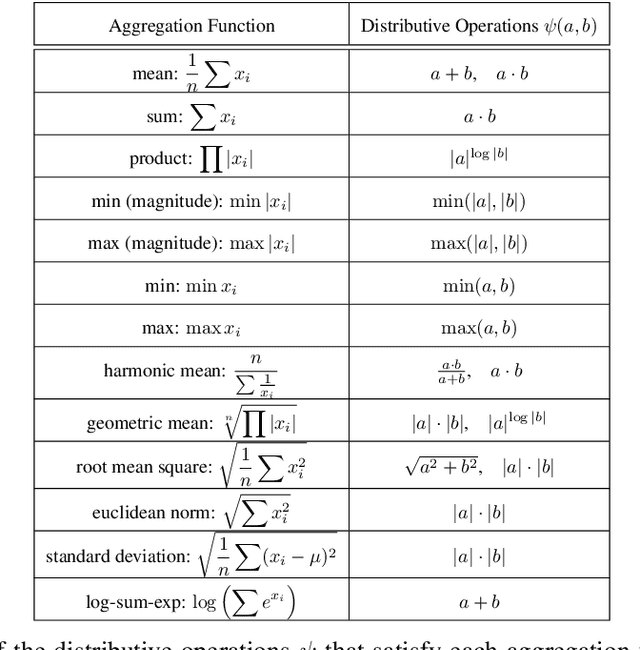

Graph Neural Network (GNN) architectures are defined by their implementations of update and aggregation modules. While many works focus on new ways to parametrise the update modules, the aggregation modules receive comparatively little attention. Because it is difficult to parametrise aggregation functions, currently most methods select a "standard aggregator" such as $\mathrm{mean}$, $\mathrm{sum}$, or $\mathrm{max}$. While this selection is often made without any reasoning, it has been shown that the choice in aggregator has a significant impact on performance, and the best choice in aggregator is problem-dependent. Since aggregation is a lossy operation, it is crucial to select the most appropriate aggregator in order to minimise information loss. In this paper, we present GenAgg, a generalised aggregation operator, which parametrises a function space that includes all standard aggregators. In our experiments, we show that GenAgg is able to represent the standard aggregators with much higher accuracy than baseline methods. We also show that using GenAgg as a drop-in replacement for an existing aggregator in a GNN often leads to a significant boost in performance across various tasks.
Constrained Environment Optimization for Prioritized Multi-Agent Navigation
May 18, 2023Traditional approaches to the design of multi-agent navigation algorithms consider the environment as a fixed constraint, despite the influence of spatial constraints on agents' performance. Yet hand-designing conducive environment layouts is inefficient and potentially expensive. The goal of this paper is to consider the environment as a decision variable in a system-level optimization problem, where both agent performance and environment cost are incorporated. Towards this end, we propose novel problems of unprioritized and prioritized environment optimization, where the former considers agents unbiasedly and the latter accounts for agent priorities. We show, through formal proofs, under which conditions the environment can change while guaranteeing completeness (i.e., all agents reach goals), and analyze the role of agent priorities in the environment optimization. We proceed to impose real-world constraints on the environment optimization and formulate it mathematically as a constrained stochastic optimization problem. Since the relation between agents, environment and performance is challenging to model, we leverage reinforcement learning to develop a model-free solution and a primal-dual mechanism to handle constraints. Distinct information processing architectures are integrated for various implementation scenarios, including online/offline optimization and discrete/continuous environment. Numerical results corroborate the theory and demonstrate the validity and adaptability of our approach.
System Neural Diversity: Measuring Behavioral Heterogeneity in Multi-Agent Learning
May 03, 2023Evolutionary science provides evidence that diversity confers resilience. Yet, traditional multi-agent reinforcement learning techniques commonly enforce homogeneity to increase training sample efficiency. When a system of learning agents is not constrained to homogeneous policies, individual agents may develop diverse behaviors, resulting in emergent complementarity that benefits the system. Despite this feat, there is a surprising lack of tools that measure behavioral diversity in systems of learning agents. Such techniques would pave the way towards understanding the impact of diversity in collective resilience and performance. In this paper, we introduce System Neural Diversity (SND): a measure of behavioral heterogeneity for multi-agent systems where agents have stochastic policies. %over a continuous state space. We discuss and prove its theoretical properties, and compare it with alternate, state-of-the-art behavioral diversity metrics used in cross-disciplinary domains. Through simulations of a variety of multi-agent tasks, we show how our metric constitutes an important diagnostic tool to analyze latent properties of behavioral heterogeneity. By comparing SND with task reward in static tasks, where the problem does not change during training, we show that it is key to understanding the effectiveness of heterogeneous vs homogeneous agents. In dynamic tasks, where the problem is affected by repeated disturbances during training, we show that heterogeneous agents are first able to learn specialized roles that allow them to cope with the disturbance, and then retain these roles when the disturbance is removed. SND allows a direct measurement of this latent resilience, while other proxies such as task performance (reward) fail to.
Learning Environment-Aware Control Barrier Functions for Safe and Feasible Multi-Robot Navigation
Mar 08, 2023Control Barrier Functions (CBFs) have been applied to provide safety guarantees for robot navigation. Traditional approaches consider fixed CBFs during navigation and hand-tune the underlying parameters apriori. Such approaches are inefficient and vulnerable to changes in the environment. The goal of this paper is to learn CBFs for multi-robot navigation based on what robots perceive about their environment. In order to guarantee the feasibility of the navigation task, while ensuring robot safety, we pursue a trade-off between conservativeness and aggressiveness in robot behavior by defining dynamic environment-aware CBF constraints. Since the explicit relationship between CBF constraints and navigation performance is challenging to model, we leverage reinforcement learning to learn time-varying CBFs in a model-free manner. We parameterize the CBF policy with graph neural networks (GNNs), and design GNNs that are translation invariant and permutation equivariant, to synthesize decentralized policies that generalize across environments. The proposed approach maintains safety guarantees (due to the underlying CBFs), while optimizing navigation performance (due to the reward-based learning). We perform simulations that compare the proposed approach with fixed CBFs tuned by exhaustive grid-search. The results show that environment-aware CBFs are capable of adapting to robot movements and obstacle changes, yielding improved navigation performance and robust generalization.