 Add to Chrome
 Add to Firefox
 Add to Edge
Constrained Reinforcement Learning Using Successor Representations
Jul 27, 2026
Real-world Reinforcement Learning depends on the ability to formulate safety constraints into a policy. A common way to model such constraints is to introduce an additional cost signal in the Markov Decision Process, which notifies the agent of unwanted behavior independently of the reward signal. Unfortunately, current methods are hard to adapt to changes in the cost function introduced by, e.g., domain shift or obstacles moving over time. The lack of adaptability means that policies are too unflexible to deal with complex real-world conditions. We propose the Safe Deep Successor Representation (SafeDSR), a novel method that allows quick retraining of policies towards new cost structures. SafeDSR extends the Deep Successor Representation (Kulkarni et al., 2016) to Constrained Reinforcement Learning by introducing a single learnable weight matrix to decouple the learned value function across dynamics, rewards, and costs. This matrix can be updated in a supervised manner instead of having to adapt the whole network if the cost structure of the environment changes. We demonstrate this ability in a freely configurable two-dimensional navigation environment and show that our method is competitive on a simple navigation task while being considerably more flexible
* published in Transactions for Machine Learning Research 2026

The S-ICDF Dataset: Sionna-Simulated Dynamic Interference Characterization and Direction Finding
Jul 03, 2026Jamming and spoofing threaten wireless and satellite navigation by disrupting or manipulating radio frequency (RF) signals, undermining availability, integrity, and trust. Robust interference monitoring (i.e., detection, classification, characterization, and direction finding) is therefore essential to identify and localize anomalous signals. While machine learning (ML) promises improved performance in complex environments, its development and validation depend on large-scale datasets that capture realistic signal and channel variability. Collecting such data in the real world is difficult because intentional jamming is illegal and ground-truth attribution is confounded by propagation, hardware, and environmental effects. To address this gap, we create and publish S-ICDF, a large-scale indoor interference dataset generated with Sionna, a GPU-accelerated simulation library for physical-layer wireless communications. S-ICDF covers 102 interference configurations, including diverse antenna array patterns, bandwidths, and simulation settings such as noise level and reflection depth. We further provide baseline results by benchmarking S-ICDF with classical estimation and direction finding (DF) methods (MUSIC, ESPRIT, and CAPON) and with modern ML approaches. The dataset is publicly available at: https://gitlab.cc-asp.fraunhofer.de/darcy_gnss/sicdf_dataset
Active Sensing with Meta-Reinforcement Learning for Emitter Localization from RF Observations
May 12, 2026Global navigation satellite system (GNSS) interference poses a serious threat to reliable positioning, especially in indoor and multipath-rich environments where source localization is highly challenging. In this paper, we formulate GNSS interference localization as an active sensing problem and propose a reinforcement learning (RL) framework in which an agent sequentially explores the environment to infer the position of an emitter source from radio frequency (RF) observations acquired with a 2x2 patch antenna. The localization task is modeled as a partially observable decision process, since single-snapshot measurements are often ambiguous under multipath propagation and changing channel conditions. To address this, the proposed framework combines high-dimensional RF sensing with deep RL and recurrent policy learning. We investigate both value-based and policy-based approaches, namely Deep Q-Networks (DQN) and Proximal Policy Optimization (PPO), and study their behavior under domain shift. The approach is evaluated on a simulated dataset generated with the Sionna ray-tracing module, which provides realistic propagation effects and diverse environment configurations. Experimental results show that the proposed method achieves a localization success rate of 80.1%, demonstrating the potential of RL for adaptive GNSS interference localization. Overall, the results highlight simulation-assisted training as a promising direction for robust interference localization in challenging propagation environments.
Optimizing Quantum Circuits via ZX Diagrams using Reinforcement Learning and Graph Neural Networks
Apr 04, 2025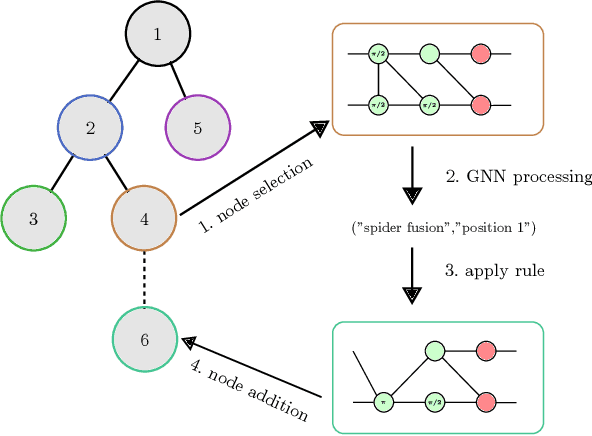
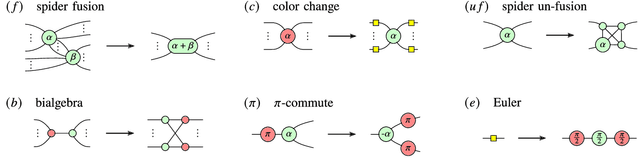
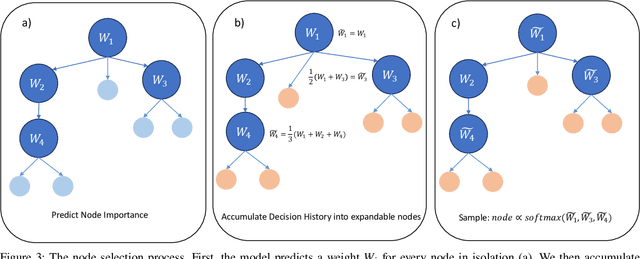
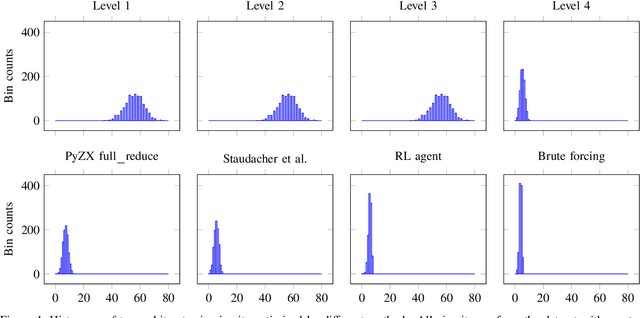
Quantum computing is currently strongly limited by the impact of noise, in particular introduced by the application of two-qubit gates. For this reason, reducing the number of two-qubit gates is of paramount importance on noisy intermediate-scale quantum hardware. To advance towards more reliable quantum computing, we introduce a framework based on ZX calculus, graph-neural networks and reinforcement learning for quantum circuit optimization. By combining reinforcement learning and tree search, our method addresses the challenge of selecting optimal sequences of ZX calculus rewrite rules. Instead of relying on existing heuristic rules for minimizing circuits, our method trains a novel reinforcement learning policy that directly operates on ZX-graphs, therefore allowing us to search through the space of all possible circuit transformations to find a circuit significantly minimizing the number of CNOT gates. This way we can scale beyond hard-coded rules towards discovering arbitrary optimization rules. We demonstrate our method's competetiveness with state-of-the-art circuit optimizers and generalization capabilities on large sets of diverse random circuits.
Reinforcement Learning for Node Selection in Branch-and-Bound
Sep 29, 2023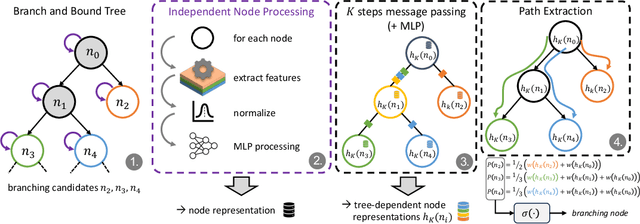

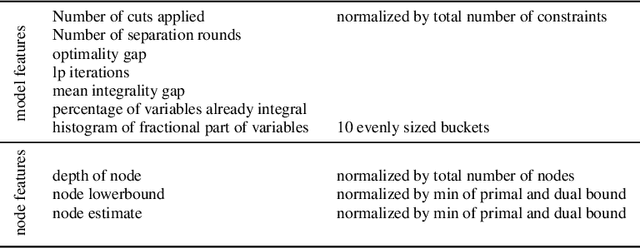
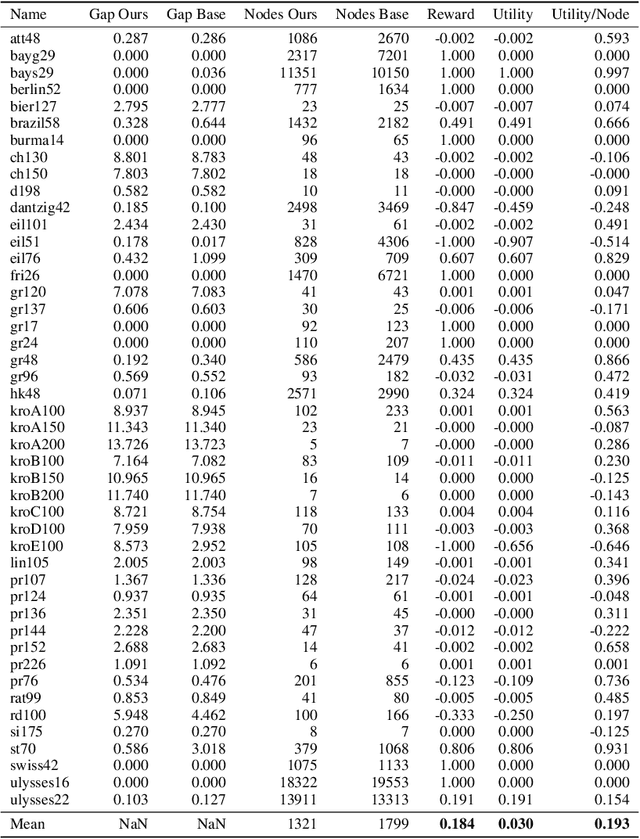
A big challenge in branch and bound lies in identifying the optimal node within the search tree from which to proceed. Current state-of-the-art selectors utilize either hand-crafted ensembles that automatically switch between naive sub-node selectors, or learned node selectors that rely on individual node data. We propose a novel bi-simulation technique that uses reinforcement learning (RL) while considering the entire tree state, rather than just isolated nodes. To achieve this, we train a graph neural network that produces a probability distribution based on the path from the model's root to its ``to-be-selected'' leaves. Modelling node-selection as a probability distribution allows us to train the model using state-of-the-art RL techniques that capture both intrinsic node-quality and node-evaluation costs. Our method induces a high quality node selection policy on a set of varied and complex problem sets, despite only being trained on specially designed, synthetic TSP instances. Experiments on several benchmarks show significant improvements in optimality gap reductions and per-node efficiency under strict time constraints.
OpenAssistant Conversations -- Democratizing Large Language Model Alignment
Apr 14, 2023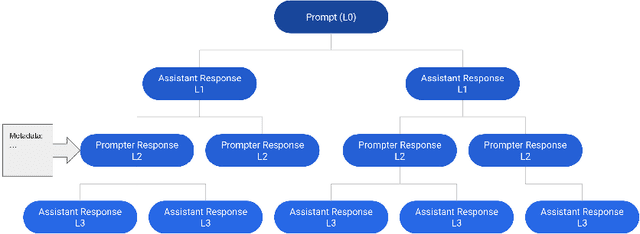
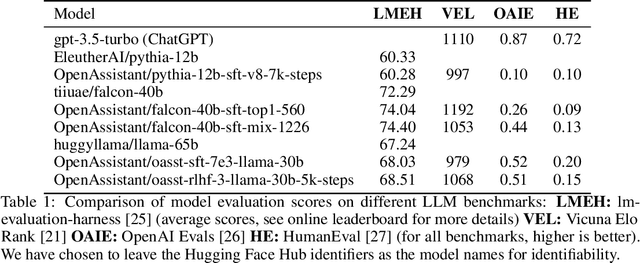
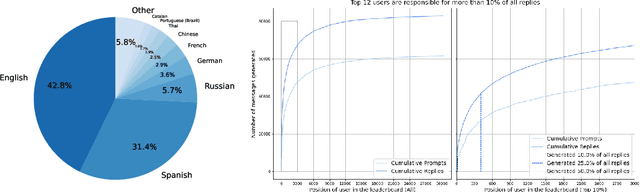

Aligning large language models (LLMs) with human preferences has proven to drastically improve usability and has driven rapid adoption as demonstrated by ChatGPT. Alignment techniques such as supervised fine-tuning (SFT) and reinforcement learning from human feedback (RLHF) greatly reduce the required skill and domain knowledge to effectively harness the capabilities of LLMs, increasing their accessibility and utility across various domains. However, state-of-the-art alignment techniques like RLHF rely on high-quality human feedback data, which is expensive to create and often remains proprietary. In an effort to democratize research on large-scale alignment, we release OpenAssistant Conversations, a human-generated, human-annotated assistant-style conversation corpus consisting of 161,443 messages distributed across 66,497 conversation trees, in 35 different languages, annotated with 461,292 quality ratings. The corpus is a product of a worldwide crowd-sourcing effort involving over 13,500 volunteers. To demonstrate the OpenAssistant Conversations dataset's effectiveness, we present OpenAssistant, the first fully open-source large-scale instruction-tuned model to be trained on human data. A preference study revealed that OpenAssistant replies are comparably preferred to GPT-3.5-turbo (ChatGPT) with a relative winrate of 48.3% vs. 51.7% respectively. We release our code and data under fully permissive licenses.
SmartPatch: Improving Handwritten Word Imitation with Patch Discriminators
May 21, 2021
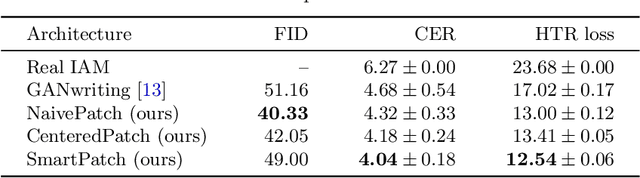
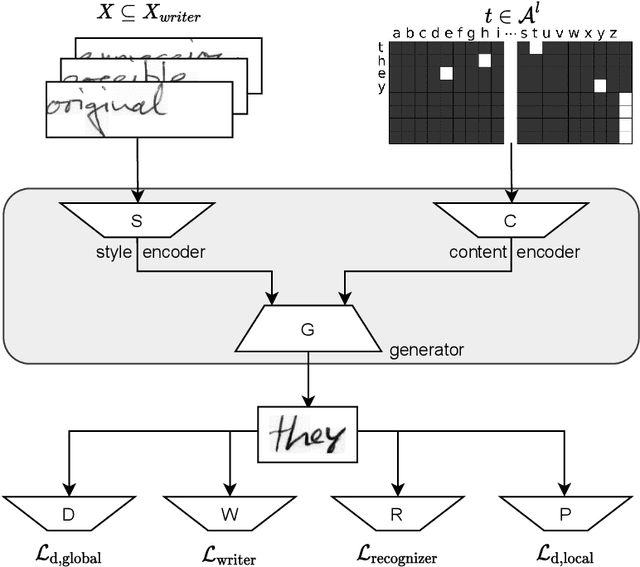

As of recent generative adversarial networks have allowed for big leaps in the realism of generated images in diverse domains, not the least of which being handwritten text generation. The generation of realistic-looking hand-written text is important because it can be used for data augmentation in handwritten text recognition (HTR) systems or human-computer interaction. We propose SmartPatch, a new technique increasing the performance of current state-of-the-art methods by augmenting the training feedback with a tailored solution to mitigate pen-level artifacts. We combine the well-known patch loss with information gathered from the parallel trained handwritten text recognition system and the separate characters of the word. This leads to a more enhanced local discriminator and results in more realistic and higher-quality generated handwritten words.