 Add to Chrome
 Add to Firefox
 Add to Edge
Sequence Diffusion Model for Temporal Link Prediction in Continuous-Time Dynamic Graph
Jan 30, 2026
Temporal link prediction in dynamic graphs is a fundamental problem in many real-world systems. Existing temporal graph neural networks mainly focus on learning representations of historical interactions. Despite their strong performance, these models are still purely discriminative, producing point estimates for future links and lacking an explicit mechanism to capture the uncertainty and sequential structure of future temporal interactions. In this paper, we propose SDG, a novel sequence-level diffusion framework that unifies dynamic graph learning with generative denoising. Specifically, SDG injects noise into the entire historical interaction sequence and jointly reconstructs all interaction embeddings through a conditional denoising process, thereby enabling the model to capture more comprehensive interaction distributions. To align the generative process with temporal link prediction, we employ a cross-attention denoising decoder to guide the reconstruction of the destination sequence and optimize the model in an end-to-end manner. Extensive experiments on various temporal graph benchmarks show that SDG consistently achieves state-of-the-art performance in the temporal link prediction task.

OpenAssistant Conversations -- Democratizing Large Language Model Alignment
Apr 14, 2023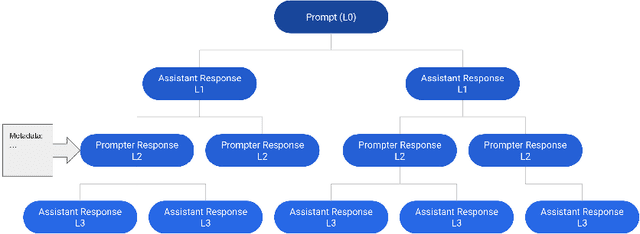
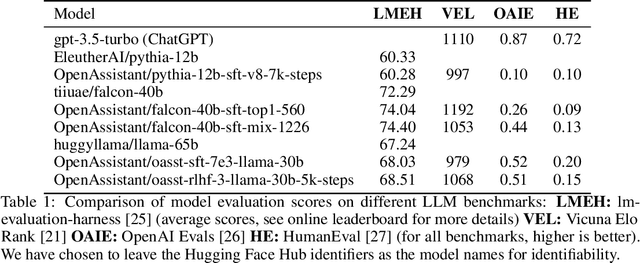
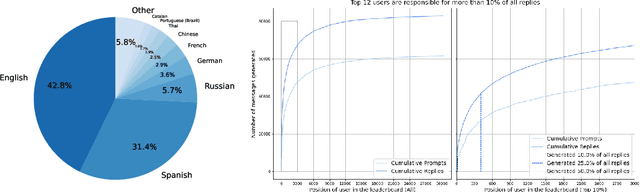

Aligning large language models (LLMs) with human preferences has proven to drastically improve usability and has driven rapid adoption as demonstrated by ChatGPT. Alignment techniques such as supervised fine-tuning (SFT) and reinforcement learning from human feedback (RLHF) greatly reduce the required skill and domain knowledge to effectively harness the capabilities of LLMs, increasing their accessibility and utility across various domains. However, state-of-the-art alignment techniques like RLHF rely on high-quality human feedback data, which is expensive to create and often remains proprietary. In an effort to democratize research on large-scale alignment, we release OpenAssistant Conversations, a human-generated, human-annotated assistant-style conversation corpus consisting of 161,443 messages distributed across 66,497 conversation trees, in 35 different languages, annotated with 461,292 quality ratings. The corpus is a product of a worldwide crowd-sourcing effort involving over 13,500 volunteers. To demonstrate the OpenAssistant Conversations dataset's effectiveness, we present OpenAssistant, the first fully open-source large-scale instruction-tuned model to be trained on human data. A preference study revealed that OpenAssistant replies are comparably preferred to GPT-3.5-turbo (ChatGPT) with a relative winrate of 48.3% vs. 51.7% respectively. We release our code and data under fully permissive licenses.