 Add to Chrome
 Add to Firefox
 Add to Edge
BurstGP: Enhancing Raw Burst Image Super Resolution with Generative Priors
Apr 26, 2026
Burst image super resolution (BISR) aims to construct a single high-resolution (HR) image by aggregating information from multiple low-resolution (LR) frames, relying on temporal redundancy and spatial coherence across the burst. While conventional methods achieve impressive results, they often struggle with complex textures and oversmoothing. Diffusion models, particularly those pretrained on high-quality data, have shown remarkable capability in generating realistic details for image and video super-resolution. However, their potential remains largely under-explored in BISR, where existing approaches typically rely on task-specific diffusion models trained from scratch and operate on single-frame reconstructions. In this work, we propose BurstGP, a novel diffusion-based solution for BISR, which leverages generative priors of recent foundation models to overcome these issues. In particular, we build a multiframe-aware diffusion model on top of a conventional BISR approach, which boosts image quality with minimal loss to fidelity. Further, we introduce (i) a novel degradation-aware conditioning mechanism, which controls synthesis of fine details based on the estimated degradation in the input, and (ii) a robust sRGB-to-lRGB inverter, enabling us to utilize generative multiframe (video) sRGB priors, while operating with raw input and lRGB output images. Empirically, we demonstrate that BurstGP outperforms the existing state of the art, both quantitatively (especially with respect to perceptual metrics, including MUSIQ and LPIPS) and qualitatively. In particular, our proposed method excels at recovering richer textures and finer structural details, highlighting the potential of video priors for BISR over traditional methods.

RawGen: Learning Camera Raw Image Generation
Mar 31, 2026Cameras capture scene-referred linear raw images, which are processed by onboard image signal processors (ISPs) into display-referred 8-bit sRGB outputs. Although raw data is more faithful for low-level vision tasks, collecting large-scale raw datasets remains a major bottleneck, as existing datasets are limited and tied to specific camera hardware. Generative models offer a promising way to address this scarcity -- however, existing diffusion frameworks are designed to synthesize photo-finished sRGB images rather than physically consistent linear representations. This paper presents RawGen, to our knowledge the first diffusion-based framework enabling text-to-raw generation for arbitrary target cameras, alongside sRGB-to-raw inversion. RawGen leverages the generative priors of large-scale sRGB diffusion models to synthesize physically meaningful linear outputs, such as CIE XYZ or camera-specific raw representations, via specialized processing in latent and pixel spaces. To handle unknown and diverse ISP pipelines and photo-finishing effects in diffusion-model training data, we build a many-to-one inverse-ISP dataset where multiple sRGB renditions of the same scene generated using diverse ISP parameters are anchored to a common scene-referred target. Fine-tuning a conditional denoiser and specialized decoder on this dataset allows RawGen to obtain camera-centric linear reconstructions that effectively invert the rendering pipeline. We demonstrate RawGen's superior performance over traditional inverse-ISP methods that assume a fixed ISP. Furthermore, we show that augmenting training pipelines with RawGen's scalable, text-driven synthetic data can benefit downstream low-level vision tasks.
Face2Scene: Using Facial Degradation as an Oracle for Diffusion-Based Scene Restoration
Mar 17, 2026Recent advances in image restoration have enabled high-fidelity recovery of faces from degraded inputs using reference-based face restoration models (Ref-FR). However, such methods focus solely on facial regions, neglecting degradation across the full scene, including body and background, which limits practical usability. Meanwhile, full-scene restorers often ignore degradation cues entirely, leading to underdetermined predictions and visual artifacts. In this work, we propose Face2Scene, a two-stage restoration framework that leverages the face as a perceptual oracle to estimate degradation and guide the restoration of the entire image. Given a degraded image and one or more identity references, we first apply a Ref-FR model to reconstruct high-quality facial details. From the restored-degraded face pair, we extract a face-derived degradation code that captures degradation attributes (e.g., noise, blur, compression), which is then transformed into multi-scale degradation-aware tokens. These tokens condition a diffusion model to restore the full scene in a single step, including the body and background. Extensive experiments demonstrate the superior effectiveness of the proposed method compared to state-of-the-art methods.
RAW-Domain Degradation Models for Realistic Smartphone Super-Resolution
Mar 12, 2026Digital zoom on smartphones relies on learning-based super-resolution (SR) models that operate on RAW sensor images, but obtaining sensor-specific training data is challenging due to the lack of ground-truth images. Synthetic data generation via ``unprocessing'' pipelines offers a potential solution by simulating the degradations that transform high-resolution (HR) images into their low-resolution (LR) counterparts. However, these pipelines can introduce domain gaps due to incomplete or unrealistic degradation modeling. In this paper, we demonstrate that principled and carefully designed degradation modeling can enhance SR performance in real-world conditions. Instead of relying on generic priors for camera blur and noise, we model device-specific degradations through calibration and unprocess publicly available rendered images into the RAW domain of different smartphones. Using these image pairs, we train a single-image RAW-to-RGB SR model and evaluate it on real data from a held-out device. Our experiments show that accurate degradation modeling leads to noticeable improvements, with our SR model outperforming baselines trained on large pools of arbitrarily chosen degradations.
Qonvolution: Towards Learning High-Frequency Signals with Queried Convolution
Dec 15, 2025Accurately learning high-frequency signals is a challenge in computer vision and graphics, as neural networks often struggle with these signals due to spectral bias or optimization difficulties. While current techniques like Fourier encodings have made great strides in improving performance, there remains scope for improvement when presented with high-frequency information. This paper introduces Queried-Convolutions (Qonvolutions), a simple yet powerful modification using the neighborhood properties of convolution. Qonvolution convolves a low-frequency signal with queries (such as coordinates) to enhance the learning of intricate high-frequency signals. We empirically demonstrate that Qonvolutions enhance performance across a variety of high-frequency learning tasks crucial to both the computer vision and graphics communities, including 1D regression, 2D super-resolution, 2D image regression, and novel view synthesis (NVS). In particular, by combining Gaussian splatting with Qonvolutions for NVS, we showcase state-of-the-art performance on real-world complex scenes, even outperforming powerful radiance field models on image quality.
Augmenting Perceptual Super-Resolution via Image Quality Predictors
Apr 25, 2025

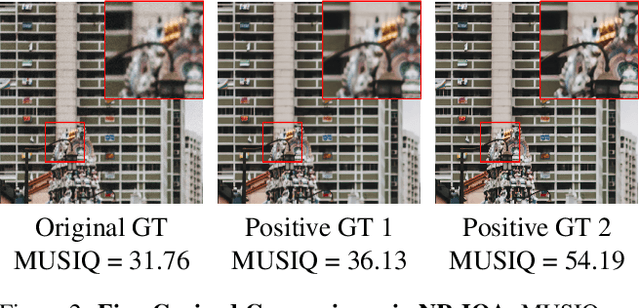

Super-resolution (SR), a classical inverse problem in computer vision, is inherently ill-posed, inducing a distribution of plausible solutions for every input. However, the desired result is not simply the expectation of this distribution, which is the blurry image obtained by minimizing pixelwise error, but rather the sample with the highest image quality. A variety of techniques, from perceptual metrics to adversarial losses, are employed to this end. In this work, we explore an alternative: utilizing powerful non-reference image quality assessment (NR-IQA) models in the SR context. We begin with a comprehensive analysis of NR-IQA metrics on human-derived SR data, identifying both the accuracy (human alignment) and complementarity of different metrics. Then, we explore two methods of applying NR-IQA models to SR learning: (i) altering data sampling, by building on an existing multi-ground-truth SR framework, and (ii) directly optimizing a differentiable quality score. Our results demonstrate a more human-centric perception-distortion tradeoff, focusing less on non-perceptual pixel-wise distortion, instead improving the balance between perceptual fidelity and human-tuned NR-IQA measures.
Towards Unsupervised Blind Face Restoration using Diffusion Prior
Oct 06, 2024Blind face restoration methods have shown remarkable performance, particularly when trained on large-scale synthetic datasets with supervised learning. These datasets are often generated by simulating low-quality face images with a handcrafted image degradation pipeline. The models trained on such synthetic degradations, however, cannot deal with inputs of unseen degradations. In this paper, we address this issue by using only a set of input images, with unknown degradations and without ground truth targets, to fine-tune a restoration model that learns to map them to clean and contextually consistent outputs. We utilize a pre-trained diffusion model as a generative prior through which we generate high quality images from the natural image distribution while maintaining the input image content through consistency constraints. These generated images are then used as pseudo targets to fine-tune a pre-trained restoration model. Unlike many recent approaches that employ diffusion models at test time, we only do so during training and thus maintain an efficient inference-time performance. Extensive experiments show that the proposed approach can consistently improve the perceptual quality of pre-trained blind face restoration models while maintaining great consistency with the input contents. Our best model also achieves the state-of-the-art results on both synthetic and real-world datasets.
Reconstructive Latent-Space Neural Radiance Fields for Efficient 3D Scene Representations
Oct 27, 2023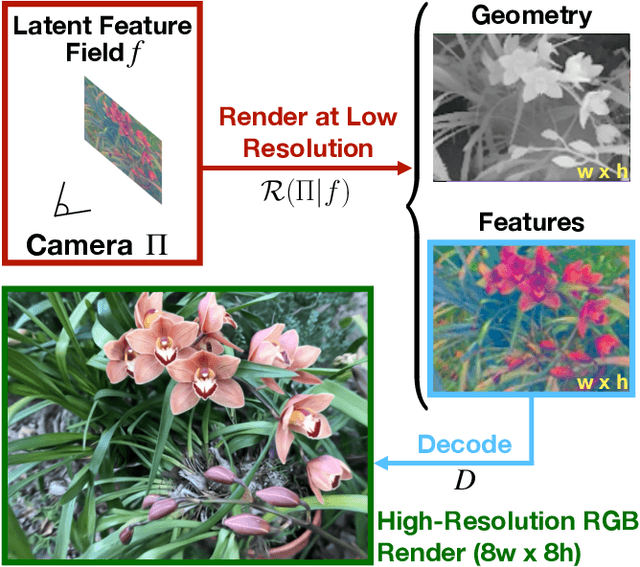
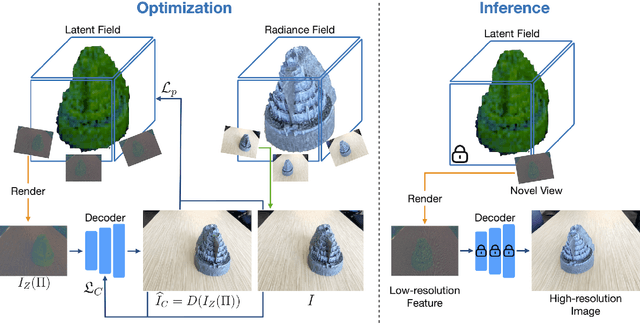
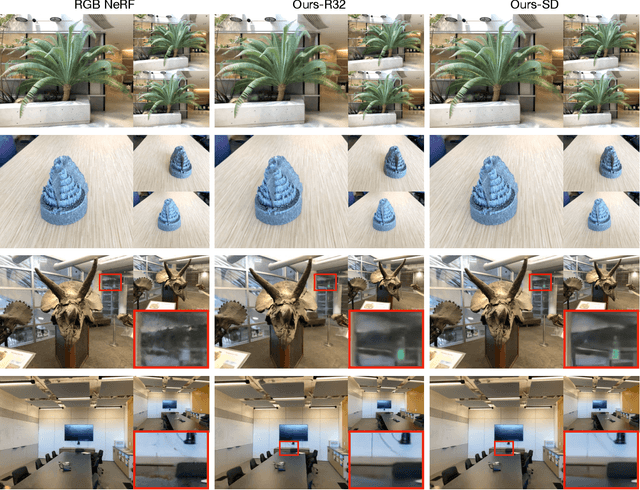
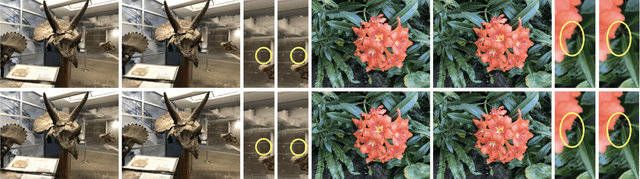
Neural Radiance Fields (NeRFs) have proven to be powerful 3D representations, capable of high quality novel view synthesis of complex scenes. While NeRFs have been applied to graphics, vision, and robotics, problems with slow rendering speed and characteristic visual artifacts prevent adoption in many use cases. In this work, we investigate combining an autoencoder (AE) with a NeRF, in which latent features (instead of colours) are rendered and then convolutionally decoded. The resulting latent-space NeRF can produce novel views with higher quality than standard colour-space NeRFs, as the AE can correct certain visual artifacts, while rendering over three times faster. Our work is orthogonal to other techniques for improving NeRF efficiency. Further, we can control the tradeoff between efficiency and image quality by shrinking the AE architecture, achieving over 13 times faster rendering with only a small drop in performance. We hope that our approach can form the basis of an efficient, yet high-fidelity, 3D scene representation for downstream tasks, especially when retaining differentiability is useful, as in many robotics scenarios requiring continual learning.
Dual-Camera Joint Deblurring-Denoising
Sep 16, 2023Recent image enhancement methods have shown the advantages of using a pair of long and short-exposure images for low-light photography. These image modalities offer complementary strengths and weaknesses. The former yields an image that is clean but blurry due to camera or object motion, whereas the latter is sharp but noisy due to low photon count. Motivated by the fact that modern smartphones come equipped with multiple rear-facing camera sensors, we propose a novel dual-camera method for obtaining a high-quality image. Our method uses a synchronized burst of short exposure images captured by one camera and a long exposure image simultaneously captured by another. Having a synchronized short exposure burst alongside the long exposure image enables us to (i) obtain better denoising by using a burst instead of a single image, (ii) recover motion from the burst and use it for motion-aware deblurring of the long exposure image, and (iii) fuse the two results to further enhance quality. Our method is able to achieve state-of-the-art results on synthetic dual-camera images from the GoPro dataset with five times fewer training parameters compared to the next best method. We also show that our method qualitatively outperforms competing approaches on real synchronized dual-camera captures.
Watch Your Steps: Local Image and Scene Editing by Text Instructions
Aug 17, 2023Denoising diffusion models have enabled high-quality image generation and editing. We present a method to localize the desired edit region implicit in a text instruction. We leverage InstructPix2Pix (IP2P) and identify the discrepancy between IP2P predictions with and without the instruction. This discrepancy is referred to as the relevance map. The relevance map conveys the importance of changing each pixel to achieve the edits, and is used to to guide the modifications. This guidance ensures that the irrelevant pixels remain unchanged. Relevance maps are further used to enhance the quality of text-guided editing of 3D scenes in the form of neural radiance fields. A field is trained on relevance maps of training views, denoted as the relevance field, defining the 3D region within which modifications should be made. We perform iterative updates on the training views guided by rendered relevance maps from the relevance field. Our method achieves state-of-the-art performance on both image and NeRF editing tasks. Project page: https://ashmrz.github.io/WatchYourSteps/